
UNITED STATES
SECURITIES AND EXCHANGE COMMISSION
WASHINGTON, D.C. 20549
FORM
(Mark One)
| ANNUAL REPORT PURSUANT TO SECTION 13 OR 15(d) OF THE SECURITIES EXCHANGE ACT OF 1934 |
For
the Fiscal Year Ended
or
| TRANSITION REPORT PURSUANT TO SECTION 13 OR 15(d) OF THE SECURITIES EXCHANGE ACT OF 1934 |
Commission
File Number:
(Exact Name of Registrant as Specified in Its Charter)
| (State or Other Jurisdiction of | (I.R.S. Employer | |
| Incorporation or Organization) | Identification Number) | |
| (Address of Principal Executive Offices) | (Zip Code) |
(Registrant’s telephone number, including area code)
Securities registered pursuant to Section 12(b) of the Act:
| Title of Each Class: | Trading Symbol | Name of Each Exchange on which Registered | ||
| The Capital Market | ||||
| The Capital Market |
Securities registered pursuant to Section 12(g) of the Act: None
Indicate
by check mark if the registrant is a well-known seasoned issuer, as defined in Rule 405 of the Securities Act. Yes ☐
Indicate
by check mark if the registrant is not required to file reports pursuant to Section 13 or Section 15(d) of the Act. Yes ☐
Indicate
by check mark whether the registrant (1) has filed all reports required to be filed by Section 13 or 15(d) of the Securities Exchange
Act of 1934 during the preceding 12 months (or for such shorter period that the registrant was required to file such reports), and (2)
has been subject to such filing requirements for the past 90 days.
Indicate
by check mark whether the registrant has submitted electronically every Interactive Data File required to be submitted pursuant to Rule
405 of Regulation S-T during the preceding 12 months (or for such shorter period that the registrant was required to submit such files).
Indicate by check mark whether the registrant is a large accelerated filer, an accelerated filer, a non-accelerated filer, a smaller reporting company, or an emerging growth company. See definitions of “large accelerated filer,” “accelerated filer,” “smaller reporting company,” and “emerging growth company” in Rule 12b-2 of the Exchange Act.
| Large accelerated filer | ☐ | Accelerated filer | ☐ |
| ☒ | Smaller reporting company | ||
| Emerging growth company |
If
an emerging growth company, indicate by check mark if the registrant has elected not to use the extended transition period for complying
with any new or revised financial accounting standards provided pursuant to Section 13(a) of the Exchange Act.
Indicate
by check mark whether the registrant has filed a report on and attestation to its management’s assessment of the effectiveness
of its internal control over financial reporting under Section 404(b) of the Sarbanes-Oxley Act (15 U.S.C. 7262(b)) by the registered
public accounting firm that prepared or issued its audit report.
If
securities are registered pursuant to Section 12(b) of the Act, indicate by check mark whether the financial statements of the registrant
included in the filing reflect the correction of an error to previously issued statements.
Indicate by check mark whether any of those error corrections are restatements that required a recovery analysis of incentive-based compensation received by any of the registrant’s executive officers during the relevant recovery period pursuant to Section 240.10D-1(b). ☐
Indicate
by check mark whether the registrant is a shell company (as defined in Rule 12b-2 of the Act). Yes ☐ No
The
aggregate market value of the voting and non-voting common equity held by non-affiliates of the Registrant, based on the closing price
of the shares of common stock on the Nasdaq Capital Market on June 30, 2025, was approximately $
As of March 25, 2026, the number of outstanding shares of the registrant’s common stock, par value $ per share, was .
DOCUMENTS INCORPORATED BY REFERENCE
DERMATA THERAPEUTICS, INC.
ANNUAL REPORT ON FORM 10-K
FOR THE FISCAL YEAR ENDED DECEMBER 31, 2025
TABLE OF CONTENTS
| 2 |
CAUTIONARY NOTE REGARDING FORWARD-LOOKING STATEMENTS
This annual report on Form 10-K contains forward-looking statements made pursuant to the safe harbor provisions of the Private Securities Litigation Reform Act of 1995 under Section 27A of the Securities Act of 1933, as amended, and Section 21E of the Securities Exchange Act of 1934, as amended. Forward-looking statements include statements with respect to our beliefs, plans, objectives, goals, expectations, anticipations, assumptions, estimates, intentions and future performance, and involve known and unknown risks, uncertainties and other factors, which may be beyond our control, and which may cause our actual results, performance or achievements to be materially different from future results, performance or achievements expressed or implied by such forward-looking statements. All statements other than statements of historical fact are statements that could be forward-looking statements. You can identify these forward-looking statements through our use of words such as “may,” “can,” “anticipate,” “assume,” “should,” “indicate,” “would,” “believe,” “contemplate,” “expect,” “seek,” “estimate,” “continue,” “plan,” “point to,” “project,” “predict,” “could,” “intend,” “target,” “potential” and other similar words and expressions of the future.
There are a number of important factors that could cause the actual results to differ materially from those expressed in any forward-looking statement made by us. These factors include, but are not limited to:
| ● | our lack of operating history; | |
| ● | the expectation that we will incur significant operating losses for the foreseeable future and will need significant additional capital; | |
| ● | our current and future capital requirements to support our development and commercialization efforts for our products and our ability to satisfy our capital needs; | |
| ● | our dependence on our products, which are still in various stages of development; | |
| ● | our ability to acquire sufficient quantities of raw material needed to manufacture our products; | |
| ● | our, or that of our third-party manufacturers, ability to manufacture current Good Manufacturing Practices (“cGMPs”) quantities of our products as required to support commercial quantities of our products; | |
| ● | the possibility that our planned over the counter (“OTC”) formulation, dosage, combinations, or indication will fall outside the scope of applicable OTC monographs, will require new drug applications (“NDA”), or are otherwise challenged by the U.S. Food and Drug Administration (“FDA”), state boards, or other regulators, any of which could delay or prevent launch and commercialization or require reformulation, relabelling, additional testing, or other corrective actions; | |
| ● | the possibility that positive clinical data generated in the Rx (as defined below) setting are not predictive of consumer experience or commercial performance in the OTC (as defined below) context, and the limits such data may impose on the scope of permissible OTC claims; | |
| ● | our ability to timely secure and scale manufacturing, packaging, and quality systems suitable for commercialization, including meeting lot release, stability, shelf life, and container-closure requirements, and to manage product returns, recalls, or withdrawals if quality issues arise; | |
| ● | our ability to successfully execute our strategic pivot from Rx to direct-to-consumer (“DTC”), including our capacity to design, formulate, manufacture, package and distribute products that comply with applicable federal, state and international OTC requirements and standards, including FDA OTC monographs, current good manufacturing practices applicable to OTC products, labelling and Drug Facts requirements, and other enforcement policies; | |
| ● | our ability to establish and maintain distribution and sales channels, including DTC e-commerce, business-to-business (“B2B”) professional/clinic channels, and any retail partners, and to manage channel economics, chargebacks, returns, and working capital needs; | |
| ● | our ability to internally develop new inventions and intellectual property; | |
| ● | interpretations of current laws and the passages of future laws; | |
| ● | Impacts of increased trade tariffs, import quotas or other trade restrictions or measures taken by the United States and other countries, including the recent and potential changes in U.S. trade policies that may be made by the Trump presidential administration; | |
| ● | acceptance of our business model by investors; | |
| ● | the accuracy of our estimates regarding expenses and capital requirements; and | |
| ● | our ability to adequately support organizational and business growth. |
The foregoing does not represent an exhaustive list of matters that may be covered by the forward-looking statements contained herein or risk factors that we are faced with that may cause our actual results to differ from those anticipated in such forward-looking statements. Please see “Part I—Item 1A—Risk Factors” for additional risks which could adversely impact our business and financial performance.
All forward-looking statements are expressly qualified in their entirety by this cautionary notice. You are cautioned not to place undue reliance on any forward-looking statements, which speak only as of the date of this report or the date of the document incorporated by reference into this report. We have no obligation, and expressly disclaim any obligation, to update, revise or correct any of the forward-looking statements, whether as a result of new information, future events or otherwise. We have expressed our expectations, beliefs and projections in good faith and believe they have a reasonable basis. However, we cannot assure you that our expectations, beliefs or projections will result or be achieved or accomplished.
| 3 |
PART I
ITEM 1. BUSINESS
All references in this report to “Dermata,” the “Company,” “we,” “us,” or “our” mean Dermata Therapeutics, Inc. unless stated otherwise or the context otherwise indicates.
Overview
We are a scientific leader in skincare, dedicated to the development and commercialization of products that address common and underserved skin conditions. Dermata initially was founded with a focus on researching and developing prescription products subject to the FDA approval process. As part of this focus, we had one lead asset, referred to as XYNGARI, also known as DMT310, which we had been studying in clinical trials for the treatment of moderate-to-severe acne. In March 2025, we announced that we achieved statistically significant results from our Phase 3 STAR-1 clinical trial of XYNGARI, formerly our lead prescription (“Rx”) candidate incorporating our Spongilla lacustris for moderate-to-severe acne. XYNGARI demonstrated statistically significant results across all three co-primary endpoints at weeks 4, 8, and 12 when compared with placebo. Following the successful completion of the STAR-1 trial, we conducted a full assessment of the Rx acne landscape and the future Rx acne development pathway for XYNGARI. In September 2025, after an extensive review of current trends in dermatology, changing consumer preferences, additional non-clinical and clinical development costs, and go-to market costs for an Rx acne product, management, with support from our board of directors, determined that a strategic shift to developing and distributing DTC and B2B skincare products, that are backed by science, would be a better path to commercialization with potentially greater financial upside and faster time to market. We believe we can leverage our history and knowledge of Rx dermatology to create skincare products that are effective and safe, and available to consumers without the nuisance of obtaining a prescription. We believe this strategic repositioning will accelerate our path to commercialization, reduce our regulatory burden, and decrease development expenses, all while enabling us to address broad consumer segments in the skincare market.
We believe the skincare market, from a cosmetic, OTC, and Rx perspective, has seen a substantial shift towards consumers first relying upon multifaceted cosmetics and OTC products that simplify routines. Consumer preferences are changing to favor natural products that do more for their skin. There appears to be a resurgence of interest in traditional remedies to treat various conditions. We have also seen an increasing trend towards the use of OTC treatments for common skin diseases such as acne vulgaris (or “acne”), psoriasis vulgaris (or “psoriasis”), and acne rosacea (or “rosacea”). The causes, symptoms, and treatments for common skin issues, like acne, have over 50 million patients in the U.S., and are well researched by consumers due to the extensive publicly available information. Thus, we believe consumers are more willing to conduct and trust their own research and treat these diseases with OTC offerings prior to seeing a dermatologist. Over 70% of patients with acne first choose to try multiple OTC products to treat their acne before seeing a dermatologist. However, many of the currently available OTC acne products are mildly effective and have many tolerability issues that result in poor patient compliance. Consumers with acne that do not get satisfactory results, either due to lack of efficacy or tolerability issues, typically wait about one year before scheduling a visit with a dermatologist to seek alternative therapies. Additionally, due to the cost-effective pricing of OTC products, as compared to Rx products, a desire for self-administration, difficulty getting appointments with dermatologists, or insurance coverage for branded Rx products, many consumers are first relying on OTC products to fill their treatment needs. We believe that if we can provide consumers with a unique topical acne treatment, we have an opportunity to capture a large segment of acne patients prior to them seeking Rx products through a physician. While this is a major shift in strategy for our company, we believe pursuing the commercial sale of both cosmetic and OTC skincare products is the best path forward to meet our mission of providing consumers with efficacious and safe skincare treatment options.
We view this shift in consumer preferences as a significant benefit for our strategic repositioning. We have gained substantial clinical knowledge of various dermatology diseases and skin conditions. We plan to leverage this knowledge to create a whole product line of skincare treatments that consumers can access directly for each of their skincare needs. While our background is in clinical products, we plan to leverage the unique attributes of our hero ingredient, Spongilla lacustris, to develop both cosmetic and OTC skincare treatments. We plan to launch our first cosmetic product in the middle of 2026, with our first OTC acne product to follow shortly thereafter. In the future, we plan to offer additional products that target specific needs of consumers. For example, for consumers who want to improve the general appearance of their skin we plan to commercialize a once weekly foundational treatment for skin renewal. Consumers suffering from many common forms of acne, we plan to offer our OTC topical acne system. The foundational treatment will utilize our Bioneedle, which is 100% Spongilla lacustris powder, to provide a once weekly skin renewal routine that is simple addition to skincare routines. This kit will contain our Bioneedle which will be combined with a fluidizing agent for easy application.
| 4 |
Our Bioneedle is derived from a wildly grown freshwater sponge, Spongilla lacustris or Spongilla, which is processed into a fine, purified powder and packaged with no additives. Spongilla is a unique freshwater sponge that only grows in commercial quantities in select regions of the world, which gives our Bioneedle its distinctive organic and mechanical properties. The combination of a proprietary harvesting protocol, developed by our exclusive supplier, and the post-harvest processing procedures, produce an ingredient that we believe optimizes the mechanical components, which are silica microstructures also called spicules, as well as the organic components of Spongilla, while eliminating any harmful bacteria that could be found in many freshwater or marine sponges. Keeping our clinical roots in mind, we plan to offer an acne system that has been dermatologist tested.
Our weekly Bioneedle treatment, aimed to help refine the appearance of a consumer’s skin, will be used alongside a daily salicylic acid wipe to help fight the acne lesions. We believe the unique attributes of our clearing treatment used in tandem with an OTC monograph active ingredient (salicylic acid) could produce a superior OTC product unlike anything currently on the market. We plan to develop and distribute a variety of cosmetic and OTC products that are backed by science and are easily accessible by consumers who are more comfortable treating their skin problems independently with readily available therapies. Our core values will remain unchanged during this strategic shift as we strive to provide consumers with affordable, safe, and effective treatment options, which can be obtained either through our DTC channels or through healthcare professionals, without having to get a prescription. We believe consumers are seeking greater flexibility and freedom in treating their skin and we believe we can offer them a solution.
In addition to the DTC channel for our products, we believe there is a market for our technology to aid in the intradermal delivery of macromolecules for various aesthetic conditions. Typically, for facial aesthetics, botulinum toxins are injected into facial muscles to reduce forehead, lateral canthal, and glabella deep lines. However, this is limited to the use of intradermal delivery of botulinum toxin for a variety of skin diseases and conditions. Botox is currently the only approved botulinum toxin for the treatment of axillary hyperhidrosis via intradermal injections. While effective, intradermal injections, including 10-15 per axilla, of Botox can be painful for patients and very time consuming for dermatologists. Therefore, we believe developing a less painful, less time-consuming topical delivery of botulinum toxin into the dermis for various aesthetic and medical skin diseases and conditions, would provide physicians with an attractive alternative to intradermal injections of botulinum toxins.
We believe our Bioneedle can increase the number of intradermal uses for botulinum toxin by leveraging the unique microstructure of our Bioneedle, to create microchannels into the dermis, enabling improved dermal penetration of botulinum toxins (i.e. Botox). Additionally, we believe our technology can allow for broader coverage of larger surface areas of the skin, which we believe will provide a better field effect of the botulinum toxin.
We plan to leverage our Bioneedle platform for broad applicability across dermatologic and aesthetic skin conditions, potentially allowing dermatologists and aestheticians to increase the use of botulinum toxin. We believe this non-invasive approach could meaningfully expand the therapeutic and aesthetic utility of botulinum toxin for conditions such as axillary, palmar, and plantar hyperhidrosis, acne, acne scars, rosacea, and improved facial aesthetics (including improvements in skin luminosity and brightness, reducing pore size and number of pores, reducing fine lines, and reducing skin oiliness by decreasing sebum production). We plan to continue to explore additional uses for this platform and look forward to getting our technology in the hands of aestheticians and dermatologists so they may better serve the medical and aesthetic needs of their patients.
The Tome Evolution
When we made the strategic decision to switch to developing DTC products, we wanted to build a new brand that fully encompassed this new endeavor. We conducted extensive consumer interviews to learn what today’s skincare consumers think is missing in their skincare routines. We aimed to find the “white space” in the vast skincare environment by exploring what products and routines consumers currently use and what is missing. Through multiple interviews across multiple cohorts of consumers, we found that while the industry sees acne care, skincare, and beauty as distinct categories, many consumers see them all as collective acts of self-care. These consumers who are invested in their skin are not merely looking for a quick fix but a lasting effect that feels like self-care. Their skin is unique and they are searching for unique products, and we wanted to build a skincare brand that meets the needs of these consumers. We found that these consumers are highly invested in the products they put on their skin and are willing to purchase products at a premium price.
| 5 |
With these consumers in mind, we set out to build a brand that maintained our core values, of being honest, natural, and simple. In a category full of complex ingredients, we believe consumers want tried-and-true, time-tested products that include natural ingredients that are not manufactured in a lab. Recent trends in skincare include the use of beef tallow, holy basil, or kaolin clay. However, we feel many of these products lack the clinical rigor to warrant their long-term inclusion in a true skincare routine. This is why we felt it was the right time to leverage our hero ingredient, Spongilla lacustris, and its long history of helping people’s skin with the launch of our DTC skincare brand. We believe this approach will bridge the gap between the powerful, traditional ingredients and the innovation of today; to provide consumers with the science to back up the products they are using on their skin.
With our newfound focus, we sought a brand name that would embody our drive to develop skincare products that turned time-honored remedies into proven skincare for our mature adopters. We wanted consumers to feel like experts in the skincare they are using by being able to learn about the ingredients in the products they are using rather than just reading a label. We believe our avid skincare users have a true fascination with their skin, and thus, are in pursuit of knowledge about the best products available. We believe we can immerse our consumers in our products and especially our hero ingredient, because it truly is one of a kind. Which is why we have branded our new skincare line Tome™.
Tome in its literal meaning is a large, important, scholarly book. We wanted a name that told the right story, while being rooted in science and learning. Tome is a name that we believe will stand out from competitors and forge a deeper connection with consumers and our current and future product offerings. We intend to launch a line of skincare products with our hero ingredient, Spongilla lacustris. While some cultures have used Spongilla for various conditions like bruises, arthritis, and some cosmetic conditions, we have studied the entire sponge to learn the true mechanisms that make it such a unique ingredient. We plan to make a brand that stands for time-tested ingredients combined with next-generation science to help consumers reveal their best skin and Tome skincare products will stand as its foundation. We are currently finalizing the launch of our first commercial products, which we expect to be available in the middle of 2026.
Our Strategy
We plan on developing and commercializing differentiated OTC and aesthetic skincare products for the treatment of various skin diseases and conditions, which we believe have significant unmet needs in the skincare market. The key components of this strategy are as follows:
| ● | Successfully draw awareness to our Tome skincare brand in preparation for the launch of our first commercial products. We recently announced the name of our new skincare brand, Tome, and are working on building the brand identity for our DTC skincare products, which will represent our core value of providing consumers with skincare products that come from nature but are scientifically proven to work. | |
| ● | Successfully launch our first two commercial products, Tome Foundational Treatment and Tome Clearing Treatment. We are currently preparing for the launch of our first two commercial products, the first one being our Foundational Treatment powered by Bioneedle for skin renewal, expected to launch in the middle of 2026. The Foundational Treatment will be followed shortly by the Clearing Treatment targeted for the treatment of acne. We plan to first sell our products through our website, www.tomeskincare.com, which will be available as a monthly subscription or a one-month kit. We also plan to sell monthly kits to medical professionals, including aestheticians, med spas, and dermatologists, who wish to offer in-office treatments for their patients. We see the combination of these sales channels as a way to reach the greatest number of consumers suffering from acne and other skin conditions. |
| 6 |
| ● | Expand our OTC treatment offerings incorporating our Bioneedle technology. Given the many mechanisms of actions in our technology, we believe we can create a multi-product portfolio of OTC offerings that treat a variety of skin diseases, including psoriasis and seborrheic dermatitis. We believe there is potential to incorporate the unique attributes of our Bioneedle technology in combination with other active ingredients listed on the OTC monograph to provide consumers with differentiated products that we believe may be as effective as Rx products, but without the need for a prescription. | |
| ● | Expand our skincare line for the cosmetic market. With the ever-growing cosmetic marketplace, we see great potential to develop multiple skincare products by incorporating our Bioneedle technology into various serums, gels, and lotions for a variety of skin conditions. These skincare products could include skin renewal products, which address fines lines as well as the appearance of dark spots. We continue to work on developing these additional product offerings to meet all the skincare needs of our consumers. | |
| ● | Build a network of certified skincare professionals to deliver in-office Tome therapy sessions. We plan to build a Tome certification program, where interested aestheticians and other skincare professionals can complete a deep dive certification program of our Tome product offerings. Such certification will allow exclusive access to discounted products, new product launches, and company events. We believe this certification program will create a community of skincare professionals who can help market our products to a broad network of consumers. | |
| ● | Acquire or in-license additional skincare products that complement our current products. We continuously evaluate potential partnering opportunities that will bolster our product portfolio and provide substantial value to our organization. We intend to focus on product opportunities that are differentiated from other products on the market and can be used for a variety of skin diseases and conditions. | |
| ● | Maximize the value of our portfolio by partnering with companies who can assist with commercializing our products in territories throughout the world. We plan to explore partnerships and distribution agreements with companies throughout the world who have established commercial organizations focused on skincare. | |
| ● | Further strengthen our intellectual property portfolio, exclusivity, and raw material supply. We plan to continue to strengthen our intellectual property (“IP”) portfolio for all our products, maintain our exclusive supply agreement for our raw material requirements, and continue to protect our proprietary information. We believe these activities will be our primary competitive advantages if our product becomes commercially available. |
The dates reflected in the foregoing are estimates only, and there can be no assurances that the events included will be completed on the anticipated timeline presented, or at all. Further, there can be no assurance that we will be successful in the development or commercialization of Tome products, or any other products we may develop in the future.
Dermatology Market Overview
The skincare market represents a broad and diverse segment of the consumer health and beauty industry, encompassing both OTC products and cosmetic formulations intended to improve the appearance and condition of the skin. Within the skincare market, we believe there is ample white space for innovative and differentiated products to obtain valuable market share. The cosmetic and skincare industry has experienced significant growth in recent years, with global markets estimated to reach $736 billion by 2028. This growth has been driven by a variety of factors, including increasing demand for natural ingredients, changing consumer attitudes, and the rise of new distribution channels such as online retail.
The broader cosmetic skincare market includes products focused on exfoliation, skin renewal, texture improvement, hydration, and overall skin appearance. This segment is driven by consumer interest in preventative care, visible results, and innovative ingredient systems, and spans mass, prestige, and professional distribution channels. As a result, differentiation is often driven by formulation innovation, novel ingredient systems, and clear, compelling product positioning. We believe skincare enthusiasts are still searching for the next best skincare product that can deliver results.
| 7 |
In recent years, the cosmetic skincare market has increasingly shifted toward products that emphasize active ingredients, science-backed formulations, and visible performance benefits, often drawing inspiration from dermatology and therapeutic skincare. In the cosmetics space, there is great interest in natural components, such as plant extracts, antioxidants, peptides, and probiotics due to their potential to enhance skin health through various mechanisms. Many of these natural components have been found to have bioactive compounds including antioxidants, anti-inflammatory, and antimicrobial properties. This trend has contributed to the growth of so-called “cosmeceutical” products, which occupy a space between traditional cosmetics and OTC therapeutics by offering enhanced functionality while remaining within cosmetic regulatory frameworks. We believe consumers have a growing interest in exfoliation, skin renewal, texture refinement, and barrier support, as well as in products that provide an in-office experience but that can be done at home. We believe these dynamics have supported demand for natural ingredients and product offerings that can be leveraged across multiple product types and use frequencies, including weekly or periodic treatments positioned as intensive or corrective steps.
In addition to cosmetic uses, acne remains one of the most significant and persistent consumer skincare needs, affecting over 50 million adolescents and adults in the US, across a wide range of demographics. The OTC acne market is characterized by products containing established active ingredients from the OTC monograph, such as salicylic acid, benzoyl peroxide, and sulfur, and is largely driven by consumer demand for accessible, non-prescription solutions that can be incorporated into daily or periodic skincare routines. While the OTC acne market operates alongside the Rx acne market, prescription treatments are generally reserved for moderate to severe acne cases and may involve higher costs, potential side effects, and ongoing medical supervision, all while offering limited results. As a result, over 70% of patients with acne first choose to try OTC acne products and wait at least one year before seeing dermatologist. U.S. Google searches for “acne treatment” grew by about 19 percent to 424,000 average monthly searches in 2025 as compared with 2024. This patient sentiment towards OTC acne products can also be seen in the number of skincare brands launching new acne products in 2026. We believe this recent dynamic shift in consumer preferences creates opportunities for differentiated OTC products that deliver meaningful efficacy while offering improved tolerability, convenience, and alignment with consumers aim to amplify their skincare routine.
Taken together, we believe these factors underscore the importance of differentiation and scalability in the cosmetic and OTC markets. We believe that products built around a distinctive hero ingredient, with demonstrated functional benefits, may be well positioned to address consumer demand for effective, thoughtfully formulated skincare while supporting long-term brand and portfolio development. We believe this convergence supports demand for multifunctional products and ingredient platforms that can be adapted across both OTC and cosmetic applications, providing opportunities for brand extension and long-term portfolio development.
Our Hero Ingredient – Spongilla lacustris
History of Sponges
Freshwater sponges have an exceptionally deep evolutionary history that dates back millions of years, placing them among the earliest surviving multicellular life forms on the planet. While most sponges remained in marine environments, a smaller lineage underwent the rare and challenging transition to freshwater habitats, likely during periods of dramatic geological and climatic change. This shift required major adaptations, including tolerance to fluctuating temperatures, variable oxygen levels, and seasonal drying or freezing conditions, largely absent in stable marine settings. One of their most remarkable innovations was the development of gemmules, highly resistant reproductive structures that allow freshwater sponges to survive droughts, ice cover, and nutrient scarcity, re-emerging when conditions improve and helping them repopulate each year, making them a sustainable source.
| 8 |
The therapeutic interest in freshwater sponges emerged from both traditional medicine and modern biomedical research. In some folk practices, powdered sponge material was used topically to stimulate circulation in joints and exfoliate the skin, leveraging the microscopic silica spicules that create controlled microchannels into the skin. Modern studies, similar to the ones we have conducted in axillary hyperhidrosis and facial aesthetics, have expanded on this concept, showing that these spicules can enhance transdermal delivery of active compounds, like botulinum toxin, by temporarily increasing skin permeability. Additionally, freshwater sponges produce a range of bioactive molecules—antimicrobial, anti-inflammatory, and cytotoxic compounds—that help them defend against bacteria and predators in their natural environment.
Spongilla Lacustris Overview
Of the many marine and freshwater sponges available, Spongilla lacustris (“Spongilla”), as seen in Image 1 below, we believe represents the ideal intersection of nature, science, and visible results, which is why we chose it as a hero ingredient in our skincare products. This remarkable freshwater sponge has evolved highly specialized silica microstructures, that naturally exfoliate the skin, open microchannels and stimulate renewal, helping to improve the texture and tone of skin, all while reducing blemishes in a way that feels both effective and intentional. Beyond its physical properties, Spongilla also contains many organic compounds that may help improve multiple facets of various skin conditions. Spongilla also reflects our commitment to thoughtfully sourced, biologically intelligent ingredients that work in harmony with the skin’s natural processes. Its long history of topical use, combined with growing scientific backing, reinforces our belief that powerful skincare solutions can be derived from nature when guided by rigorous research and responsible innovation.
Image 1: Spongilla lacustris
Spongilla is a freshwater sponge from the Spongillidea family that grows in freshwater rivers and lakes in commercial quantities in select regions of the world. It goes dormant during the winter months and regrows each year through the dispersion of gemmules. These gemmules then grow into growth forms ranging from encrusting, to digitate, to branched, depending on its habitat’s growth conditions. While it grows in many parts of the northern hemisphere, there are only certain locations where it grows in the quantities and of the quality to viably support commercial products. One such location is the Volga River, where we have signed an exclusive supply agreement with one of the larger known suppliers of wild harvested Spongilla raw material for our Tome skincare line, which we believe provides us with a reliable source of our supply of Spongilla raw material for the foreseeable future. Over the last 23 years, our exclusive supplier has refined its harvesting methods and procedures and is now capable of supplying a high-quality raw material that meets our release criteria, year-over-year, for a stable and repeatable natural ingredient. Our supplier has the capacity to harvest and process large quantities of Spongilla per year, which we believe will support the quantities and of the quality of raw material necessary to support our future commercial needs. Since entering into the exclusive supply agreement, we have consistently been able to order and receive quantities of raw material to support our ongoing activities and prepare for the planned commercial launch of our once-weekly acne kit.
Bioneedle™
For many years Spongilla has been believed to be effective for various ailments, but only recently have we started to learn what makes it such a unique, multifaceted organism. With our proprietary harvesting protocols and manufacturing procedures, we are able to take Spongilla lacustric raw material and leverage the combination of evolution and scientific innovation to create a unique product we like to call, Bioneedle. Bioneedle was created to unite a biological organism that has been around for millions of years with the latest cutting-edge science in skincare, that we believe will unleash new possibilities for our consumers. The unique nature of our Bioneedle creates a skincare ingredient that has both mechanical and chemical components that are naturally occurring parts of our raw material and contribute to our hero ingredient’s mechanisms of action in the improvement of skin diseases and conditions.
Mechanical Components. The mechanical components of our Bioneedle technology come from the skeletal structure of the Spongilla, which is made up of millions of inorganic siliceous spicules that are bound together by organic material, as seen in Image 2 below. These spicules are smooth, rod-like shapes which come to a point on each end, and when the Spongilla is harvested under our specified protocol, the spicules can average between 200-350 micrometers in length and about 10-15 micrometers in diameter. While there are other species of freshwater and marine sponges, many of their spicules can be covered in barbs or hooks, as seen in Image 3, which we believe are not ideal for skincare products as they may end up getting stuck in the skin. Other sponges contain spicules that are blunt on each end or curved, making skin penetration difficult and thus we believe will not permit the successful delivery of various active compounds.
| 9 |

Image 2: Siliceous Spicules Present in Spongilla

Image 3: Other Sponge Spicules
| 10 |
After wildly harvesting and final processing in the U.S., the form and size of our spicules make them the ideal shape to penetrate the stratum corneum, the skins barrier, and temporarily create micro-channels into the dermis without penetrating subcutaneous tissue, where the larger blood vessels are located. These newly created microchannels temporarily open the skin’s barrier to allow for the targeted delivery of large and small compounds into the dermis where they could have an effect on various skin conditions. Most topically applied products currently contain penetration enhancers that help force the active molecule through the stratum corneum and into the dermis, such as Dimethyl Sulfoxide (“DMSO”). However, DMSO is only able to help smaller molecules penetrate the stratum corneum and is usually unable to aid larger molecules, such as botulinum toxin, in topical delivery. These penetration enhancers can also cause unwanted side effects such as dry skin or garlic like taste, breath, and body odor. We believe our Bioneedle is differentiated by enabling the delivery of both small and large molecules through topical application with less irritation and side effects than other topically applied products.
In addition to creating many microchannels in the skin, we believe the penetration of the spicules can open closed comedones, allowing oxygen into the anaerobic environment of the clogged pilosebaceous glands, where C. acnes and other bacteria survive. Lastly, we believe the spicules promote collagen production within the skin which accelerates the skin’s rejuvenation period, thus bringing refreshed skin to the surface at a quicker rate than the skin’s normal turnover cycle. Typically, the skin takes between three to four weeks to bring a new layer to the surface, while we believe our spicules may allow this process to complete in about one week. We believe resurfacing will aid in the time to treat inflammatory skin diseases and conditions while also enhancing the look and feel of a patient’s skin.
Organic Compounds. Our Bioneedle also contains multiple organic compounds that we believe may aid in our products’ improvement of multiple dermatology skin diseases and conditions. We believe part of Spongilla’s natural defense mechanism is the creation of organic material to fight off natural enemies present in the water in which it grows. This organic material binds its spicules together to form the skeletal structure of the sponge.
While we believe each of the mechanical and organic components of our Bioneedle technology may be beneficial in treating various skin conditions, the impact of each mechanism may be greatly enhanced when combined with the other. The large number spicules contained in each treatment create numerous microchannels through the stratum corneum, allowing for sufficient penetration and delivery of the organic components into the treatment area to reduce inflammation and bacteria. We plan to incorporate our Bioneedle technology into multiple OTC and cosmetic products that we can sell direct to consumers and business to business to provide differentiated foundational products for the broad skincare market.
Tome Skincare Product Line
Summary. Our product development strategy is centered on the scalable use of our proprietary Bioneedle as the foundation for any well-rounded skincare routine. We believe its unique mechanisms of action and its broad ability to be used alone or in combination for a variety of skin conditions and cosmetic applications, like acne, psoriasis, skin renewal, fine lines, overall skin improvement, dandruff. We plan to initially introduce our once weekly foundational treatment that we believe should be a part of any skincare routine. This will be targeted towards general skincare enthusiasts seeking an at home aesthetician product for skin renewal and general skin improvements. We also plan to offer additional products to the foundation treatment, for those consumers suffering from specific types of skin issues, like acne, psoriasis or dandruff. We believe there are many consumers that want an effective OTC product without needing to seek out a prescription from a dermatologist. We plan to first launch the foundational treatment in the middle of 2026 with the launch of the acne treatment shortly thereafter. Then, based on future consumer research and feedback, we plan to launch additional treatments for additional skincare needs. While the once weekly foundational treatment represents the first commercial demonstration of our Bioneedle technology, we believe the underlying technology has broader applicability to be used in both OTC therapeutics and cosmetic skincare categories. We believe that by leveraging a foundational ingredient, like our Bioneedle, across differentiated formulations and use cases, we can efficiently develop a cohesive portfolio of effective skincare products while reinforcing our mission to forge a new realm of skincare that is powerful, not punishing. Our team believes this platform approach provides flexibility for future innovation, supports line extensions over time, and positions us to address a wide range of consumer skin concerns beyond acne. We call this skintech at home.
Foundational Treatment – powered by Bioneedle
Our first commercial product to launch will be our Foundational Treatment, consisting of a once-weekly treatment, designed to renew a consumer’s skin so it feels fresh each and every week. We plan for the Foundational Treatment to be the base of any well-rounded skincare routine that blends timeless treatments with potent transformations. Through innovative science and deep research, we created a novel, foundational treatment that is based in powerful, natural ingredients. We believe the combination of these unique components in a thoughtfully designed treatment could deliver an aesthetician like experience right at home.
Market Overview. The beauty industry is undergoing a dynamic change, with consumers demanding transparency and clear ingredient lists. Consumers are searching for multifunctional products to simplify their routines while valuing brand loyalty and sustainable practices. There has been a clear and significant trend for natural cosmetics, which some refer to as pure beauty. This does not mean that brands can just claim their products are natural and expect consumers to believe them. Consumers are taking an active role in determining what they consider “natural”, with one survey finding that 60% of women are willing to invest in new products that prioritize natural products. In addition to looking for products with natural ingredients, consumers also want their skincare products to be multifunctional. This new trend has been referred to as “skinminimalism,” which emphasizes the benefits of simplified skincare routines. Consumers are looking to use less products, so they want the products they do use to do more by providing multiple benefits. While this typically means products will contain 2, 3, or 4 active ingredients, we believe we can offer another option with a product that is 100% Spongilla lacustris to address multiple skincare issues.
Our Solution for Skincare. Our Foundational Treatment powered by Bioneedle, will be a once weekly application to help simplify a consumer’s skincare routine while providing multiple benefits for their skin. We believe this product can be the foundation for any consumer who is looking for healthier and clearer skin. Whether they are an avid skincare user or someone that is just looking for an easy fix to their skin issues, we believe our Foundational Treatment can meet their needs. With consumers now looking for natural products that perform multiple tasks at the same time, we believe this is the ideal time to be launching our first product with our Bioneedle as the foundation.
In addition to using 100% natural Spongilla powder, our Foundational Treatment will only need to be applied once per week to provide the appearance of skin renewal that consumers desire. Most other products on the market need to be applied daily, sometimes multiple times per day, or consumers must seek the help of a skincare professional for more invasive peels and laser treatments. Therefore, we see our once weekly application as an immediate differentiator to currently available product offerings. Whether it is in addition to what they already use for their skincare, or if they feel it can replace many of the products they currently use. With an easy weekly application, we believe our Foundational Treatment can become the basis for any good skincare routine.
| 11 |
The Routine
The Bioneedle. The main part of this treatment is a powder containing our hero ingredient, Spongilla lacustris. As discussed above, this unique ingredient is multifaceted and we believe it has the ability to improve the quality of the skin. Our Bioneedle is wildly harvested and powdered to leverage its unique skin renewal properties. It is a combination of unique spicules and organic compounds that we believe work together to exfoliate the skin, aid in skin renewal, reduce blemishes, all while improving skin texture and quality. We believe the Bioneedle is ideal for consumers that need either deep renewal or general skin support due to the combination of precision mechanical resurfacing with organic, skin-conditioning ingredients to support a clearer complexion without relying on harsh stripping agents.
The Activator. The second component of the Foundational Treatment system is an activating solution that is mixed with the Bioneedle powder to form a matrix. This activating solution contains hydrogen peroxide that helps oxidize the powder and liberate the sponge spicules so they may more freely penetrate the skin upon application. Hydrogen peroxide was first produced in 1818 and has been used in many applications at varying strengths including therapeutics, chemical application, biological function, and used as an oxidizing agent.
Clearing Treatment – for acne
While we believe that all consumers can eventually achieve the clear skin they always wanted with our Foundational Treatment, we know there are some whose skin needs a little extra help, which is why we plan to offer targeted systems to meet the specific needs of our skincare consumers. The first targeted OTC system we plan to offer is our Clearing Treatment, which will be focused on the treatment of many common forms of acne. Our Clearing Treatment is designed to fight acne with salicylic acid, widely recognized for the treatment for acne, and our Bioneedle, selected for its ability to enhance exfoliation and support improved delivery of actives to the skin. This combination is intended to provide a more comprehensive and efficient treatment experience than existing acne offerings, while potentially improving the look and feel of the skin. We intend to launch the Clearing Treatment shortly after the launch of our Foundational Treatment.
Market Overview. Acne is one of the most common dermatologic diseases and can be a significant health burden. Acne is characterized by areas of scaly red skin, non-inflammatory blackheads and whiteheads, inflammatory lesions, papules, and pustules and occasionally cysts and scarring that occur on the face, neck, chest, back, shoulders, and upper arms. It affects approximately 50 million people in the U.S., with an estimated 32.6 million diagnosed cases in the U.S. in 2023, and about 85% of teenagers in the U.S. experiencing some form of acne. The U.S. acne treatment products reached approximately $1.7 billion in sales in 2025, which was up five percent from the previous year.
Most consumers experience some form of acne during their teenage years, but there is an increased frequency reported in adults with almost 20% of adult women and 8% of adult men experiencing some form of acne. While not life-threatening, acne can cause significant trauma for those suffering from it due to social stigmas, visual manifestation, substantial risk of permanent facial scarring, lowered self-esteem and social withdrawal, all affecting a patient’s quality of life. Therefore, we believe early and aggressive treatment with an effective, once weekly, topical product may lessen the overall long-term impact of this disease and may lead to an increase in a patient’s quality of skin and life.
| 12 |
Due to acne’s negative impact on a patient’s quality of life and impact on facial aesthetic, consumers suffering from acne tend to be highly motivated to treat their acne and we believe are willing to pay more out-of-pocket for high-value-add treatments, like our Clearing Treatment. It is our belief that consumers seeking an easy to use and effective topical product will prefer our OTC acne product, rather than lower priced, less effective OTC products or having to set up an appointment with a dermatologist, only to be prescribed an inferior product. Furthermore, once commercially available, we believe that our Clearing Treatment’s unique characteristics may allow us to expand our addressable acne market to include those consumers who may have first thought to seek a prescription treatment, but now see an effective OTC product, like our Clearing Treatment, as first line therapy.
The acne market can be broken into three separate classes based on the severity of the acne:
| ● | Mild Acne: characterized by few papules or pustules; typically treated with OTC products or topical prescription therapies. | |
| ● | Moderate Acne: characterized by multiple papules and pustules with moderate inflammation; typically treated with a combination of oral and topical prescription therapies. | |
| ● | Severe Acne: characterized by substantial papules and pustules, with many nodules and/or cysts and significant inflammation; currently treated with oral and topical combination treatments and photodynamic therapy as a third-line treatment option. |
By leveraging the combination of multiple components to build our treatment, we believe we can treat all levels of acne, from mild all the way up to severe acne.
Limitations of Current Standard of Care. While current treatment options may be effective for some consumers, there are many limitations and drawbacks of current OTC and Rx acne products, which cause poor patient compliance and reduced efficacy. Currently available topical therapies for the treatment of acne must be applied up to three times a day to allow an accumulation of the active ingredient within the skin to effectively treat the disease. This requirement to apply once or multiple times per day becomes very onerous and time consuming for consumers, causing many consumers to fail to comply with the strict application regimen and/or skip multiple treatments. Proper use and application schedules are particularly important for topical acne products and poor patient adherence may lead to reduced treatment effect and ultimately discontinuation of treatment by the patient due to the lack of effect.
In addition to the onerous application schedule, some current acne products, such as retinoids that must be applied multiple times a day, may cause significant stinging, burning, and peeling after each application. These tolerability issues, which may start occurring after the first application, and the substantial discomfort they cause, lead many consumers to discontinue the necessary daily application schedule or the use of the product altogether. It is well known that benzoyl peroxide, or BPO, leads to drying of the skin and that retinoids result in many local skin reactions including erythema, burning, and peeling, after the first treatment. This has been observed in the combination study of adapalene/BPO, where more than 20% of the subjects reported moderate or severe erythema and stinging/burning.
Lastly, most topical products have an unavoidable latency period of 6-8 weeks until consumers have a definite improvement in their acne lesions. This means they may have to endure 30 to 60 applications before observing that their acne is improving (assuming a daily or twice daily regimen), all while dealing with the burning, stinging, and peeling that may accompany these topical products. We believe today’s consumers become impatient with the lack of rapid perceived effect of available products thus leading to premature discontinuation of treatment. The lack of rapid treatment effect, side effects, and onerous application schedules all greatly contribute to patient noncompliance issues and could ultimately lead to treatment failure for current topical therapies. We believe consumers are more invested in rapid efficacy outcomes and low side effects than costs, thus we believe consumers will be more willing to pay for a high value acne treatment, like our Clearing Treatment.
Our Solution for Acne. We believe our Clearing Treatment will offer consumers a differentiated treatment option than what is currently available by delivering powerful results without harmful side effects. We believe our Clearing Treatment will have an apparent rapid treatment effect, clear acne lesions, and potentially improve overall skin quality, making our system a fundamental product for any skincare routine. We are in the final stages of the development and packaging to create a paradigm shift in how consumers can treat their acne. We have designed our Clearing Treatment to remedy the multiple factors of acne while also attempting to increase patient compliance through ease of use and acceptable tolerability profile.
| 13 |
Once launched, we believe our Clearing Treatment has the potential to remedy many of the negative characteristics associated with current topical therapies for acne, including cumbersome treatment regimens, negative side effects (including burning, stinging, itching or dryness, which may occur as early as the first treatment and continue daily thereafter), and delayed time to effectiveness (which may take up to eight weeks). Our Clearing Treatment system is designed to have a faster time to treatment than currently available therapies, potentially leading to higher patient compliance. A rapid visible response may encourage consumers to continue to comply with the application schedule, leading to a continued reduction in their lesions. We will recommend a 12-week treatment cycle with our Clearing Treatment or once the patient has cleared their acne, we believe they can transition over to our Foundational Treatment for continued skin maintenance. We believe continued maintenance applications will be important and encouraged for consumers to maintain acne free skin as part of their ongoing skincare routine.
Our Clearing Treatment will be sold as a 4-week supply, with the option to subscribe to a refill-based subscription at a discounted price. The Clearing Treatment will contain four weeks of daily salicylic acid wipes and four weekly Bioneedle treatments that should be applied by the patient as directed. We believe the daily wipes are a way to help quickly reduce acne lesions in between the weekly Bioneedle treatment applications. We believe this combination can be the foundation for better skin health due to its multifaceted approach of reshaping a person’s skin, with a weekly renewal of the skin and a daily acne therapy. We do not believe that consumers have to compromise on their acne treatment and see our Clearing Treatment as a way to meld ancestral wisdom with scientific innovation to create an entirely new approach to acne.
The Acne Routine
The Bioneedle Treatment. Once per week, consumers will complete their Bioneedle treatment, as discussed above, to help reset the appearance of their skin. The Bioneedle treatment will help jumpstart their skin’s natural healthy process, which will be followed by daily salicylic acid wipe applications for their daily fight against acne lesions. We believe this dual method will help not only treat acne but provide acne consumers with clearer, fresher looking skin.
The Wipe. As the daily part of their acne treatment routine, consumers will cleanse their face with the provided wipe. This wipe is infused with 0.5% salicylic acid solution, a known active ingredient for treating acne. Salicylic acid (“SA”) is part of the U.S. Food and Drug Administration’s (“FDA”) OTC monograph for the treatment of acne and has been used topically treat various skin diseases for over 2,000 years. Its origins are traced back to ancient civilizations, where extracts from willow bark were used to treat various skin disorders through its exfoliation properties. More recently, SA’s peeling properties have been considered a complementary treatment for the management of acne, since it causes the controlled and safe removal of superficial lesions followed by regeneration of dermal tissue. In addition to its promotion of cell turnover, SA is also used for its anti-inflammatory activity, helping to relieve facial erythema associated with acne. With daily cleansing of their skin with the salicylic acid wipe, consumers will not only be removing dirt and harmful oils but also beginning the removal of their acne lesions.
The upcoming launch of our Foundational Treatment and eventual launch of our Clearing Treatment is expected to solidify our presence in the skincare market while reinforcing our broader strategy of developing category-defining skincare products built around unique ingredient systems and novel usage paradigms. We plan to initially introduce the kit through targeted channels that emphasize education and regimen-based skincare, with the potential for broader distribution over time. While we cannot ensure commercial success, we believe that the differentiated formulations, simplified routine, and clear consumer messaging will support strong initial adoption and provide a foundation for future line extensions within the broader skincare market.
Future Tome Skincare Products
In addition to its skin renewal and acne-focused benefits, we believe the multifaceted Bioneedle technology offers a versatile platform for broader OTC and cosmetic applications by combining controlled mechanical resurfacing with enhanced topical performance either alone or in combination with other active ingredients. By creating transient microchannels and increasing surface turnover, we believe the Bioneedle can support improved skin smoothness, radiance, and texture refinement while helping optimize the delivery and amplifying the performance of well-established skincare active ingredients. Our Bioneedle technology may be leveraged across a range of formulations, including brightening and tone-correcting products, anti-aging and firming regimens, skin rejuvenation protocols, in addition to treating serious skin disease. While we are currently focused on preparing for the commercial launches of our Foundational Treatment and Clearing Treatment, we continue to research additional skincare market opportunities. We aim to find the “white space” in the various subsectors where few to no products currently reside and where our therapies can enter and quickly establish a strong market presence.
| 14 |
One near-term opportunity is a milder Bioneedle treatment to help with texture for more sensitive skin types. It would be positioned for consumers with sensitive skin seeking smoother, brighter skin without aggressive procedures. A Bioneedle “polishing” treatment could be paired with brightening and antioxidant ingredients to help improve dullness, uneven tone, and post-inflammatory discoloration while also visibly refining pores and skin texture. This concept is well suited for face and body applications, including areas prone to roughness such as the cheeks, jawline, and décolleté, and can be marketed as a weekly “reset” step in a cosmetic routine. Unlike other at-home texture products that claim to include spicules, our product will incorporate a mild version of our sponge matrix that may help retexture the user’s skin through a mild application. The intention of this product would be to fill the void of at-home scrubs and overly intense in-office procedures, like chemical peels or invasive microneedling devices, which can be painful and costly for consumers. This will be part of our skintech at home where we believe consumers will feel like they are receiving a luxury therapy, but at a reduced price.
A second highly compelling opportunity is an OTC topical psoriasis care system designed to help manage the visible symptoms associated with plaque buildup, rough texture, and discomfort. While the psoriasis category has seen significant innovation in prescription biologics, there are comparatively few differentiated OTC options that focus on improving scale-related texture and supporting consistent topical performance. A Bioneedle treatment could be positioned as an adjunctive, non-prescription solution that helps lift surface buildup, promotes turnover, and enhances the feel and appearance of affected areas all while being paired with a well-recognized OTC ingredient to amplify symptomatic relief. This product could create a compelling bridge between Rx treatments and OTC symptom management, with room for a premium, technology-led offering in an underserved retail segment.
A third highly strategic opportunity may be a formulate soap or shampoo for scalp and follicle-support treatment, designed to address dandruff. The OTC monograph provides for a handful of active ingredients that are approved for the treatment of dandruff and the improvement of factors that can contribute to flaking, discomfort, and poor scalp quality. The Bioneedle can help lift debris and accelerate turnover at the scalp surface while enabling better contact of soothing and balancing compounds with the skin. The microchannels of the Bioneedle may also allow the OTC active to better penetrate the scalp and target treatment to the affected area. This multi remedy approach may create a strong product story for clarifying scalp care, oily scalp management, and overall follicular health, with potential extensions into pre-shampoo treatments or leave-on scalp serums.
Together, we believe these opportunities highlight how the Bioneedle can serve as the foundational ingredient to build a scalable technology platform, supporting multiple product formats (powders, gels, masks, shampoos, and cleansers), broad consumer needs, and differentiated claims around renewal, texture refinement, and optimized topical performance. Collectively, expanding into these additional OTC and cosmetic applications would reinforce our identity as a science-driven skincare innovator by showcasing a scalable technology platform that can be adapted across multiple indications, skin types, and consumer needs. By leveraging the same clinically informed principles, optimized topical performance, and skin-supportive active pairing, these products would demonstrate consistent scientific rigor while building a cohesive portfolio narrative. This approach not only strengthens credibility with dermatology-minded consumers but also positions us as a leader in advanced, mechanism-based skincare solutions that bridge the gap between cosmetic improvement and therapeutic support.
Bioneedle Delivery System (“BDS”)
BDS is our topical treatment regimen that utilizes our unique Bioneedle to facilitate the intradermal delivery of macromolecules, such as botulinum toxin or dermal fillers, through topical application by a professional rather than with injections. These macromolecules are highly effective and approved for the treatment of multiple aesthetic skin conditions, but must be injected by a professional, either intramuscularly or intradermally, sometimes requiring numerous injections, which can be painful. We believe that our BDS may provide professionals and consumers with a topical treatment option for skin conditions that previously were hard to treat through topical therapy. BDS works by first topically applying our proprietary sponge powder to the treatment area wherein the mechanical Bioneedles penetrate the skin, thereby creating millions of microchannels into the dermis similar to the Image 4 below. These newly created microchannels allow for the application of other molecules that benefit the skin by reaching the dermis.
| 15 |
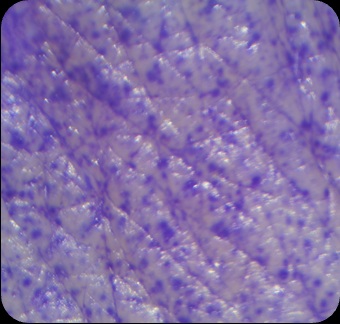
Image 4: Bioneedle Microchannels
We believe our BDS may provide advantages over other microneedling devices like a derma roller, microneedle pens, or microneedle patches. Most of these microneedling devices are manufactured, leading to certain limitations on size or array of the microneedle. Our Bioneedle is wildly harvested and based on certain environmental conditions for harvest we can obtain what we have found to be the optimal features for our Bioneedle. With our processing we are able to precisely size our sponge matrix to ensure the organic and inorganic components meet the needs for our BDS. We believe the precise size of our Bioneedles are small enough to be less painful than most derma rollers or microneedling devices, while still creating microchannels sufficient for delivery of macromolecules into the dermis. Additionally, our Bioneedles are free-floating in our matrix, rather than attached to a device, which we believe provides skincare professionals a distinct advantage to add more personalization for consumers. Skincare professionals can apply our Bioneedles to as small or as large of a surface area as they deem necessary in a uniform manner based on their desired outcome. Then, once applied, our Bioneedles stay in the skin for a short period of time, allowing the newly created microchannel to remain open rather than close up. With the open microchannel, a macromolecule, like botulinum toxin, can be applied topically to the same area to drive the macromolecule through the microchannel and into the dermis where it can have its intended effect. We also know that there are millions of spicules within our sponge matrix, allowing for the creation of a large number of microchannels as seen in Image 4 above, with each purple dot indicating the penetration of a spicule.
We believe these distinct attributes will entice skincare professionals, like aestheticians and dermatologists, to use our BDS and seek out new and unique ways to deliver a variety of macromolecules. Based on published data of spicules being used to deliver botulinum toxin we believe our BDS can be used with a variety of macromolecules in many aesthetic and medical skincare applications. These might include delivering botulinum toxin to reduce pore size or for the treatment of hyperhidrosis. Additionally, BDS could help deliver dermal fillers for a more uniform field effect, which we see as difficult to achieve with intradermal injections or currently available microneedling techniques.
On January 17, 2025, we entered into a Clinical Trial Collaboration Agreement (the “Collaboration Agreement”) with Revance Therapeutics, Inc. (“Revance”) where we intended to conduct a Phase 2a clinical trial to evaluate the topical application of our Bioneedle followed by the topical application of Revance’s botulinum toxin product, DAXXIFY® for the treatment of primary axillary hyperhidrosis. In light of our recent strategic shift to develop and distribute skincare products, we plan to continue to discuss future opportunities for this collaboration with Revance. At this time, the initiation of the Phase 2a clinical trial has been placed on hold. We still believe there is a potential to utilize our Bioneedle for the topical delivery of botulinum toxin, but with our strategic decision to withdraw the XYNGARI™ investigational new drug application (“IND”), we are currently evaluating the regulatory and commercial opportunities for this program. While the initiation of the Phase 2a clinical study is on hold, we continue to evaluate alternative ways to leverage our Bioneedle as a novel platform to enhance the topical delivery of large-molecules, like botulinum toxin, as a needle-free alternative to conventional intradermal injection of large molecules for medical and aesthetic skin conditions.
Manufacturing
We do not currently own or operate any manufacturing facilities and do not plan to own any in the near future. We rely, and will rely, on our third-party partners for the manufacture of our products for the commercial sale of our skincare products, if our products are launched.
To date, we have obtained wildly harvested Spongilla raw material directly from our exclusive supplier based in Russia. In February 2020, we signed an exclusive supply agreement with this supplier of Spongilla raw material. Our supplier has over 23 years of experience collecting and processing Spongilla and has the capacity to collect and process large quantities of Spongilla each year. We believe our supplier is able to and will continue to be able to harvest sufficient quantities of raw material to fulfill our development and potential commercial needs. We have recently received a shipment of Spongilla raw material from our supplier containing quantities of Spongilla raw material. We believe this new shipment will provide us with sufficient quantities of Spongilla to launch our first commercial product, the Foundational Treatment in the middle of 2026 and the Clearing Treatment to follow. We also believe that our supplier will be able to meet our future supply needs if the sales of our commercial products exceed our forecasted numbers. Notwithstanding, we continue to explore alternative manufacturing sources of our sponge raw material in order to ensure that we have access to sufficient supply to meet potential demand for any of our products in a cost-efficient manner. While Reka-Farm is the sole supplier of our Spongilla raw materials used in our products, we have evaluated other suppliers of Spongilla from other regions of the world; however, no other supplier nor their Spongilla supply has met the quality standards required by our cGMP practices. An alternative source to supply Spongilla raw materials would be the aquaculture of Spongilla in a lab setting, which could significantly increase the cost of raw materials as well as the availability of raw materials due to the cost and time to build an aquaculture infrastructure to supply Spongilla in commercial quantities. However, due to our ability to obtain the Spongilla from Reka-Farm, we remain confident that we will not need to incur these costs for the foreseeable future. See “Business—Material Agreements— Supply Agreement between Dermata Therapeutics LLC and Reka-Farm LLC” for more information regarding our supply of Spongilla.
| 16 |
We continue to employ strict processes to ensure the highest quality product, including internal resources to manage our contractors. The relevant manufacturers of our drug products have advised us that they are in compliance with both current Good Laboratory Practices (“cGLP”) and cGMP.
We are confident that our manufacturers have the ability to scale our processes to support our first commercial launch requirements and future commercial requirements. Our suppliers and manufacturers were specifically selected based on the capabilities of their organization, their compliance to regulations, their personnel, and the type and capabilities of their equipment. Testing methods for each stage of the manufacturing process from acquisition of raw materials through production of finished product have been developed and satisfactorily qualified per the appropriate regulations. Analytical methods and operational procedures related to each stage of our production operations including product release will continue to evolve and be validated as part of our overall development plans and commercial production.
Commercialization
We intend to commercialize our Tome skincare products through a dual-channel marketing strategy that combines DTC advertising and B2B by targeting skincare professionals, by building a practitioner community through a Tome certification program, where interested skincare professionals can complete a deep dive certification program of our Tome product offerings. With our multidimensional hero ingredient, we believe that it should not be limited to just one commercialization strategy. With our vision to provide consumers skintech at home, we believe there is an additional set of consumers who seek the care of a skincare professional and would prefer to have treatments done in office. Therefore, we see this dual-channel strategy as a way to increase our reach to a broader consumer segment than can be done with one or the other. We believe this is only possible due to the once-weekly application routine of Foundational Treatment as most other treatments need to be applied at least daily or must be performed in-office by a professional. Additionally, this hybrid model provides us with the most flexibility in the future expansion of our Tome skincare line.
Direct-to-Consumer Marketing
Our DTC strategy is designed to drive consumer awareness, education, and adoption through digital-first channels. We expect to utilize a mix of performance and brand-oriented marketing tactics, including paid digital advertising, social media platforms, search engine marketing, influencer and creator partnerships, and educational content to drive consumer awareness and purchases. These efforts are intended to communicate product positioning, usage regimen, and key differentiators, while directing consumers to our owned digital properties for conversion and fulfillment. We believe by pursuing a DTC strategy we can properly educate consumers on our product offers beyond what they can read on a box. We hope that through proper education and awareness of the power of our skincare products, consumers will feel more invested in their skincare and Tome.
Our primary DTC channel is our owned e-commerce platform, which enables us to control product positioning, pricing, merchandising, and customer experience. Through this channel, we can efficiently launch new products, run targeted promotions, test new claims and creative messaging, and optimize conversion through iterative improvements to site performance, content, and checkout flows. We also plan to selectively leverage third-party marketplaces and affiliate partnerships to expand reach, while maintaining brand consistency and minimizing channel conflict.
Customer Acquisition Strategy. We intend to drive DTC growth through a diversified customer acquisition model that includes paid digital advertising, influencer and creator partnerships, affiliate marketing, and organic demand generation or word-of-mouth. Paid channels may include social media advertising, search engine marketing, and retargeting campaigns, optimized using performance metrics such as customer acquisition cost, conversion rate, and lifetime value. We also plan to invest in brand-building initiatives such as educational content, dermatologist-and aesthetician-aligned messaging, and community-driven social engagement to improve efficiency over time by increasing organic traffic and repeat purchase rates.
| 17 |
Retention and Lifecycle Marketing. We emphasize retention as a core driver of profitability and sustainable growth. Our lifecycle strategy includes personalized email and SMS marketing, application and replenishment reminders, loyalty and referral programs, and subscription or auto-replenishment offerings where appropriate. We aim to increase repeat purchase frequency by promoting regimen-based usage, the eventual sale of cross-selling complementary products, and delivering ongoing skincare education tailored to customer needs and skin concerns. We plan to track key retention metrics including repeat purchase rate, cohort performance, and churn to continuously improve engagement and product adoption. We believe by monitoring these metrics we can more easily identify our high value users that help build brand loyalty.
Operations, Fulfillment, and Scalability. Our DTC operations will be supported by scalable fulfillment and logistics capabilities, including third-party warehousing and shipping partners. We will seek to maintain high service levels through reliable inventory planning, demand forecasting, and quality assurance processes. We continually evaluate packaging, shipping methods, and fulfillment workflows to balance cost efficiency with delivery speed and customer satisfaction. As order volume increases, we expect to realize improved efficiencies through operational scale and vendor optimization.
Key Risks and Considerations. Our DTC strategy is subject to risks including rising digital advertising costs, platform algorithm changes, increased competition, evolving consumer preferences, and supply chain disruptions. Additionally, customer acquisition performance may fluctuate due to macroeconomic conditions and changes in privacy regulations that affect targeting and attribution. We seek to mitigate these risks by diversifying acquisition channels, strengthening organic demand, investing in retention, and maintaining operational flexibility.
Strategic Objectives. Our DTC commercialization strategy is designed to (i) build durable customer relationships through a differentiated brand experience, (ii) improve profitability through higher margin sales and repeat purchase behavior, and (iii) create a scalable platform for new product launches and long-term growth. We believe our disciplined execution across acquisition, retention, and operational scalability positions us to expand our customer base and drive sustainable DTC revenue growth.
B2B - Professional Channel Marketing
In addition to a DTC channel, we also plan to pursue a B2B commercialization strategy, or professional channel marketing, focused on building trusted relationships with licensed aestheticians, dermatology practices, and other qualified skincare professionals. This channel is designed to expand awareness and adoption through professional recommendation, strengthen clinical credibility, and create a recurring, high-retention revenue stream driven by protocol-based usage and repeat replenishment. We believe professional endorsement and education can serve as a meaningful catalyst for consumer conversion, particularly for products positioned around clinically informed ingredients and outcomes, like our Foundational Treatment.
Target Customers and Channel Positioning. Our primary B2B customers will likely include licensed aestheticians, dermatology practices, medical spas, and other skincare professionals who influence consumer purchasing decisions through treatment protocols and product recommendations. We plan to position our portfolio as a professional-grade skincare system supported by education, usage guidance, and regimen-based solutions. We intend to differentiate through product efficacy, ingredient transparency, and professional training designed to improve consumer outcomes and satisfaction. Providing consumers the option to have their treatment done in-office will allow the skincare professionals the flexibility to use our hero ingredient in other skincare treatments as they see fit.
Professional Marketing and Demand Generation. We intend to build awareness within the professional community through a combination of targeted outreach and industry marketing initiatives. These efforts may include attendance at professional conferences and trade events, partnerships with key opinion leaders (“KOLs”), professional sampling, and educational webinars. We also plan to leverage practice-facing digital marketing, including paid search and social campaigns targeted to licensed professionals, as well as email marketing and professional community engagement to drive onboarding and repeat purchasing.
| 18 |
Certification Program and Professional Education. A core element of our B2B strategy will be a structured certification program intended to educate professionals on product science, ingredient benefits, and recommended treatment and home-care protocols. The certification program will be designed to ensure consistent product usage, enhance treatment outcomes, and support high-quality recommendations to consumers. Program components may include:
| ● | Foundational training modules covering skin physiology, key actives, product indications, contraindications, and regimen construction. | |
| ● | Protocol-based education for common skin concerns (e.g., acne, hyperpigmentation, aging, sensitive skin), including sequencing and frequency guidance. | |
| ● | Assessment and credentialing, such as knowledge checks or final examinations, with certification status granted upon completion. | |
| ● | Ongoing continuing education, including periodic updates on new products, clinical learnings, and evolving best practices. | |
| ● | Professional resources, including downloadable treatment guides, consumer handouts, before-and-after documentation standards, and retail merchandising support. |
We expect the certification program to increase practitioner confidence, improve consistency of use across settings, and drive higher conversion and repeat purchasing through protocol adherence and customer satisfaction.
Practice Enablement and Commercial Terms. We plan to support professional partners with tools and incentives designed to make adoption and ongoing selling efficient. This may include professional starter kits, backbar formats where applicable, retail-ready merchandising, and reordering tools integrated into our B2B platform. We may offer tiered pricing, minimum order thresholds, referral codes, and volume-based incentives to align with practice economics while maintaining premium brand positioning. Certified providers may receive access to exclusive benefits such as early product access, advanced training, co-marketing opportunities, and priority support.
Sales Model and Account Development. We plan to execute this channel through a combination of inside sales, strategic field support in key markets, and digital self-serve ordering for smaller accounts. Our approach emphasizes long-term account development through training, replenishment cadence management, and practice-specific regimen customization. We plan to measure account performance using metrics such as reorder frequency, average order value, number of certified professionals per account, and sell-through performance where available. This will allow us to monitor and reward high sellers with additional incentives.
Integration with DTC Strategy. We believe the professional channel can act as a complementary driver of DTC growth by increasing consumer trust and accelerating trial through professional recommendation. We may support certified professionals with referral tools, co-branded landing pages, or consumer education materials that encourage ongoing replenishment through either the professional channel or our owned e-commerce platform, depending on partner preference and channel strategy. We intend to manage pricing and messaging across channels to reduce conflict and preserve brand integrity. We also intend to list certified providers on our website so interested consumers may contact them for virtual or in-office consultations. We believe this will provide greater consumer confidence in their purchase.
Key Risks and Considerations. The professional channel is subject to risks including slower onboarding cycles, variability in practitioner engagement, competitive offerings, and regulatory considerations related to product claims and professional marketing. Additionally, scaling the channel requires consistent training quality and operational support. We seek to mitigate these risks through standardized certification content, dedicated partner support, disciplined account qualification, and ongoing measurement of partner performance.
Strategic Objectives. Our B2B strategy is designed to (i) establish credibility through professional adoption and recommendation, (ii) create recurring revenue through replenishment-driven purchasing behavior, (iii) expand brand awareness among high-intent consumers through trusted professional relationships, and (iv) build a scalable platform for future product launches supported by practitioner education and certification.
| 19 |
Integrated Go-to-Market Approach
We believe the combination of DTC marketing and B2B professional engagement provides a complementary approach to building brand awareness and credibility. DTC marketing is intended to generate consumer demand at scale, while professional outreach is expected to support trust, validation, and longer-term brand equity within the skin-care ecosystem.
We expect to scale marketing investments gradually following launch, with flexibility to adjust channel mix, spending levels, and geographic focus based on market response, operational capacity, and regulatory considerations. Our ability to execute this strategy successfully will depend on multiple factors, including competitive dynamics, consumer acceptance, marketing efficiency, and our ability to maintain compliance with applicable laws and regulations governing OTC products and advertising.
REGULATION
Our business is subject to various laws and regulations, particularly with respect to our product categories. As is the case with most companies in our industry, we receive inquiries from time to time from government regulatory authorities regarding the nature of our business and other issues, such as compliance with local direct selling, transfer pricing, customs, taxation, foreign exchange control, securities and other laws.
Product Regulations
Our OTC and cosmetic products and related promotional and marketing activities are subject to extensive government regulation by numerous federal, state, and local government agencies and authorities, including the United States Food and Drug Administration (the “FDA”), the Federal Trade Commission (the “FTC”), the Consumer Product Safety Commission, the Department of Agriculture, United States and State Attorneys General, and state regulatory agencies in the United States, and similar government agencies in all other markets in which we may operate in the future. In the United States, the FDA, in particular, regulates the formulation, manufacture and labelling of OTC drugs, cosmetics, dietary supplements, foods and medical devices such as those that we distribute.
Regulation of Skincare Products in the United States. Our skincare products are subject to various laws and regulations that regulate cosmetic and personal care products and set forth regulations that, among other things, determine whether a product can be marketed as a “cosmetic” or as an OTC drug. In the United States, the regulation of cosmetic content and labeling is under the primary jurisdiction of the FDA. Cosmetics are not subject to pre-market approval by the FDA, but their ingredients and their label and labeling content are regulated by the FDA, and those who sell cosmetics have the burden to ensure that they are safe for use as directed and not adulterated or misbranded. The labeling of cosmetic products is subject to the requirements of the Federal Food, Drug, and Cosmetic Act (“FDCA”), the Fair Packaging and Labeling Act and other FDA regulations. In 2024, the FDA began implementing portions of the Modernization of Cosmetics Regulation Act of 2022 (“MoCRA”). MoCRA increases the regulation of cosmetics by, among other things, requiring cosmetic manufacturer facility registration, product listings, and reporting of serious adverse events to the FDA. Rollout of MoCRA will continue in the coming years, including the issuance of cosmetic GMPs. Failure to correctly interpret and comply with the new requirements could lead to government actions against us and the associated impairment to our business.
Regulation of Cosmetics
The FDCA defines cosmetics by their intended use, as “articles intended to be rubbed, poured, sprinkled, or sprayed on, introduced into, or otherwise applied to the human body . . . for cleansing, beautifying, promoting attractiveness, or altering the appearance . . . .” Among the products included in this definition are skin moisturizers, perfumes, lipsticks, fingernail polishes, eye and facial makeup preparations, shampoos, permanent waves, hair colors, toothpastes and deodorants, as well as material intended for use as a component of a cosmetic product. A product may be considered a drug if it is intended for use in the diagnosis, cure, mitigation, treatment, or prevention of disease, or is intended to affect the structure or any function of the body (“structure/function claims”). A product’s intended use can be inferred from marketing or product claims, and regulators may consider the marketing claims of our sales force. Structure/function claims are generally prohibited for cosmetic products as are disease prevention and treatment claims. The FDA prohibits certain ingredients from being included in cosmetic products. It is possible that cosmetic product ingredients now commonly in use may be restricted or prohibited in the future as more is learned about such ingredients.
| 20 |
In recent years, the FDA has issued warning letters to many cosmetic companies alleging improper structure/function claims regarding their cosmetic products, including, for example, product claims regarding gene activity, cellular rejuvenation, and rebuilding collagen. Cosmetic companies confront difficulty in determining whether a claim would be considered by the FDA to be an improper structure/function claim. Given this difficulty, and our research and product development focus on the sources of aging and the influence of certain ingredients on gene expression, there is a risk that we could receive a warning letter, be required to modify our product claims, or take other actions to satisfy the FDA if the FDA determines any of our marketing materials contain improper structure/function claims for our cosmetic products. In addition, plaintiffs’ lawyers have filed class action lawsuits against some of our competitors after our competitors received these FDA warning letters. There can be no assurance that we will not be subject to government actions or lawsuits, which could harm our business.
Regulation of OTC Drugs
Certain products, such as acne treatments, are classified as OTC drugs. OTC drugs are subject to many of the same regulations as prescription drugs, including compliance with general labeling requirements and cGMPs. Most OTC drug products are marketed in conformity with the requirements of an FDA-established OTC drug monograph that is applicable to that drug. An OTC drug monograph is a type of “recipe book” covering acceptable ingredients, doses, formulations, directions for use, warnings, and, in some cases, testing parameters. Products conforming to a monograph may be marketed without FDA pre-approval. OTC monographs include well-known ingredients and specific requirements for permitted indications, required warnings and precautions, allowable combinations of ingredients and dosage levels. Pharmaceutical products marketed under the OTC monograph system must conform to specific quality, formula and labeling requirements. Facilities where OTC drugs are manufactured, tested, packaged, stored or distributed must be registered with FDA and comply with cGMP regulations and/or regulations promulgated by the FDA or other competent authorities. OTC monograph products that do not comply with these standards can be deemed unapproved new drugs and can be required to be withdrawn from the market.
Some OTC drug products are marketed under approved New Drug Applications (“NDA”) rather than under OTC monographs.
If FDA were to find that one of our OTC drug products is not being marketed in compliance with the OTC monograph that is applicable to that drug product, we may be required to reformulate the product or cease marketing that product until it is the subject of an approved NDA or until the time, if ever, that the monograph is amended to include such product.
Advertising and Product Claims.
Most of our major markets also regulate advertising and product claims regarding the efficacy and quality of products and require adequate and reliable scientific substantiation of all claims. In some cases, such regulations may limit our ability to inform consumers of some of the benefits our products offer.
The FTC, which exercises primary jurisdiction over the advertising of all of our products in the United States, has instituted enforcement actions against cosmetic companies for, among other things, deceptive advertising and lack of adequate scientific substantiation for claims. We also face limitations on our use of the scientific experts who have helped us develop and test some of our products. In the United States, for example, the FTC’s Guides Concerning the Use of Endorsements and Testimonials in Advertising may restrict marketing to those results obtained by a “typical” consumer and require disclosure of any material connections between an endorser and the company or products they are endorsing. This negative publicity could harm consumers’ perception of our business and our products, which could negatively impact our revenue. We cannot be sure that the FTC, or comparable foreign agencies, will not question our advertising or other operations in the future.
In recent years, the FTC has initiated numerous investigations of and actions against companies that sell OTC and cosmetic products. The FTC may enforce compliance with the law in a variety of ways, both administratively and judicially, using compulsory process, cease and desist orders, and injunctions. FTC enforcement can result in consent decrees or orders requiring, among other things, injunctive provisions, corrective advertising, consumer redress, and such other relief as the agency deems necessary to protect the public. Violation of these consent decrees or orders could result in substantial financial or other penalties. The FTC also sends warning letters as it monitors companies’ activities. In addition, during 2023, the FTC sent notices of penalty offense to nearly 700 companies, including us, regarding the requirement of sufficient substantiation for product claims. Pursuant to the FTC’s “penalty offense authority,” companies that received the notice are expected to comply with the standards set in the FTC’s prior administrative cases on this topic, and they could incur significant civil penalties if they or their representatives fail to do so. No assurance can be given that the FTC will not question our advertising or other operations in the United States in the future. Any action in the future by the FTC could materially and adversely affect our ability to successfully market our products in the United States.
| 21 |
Competition
The medical and aesthetic skin care markets in which we plan to sell our Tome skincare products are crowded with many small, medium, and large skin care companies. While we believe that our unique natural, once-weekly Tome Foundational Treatment and eventual Clearing Treatment will differentiate Dermata from other competitive OTC acne and skincare products, we will face significant competition from established consumer skin-care brands such as Neutrogena®, Proactiv®, Clean & Clear®, PanOxyl®, La Roche-Posay®, CeraVe®, and Differin®, many of which are owned or distributed by large multinational consumer health companies. These brands offer a range of acne products utilizing well-known active ingredients and benefit from broad retail distribution, significant brand recognition, and substantial marketing resources. Moreover, many of these competitors have substantially greater manufacturing, financial, research and development, and OTC marketing experience, with a substantially greater portfolio of OTC and skin care/cosmetic products than we do. As a result, our prospective competitors may be able to develop competing or superior products and compete more aggressively and sustain their competitive advantage over a longer period of time than us. Our products may be rendered obsolete or may lack economic viability in the face of competition.
In addition, we compete with digital-first and DTC skincare companies, including brands such as Curology®, Apostrophe®, Hims & Hers®, and similar platforms, some of which offer prescription-based acne treatments alongside OTC products. While prescription products differ from OTC treatments, these companies may compete for the same consumer attention and discretionary spending.
We also face indirect competition from professional-only or clinic-dispensed skin-care brands recommended or sold by dermatologists and aestheticians, as well as from generic and private-label OTC acne products offered by retailers and online marketplaces, which may compete primarily on price.
While our Foundational Treatment is our first product launch, we plan to develop and launch additional products utilizing our Bioneedle and know-how. These new products, which could be future OTC products for diseases like acne, psoriasis or seborrheic dermatitis or Spongilla-based skin care/cosmetic product, will likely face competition from other OTC or prescription products, as well as other “spicule-based” cosmetic products, many of whom have established sales and brand name awareness among the consumers we will be targeting.
Intellectual Property
Overview
Our commercial success depends in part on our ability to obtain and maintain proprietary protection for our Clearing Treatment, Bioneedle Delivery System and any of our future products, medical devices, methodologies, assays, drug development technologies, harvesting procedures, know-how; to operate without infringing on or otherwise violating the proprietary rights of others; and to prevent others from infringing or otherwise violating our proprietary rights. Our strategy is to protect our proprietary position by, among other things, filing U.S. and foreign patent applications related to our product and other proprietary technologies, inventions and improvements that are important to the development and implementation of our business. We also rely on trade secrets, trademarks, know-how, continuing technological innovations, exclusivity agreements, nondisclosure and confidentiality agreements, license agreements, assignment of inventions and potential in-licensing opportunities to develop and maintain our proprietary position.
Patent Portfolio
Our patent estate consists of in-licensed and solely owned patent applications. Typically, we initially file U.S. provisional patent applications and then file applications directly or under the Patent Cooperation Treaty, or PCT, which is an international patent law treaty that provides a unified procedure for filing a single initial patent application to seek patent protection for an invention simultaneously in any one of the designated member jurisdictions and states, including in the U.S. Although a PCT application does not issue as a patent, it allows the applicant to seek protection in any of the member states through national phase applications filed at a later date. We currently have multiple patents and patent applications in our patent portfolio and continue to pursue and seek additional patent coverage of all our products.
| 22 |
Clearing Treatment
Our Clearing Treatment portfolio includes one family owned by us. Our family related to Clearing Treatment for acne, with a patent issuance in the U.S. by the United States Patent and Trademark Office, entitled “Compositions and methods for the treatment of skin conditions” (U.S. Patent No. 12,208,123) and a recent granted patent in Australia by the Australian Patent Office, entitled Compositions and methods for the treatment of skin conditions” (Australian Patent No. 2019419387). We also have applications pending in Canada. This family refers to specific attributes of our Bioneedle as well as treatment related attributes for the treatment of acne based on the data received prior to its filing. Patents in this patent family, if granted, are expected to expire in 2041 in the US and in 2039 in other jurisdictions, absent any patent term adjustments or extensions. We expect our intellectual property portfolio to be protected by patents, the maintaining of our exclusive supply agreement for our raw material requirements, and our continued efforts to protect our proprietary information including trade secrets.
BDS for Delivery of Botulinum Toxin
Our BDS for delivery of botulinum toxin portfolio includes two families owned by Dermata. The first family consists of issued patents in Japan and Australia, a pending non-provisional U.S. patent application, and six pending foreign patent applications in Canada, China, the European Patent Office, Japan, Hong Kong, and South Korea. These patents/patent applications relate to compositions for the treatment of skin diseases using our proprietary sponge powder in combination with multiple types of botulinum toxin for both medical and aesthetic skin conditions and diseases. Patents in this patent family, if granted, are expected to expire in 2039, absent any patent term adjustments or extensions. The second family is related to certain of our clinical methods related to sponge powder and botulinum toxin. This second family consists of two pending US non-provisional applications and additional applications pending in Australia, Canada, Hong Kong, the European Patent Office, Japan, and South Korea. Patents in this patent family, if granted are expected to expire in 2041, absent any patent term adjustments or extensions.
Our BDS for other large molecule portfolio includes one family owned by Dermata. The family consists of pending applications in the U.S., Australia, and Japan, covering compositions for the treatment of conditions by dermal fillers in combination with our proprietary sponge powder. Patents in this patent family, if granted, are expected to expire in 2040, absent any patent term adjustments or extensions.
Although we believe our patent portfolio offers significant protection for our Clearing Treatment, BDS for delivery of Botulinum Toxin, BDS for other large molecules, and additional combination regimens, the protection offered by our patents may be, to some extent, more limited than the protection provided by patents which claim chemical structures which were previously unknown. Accordingly, other parties may compete with us, for example, by independently developing or obtaining competing topical formulations that design around our patent claims, but which may contain the same or similar active ingredients, or by seeking to invalidate our patents.
The term of individual patents depends upon the laws of the countries in which they are obtained. In most countries in which we file, the patent term is 20 years from the earliest priority date of filing of a non-provisional patent application. However, the term of United States patents may be extended for delays incurred due to compliance with the FDA, requirements or by delays encountered during prosecution that are caused by the United States Patent and Trademark Office, or the USPTO. For example, the Hatch-Waxman Act permits a patent term extension for FDA-approved drugs of up to five years beyond the expiration of the patent. The length of the patent term extension is related to the length of time the drug is under regulatory review. Patent term extension cannot extend the remaining term of a patent beyond a total of 14 years from the date of product approval, and only one patent applicable to an approved drug may be extended. Similar provisions are available in Europe and other jurisdictions to extend the term of a patent that covers an approved drug. In the future, if and when our products receive FDA approval, we expect to apply for patent term extensions on patents covering those products. We intend to seek patent term extensions in any jurisdiction where these are available and where we also have a patent that may be eligible; however there is no guarantee that the applicable authorities, including the United State Patent and Trademark Office and United States FDA, will agree with our assessment of whether such extensions should be granted, and even if granted, the length of such extensions.
| 23 |
Other Intellectual Property
In addition to patent protection, we also rely heavily on trade secrets, including unpatented know-how, technology innovation, technical specifications and assays and other proprietary information in attempting to develop and maintain our competitive advantage. We believe our ability to protect our unpatented know-how and trade secrets are as important if not more important than our patent portfolio due to the complex nature and lack of expiration associated with such information.
We seek trademark protection in the United States and in certain other jurisdictions where available and when we deem appropriate. We currently have registrations for Dermata in the United States and multiple other jurisdictions. We also have pending applications for trademark registrations for Tome, Tome Skincare, Bioneedle, Bioneedles, Tome Bioneedles, Studied Skincare, and we intend to continue to file additional applications for trademark registrations in connection with our products in various jurisdictions, including the United States.
Material Agreements
Clinical Trial Collaboration Agreement between the Company and Revance Therapeutics, Inc.
On January 17, 2025, the Company entered into a Clinical Trial Collaboration Agreement (Clinical Trial Agreement) with Revance Therapeutics, Inc. (Revance), pursuant to which the Company and Revance intend to conduct a multi-center clinical trial (Trial) to evaluate the topical application of XYNGARITM, the Company’s topical Spongilla powder (formerly referred to as DMT310), with DAXXIFY® (daxibotulinumtoxinA-lanm), Revance’s botulinum toxin type A. Pursuant to the terms of the Clinical Trial Agreement, Revance has granted the Company a non-exclusive, worldwide, non-transferable, royalty-free license, with a right to sublicense (subject to limitations), to use certain Revance intellectual property, solely as necessary or useful for the Company to conduct the trial under the Clinical Trial Agreement. The Company has granted Revance a similar license to use topical Spongilla powder and other compound(s) under the Clinical Trial Agreement. The Clinical Trial Agreement will terminate upon completion of the Trial, the delivery of the data resulting from the Trial and the completion of any statistical analyses of the data resulting from the Trial. Either party may terminate the Clinical Trial Agreement upon a material breach by the other party that remains uncured following 30 days after the date of written notice of such breach. In addition, either party may terminate the Clinical Trial Agreement immediately upon written notice if such party reasonably deems it necessary in order to protect the safety, health or welfare of subjects enrolled in the Trial. The Company has agreed to sponsor, conduct, and fund the Phase 2a clinical trial, but no financial obligations or consideration is contemplated in the Clinical Trial Agreement. At this time, the initiation of the Phase 2a clinical trial has been placed on hold. We still believe there is a potential to utilize our Spongilla powder for the topical delivery of botulinum toxin and are currently evaluating the regulatory and commercial opportunities for this program.
Supply Agreement between the Company and Reka-Farm LLC
On February 27, 2020, we entered into an exclusive Supply Agreement (or, the Supply Agreement) with Reka-Farm, LLC (or, Reka-Farm), whereby Reka-Farm will supply us with the Spongilla raw materials necessary for use in the development of our products. The Supply Agreement has an indefinite term unless and until terminated. For the term of the Supply Agreement, Reka-Farm is prohibited from supplying Spongilla for development and sale of any other product outside of the Russian Federation, other than Cosmetic Products (as defined in the Supply Agreement).
Pursuant to the Supply Agreement, we shall provide Reka-Farm with two-year rolling forecasts of our Spongilla raw material requirements, and such forecasts shall be provided to Reka-Farm on a semi-annual basis, beginning on January 1, 2021 (each, a Forecast). Pursuant to the Supply Agreement, Reka-Farm has guaranteed its ability to supply us with the required amounts of Spongilla as specified in each Forecast for the first 12 months of each Forecast. All Forecasts are non-binding on us. If Reka-Farm is unable to supply us with Spongilla raw material in accordance with a Forecast, all available quantities of Spongilla then available to Reka-Farm shall be made available to us on a first priority basis until all amounts of Spongilla set forth in the Forecast are supplied.
Pursuant to the Supply Agreement, we pay a pre-negotiated price per kilogram for Spongilla supplied by Reka-Farm, and we are required to pay to Reka-Farm a royalty payment of less than one percent of the Net Sales (as defined in the Supply Agreement) of any products we develop containing Spongilla raw material supplied by Reka-Farm.
| 24 |
The Supply Agreement may be terminated (i) by either party for material breach with 90 days written notice, if such material breach is not cured within such notice period and (ii) by us for any reason or no reason upon 90 days written notice to Reka-Farm.
The Supply Agreement includes customary terms relating to, among others, indemnification, intellectual property protection, confidentiality, remedies, warranties, as well as certain quality requirements.
Corporate and Other Information
We were formed in December 2014 as a Delaware limited liability company (“LLC”) under the name Dermata Therapeutics, LLC. On March 24, 2021, we converted from an LLC to a Delaware C-corporation and changed our name to Dermata Therapeutics, Inc.
Human Capital Resources
As of the date of this report, we have nine full-time employees, with four employees working in the selling, general and administrative department, two engaged in non-clinical and clinical development, two working in the chemistry, manufacturing, and controls department, and one employee working in the regulatory affairs and quality control department.
We believe that our future success will depend, in part, on our continued ability to attract, hire and retain qualified personnel. In particular, we depend on the skills, experience and performance of our senior management and research personnel. We compete for qualified personnel with other medical pharmaceutical and healthcare companies, as well as universities and non-profit research institutions.
We provide competitive compensation and benefits programs to help meet the needs of our employees. In addition to salaries, these programs (which vary by employment classification) include incentive compensation plans, healthcare and insurance benefits, retirement investments, paid time off, and family leave, among others. We also use targeted equity-based grants with vesting conditions to facilitate retention of personnel, particularly for our key employees.
The success of our business is fundamentally connected to the well-being of our people. Accordingly, we are committed to the health and safety of our employees.
| 25 |
ITEM 1A. RISK FACTORS
Investing in our securities involves a high degree of risk. You should carefully consider the risks and uncertainties described below, together with all of the other information in this report, including the consolidated financial statements, the notes thereto and the section entitled “Management’s Discussion and Analysis of Financial Condition and Results of Operations” included elsewhere in this report before deciding whether to invest in our securities. The risks and uncertainties described below are not the only ones we face. Additional risks and uncertainties that we are unaware of or that we deem immaterial may also become important factors that adversely affect our business. If any of the following risks actually occur, our business, financial condition, results of operations and future prospects could be materially and adversely affected. In that event, the market price of our common stock and/or Warrants could decline, and you could lose part or all of your investment. These disclosures reflect our beliefs and opinions as to factors that could materially and adversely affect us and our securities in the future. References to past events are provided by way of example only and are not intended to be a complete listing or a representation as to whether or not such factors have occurred in the past or their likelihood of occurring in the future.
Summary of Risks Associated with Our Business
Our business and an investment in our company is subject to numerous risks and uncertainties, including those highlighted in the section titled “Risk Factors” immediately following this summary. Some of these risks include:
| ● | the skincare industry is highly competitive, and if we are unable to compete effectively, our results will suffer; | |
| ● | our lack of operating history as a commercial company and have never launched a commercial product as a company; | |
| ● | we have a history of net losses, and may experience future losses; | |
| ● | our current and future capital requirements to support our development and commercialization efforts for our products and our ability to satisfy our capital needs; | |
| ● | our dependence on our products, which are still in various stages of development and pre-commercial launch; | |
| ● | our ability to acquire sufficient quantities of raw material needed to manufacture our products; | |
| ● | our, or that of our third-party manufacturers, ability to manufacture cGMP quantities of our product ingredients as required for consumer use studies and, subsequently, our ability to manufacture commercial quantities of our products; | |
| ● | the expectation that any planned OTC formulation, dosage, combination, or indications fall inside the scope of an applicable OTC monograph, will not require a new drug application, and are otherwise not challenged by FDA, state boards, or other regulators, any of which could delay or prevent launch or require reformulation, relabeling, additional testing, or other corrective actions; | |
| ● | the possibility that data generated from a consumer use study are not predictive of consumer experience or commercial performance in the OTC context, and the limits such data may impose on the scope of permissible OTC claims; | |
| ● | the possibility that data generated from a consumer use study are not predictive of consumer experience or commercial performance in the cosmetic context, and the limits such data may impose on the scope of permissible cosmetic claims; | |
| ● | our ability to timely secure and scale manufacturing, packaging, and quality systems suitable for commercialization, including meeting lot release, stability, shelf life, and container-closure requirements, and to manage product returns, recalls, or withdrawals if quality issues arise; | |
| ● | our ability to establish and maintain distribution and sales channels, including DTC e-commerce, B2B professional/clinic channels, and any retail partners, and to manage channel economics, chargebacks, returns, and working capital needs; | |
| ● | we maintain a single source for our sponge raw material and our business and operating results could be harmed if supply is restricted or ceases or the price for the raw materials used in our manufacturing processes increases; | |
| ● | our ability to internally develop new inventions and intellectual property; | |
| ● | interpretations of current laws and the passages of future laws; | |
| ● | impacts of increased trade tariffs, import quotas or other trade restrictions or measures taken by the United States and other countries, including the recent and potential changes in U.S. trade policies that may be made by the Trump presidential administration; | |
| ● | acceptance of our business model by investors; | |
| ● | the accuracy of our estimates regarding expenses and capital requirements; and | |
| ● | our ability to adequately support organizational and business growth. |
| 26 |
Risks Related to Our Financial Position and Need for Capital
We are a pre-commercial stage company with a limited operating history.
We are a pre-commercial stage company with a limited operating history upon which you can evaluate our business and prospects. We have never sold a commercial product before and there is no guarantee that we will be successful. The likelihood of success of our business plan must be considered in light of the problems, substantial expenses, difficulties, complications and delays frequently encountered in connection with developing and selling skincare products and competitive environment in which we plan to operate.
Accordingly, you should consider our prospects in light of the costs, uncertainties, delays and difficulties frequently encountered by companies launching their first commercial product. Potential investors should carefully consider the risks and uncertainties that a company with a limited operating history will face. In particular, potential investors should consider that we cannot assure you that we will be able to, among other things:
| ● | successfully implement or execute our current business plan, and we cannot assure you that our business plan is sound; | |
| ● | successfully manufacture our products and establish commercial supply; | |
| ● | secure, maintain and, as necessary, defend our intellectual property rights; | |
| ● | secure market exclusivity and/or adequate intellectual property protection for our commercial products; | |
| ● | attract and retain an experienced management and advisory team; | |
| ● | secure acceptance of our products with consumers and healthcare professionals; | |
| ● | launch commercial sales of our products, whether alone or in collaboration with others; | |
| ● | comply with post-marketing regulatory requirements; | |
| ● | raise sufficient funds in the capital markets or otherwise to effectuate our business plan; and | |
| ● | utilize the funds that we have and may raise in the future to efficiently execute our business strategy. |
If we cannot successfully execute any one of the foregoing, our business may fail and your investment will be adversely affected.
We have incurred losses since inception and anticipate that we will continue to incur losses for the foreseeable future. We are not currently profitable, and we may never achieve or sustain profitability.
We have never generated revenue from operations and may not generate revenues for several months or years, if ever. We are currently operating at a loss and expect our operating costs will continue to increase as we attempt to launch our first commercial product and continue to operate as a public company. We expect to incur substantial expenses without corresponding revenues unless and until we are able to successfully commercialize any of our products. Even if we are able to commercialize our products, there can be no assurance that we will generate significant revenues or ever achieve profitability. We have incurred losses in each year since we commenced operations in December 2014. We incurred net losses of approximately $7.8 million and approximately $12.3 million for the years ended December 31, 2025, and 2024, respectively. As of December 31, 2025, we had an accumulated deficit of approximately $73.2 million. The size of our future net losses will depend, in part, on our future expenses and our ability to generate revenue, if any. Revenue from our current and potential future collaborations is uncertain because milestones or other contingent payments under our agreements may not be achieved or received.
| 27 |
As of December 31, 2025, we had capital resources consisting of cash and cash equivalents of $7.5 million. We will continue to expend substantial cash resources for the foreseeable future for the development of our products and commercial launches of our products. These expenditures will include costs associated with research and development, manufacturing and supply, as well as marketing and selling our products.
We are uncertain when or if we will be able to achieve or sustain profitability. If we achieve profitability in the future, we may not be able to sustain profitability in subsequent periods. Failure to become and remain profitable would impair our ability to sustain operations and adversely affect the price of our securities and our ability to raise capital.
We will require additional capital to fund our operations, and if we fail to obtain necessary financing, we may not be able to complete the development and commercialization of our products.
We believe that our existing cash, together with interest thereon, will be sufficient to fund our operations into the first quarter of 2027. We have based these estimates, however, on assumptions that may prove to be wrong, and we could spend our available capital resources much faster than we currently expect or require more capital to fund our operations than we currently expect. We estimate that our existing cash will cover the anticipated expenditures for the development of and commercial launch of our Tome Foundational Treatment, but we may need to raise additional capital to fund our operations and continue to support our commercialization activities.
The amount and timing of our future funding requirements will depend on many factors, including:
| ● | the timing, rate of progress and cost of any product development activities for our current and any future products that we develop, in-license or acquire; | |
| ● | the number and characteristics of any additional future products we develop or acquire; | |
| ● | our ability to establish and maintain strategic collaborations, licensing, co-promotion or other arrangements and the terms and timing of such arrangements; | |
| ● | the cost of commercialization activities if our current or any future products are made available for sale, including manufacturing, marketing, sales and distribution costs; | |
| ● | the degree and rate of market acceptance of any commercially available products; | |
| ● | costs under our third-party manufacturing and supply arrangements for our current and any future products and any products we commercialize; | |
| ● | costs and timing of completion of any additional outsourced commercial manufacturing or supply arrangements that we may establish; | |
| ● | costs of preparing, filing, prosecuting, maintaining, defending and enforcing any patent claims and other intellectual property rights associated with our products; | |
| ● | costs associated with prosecuting or defending any litigation that we are or may become involved in and any damages payable by us that result from such litigation; | |
| ● | costs associated with any product recall that could occur; | |
| ● | costs of operating as a public company; | |
| ● | the emergence, approval, availability, perceived advantages, relative cost, relative safety and relative efficacy of alternative and competing products or treatments; | |
| ● | costs associated with any acquisition or in-license of products and products, technologies or businesses; and | |
| ● | personnel, facilities and equipment requirements. |
| 28 |
We cannot be certain that additional funding will be available on acceptable terms, or at all. In addition, future debt financing into which we enter may impose upon us covenants that restrict our operations, including limitations on our ability to incur liens or additional debt, pay dividends, redeem our stock, make certain investments and engage in certain merger, consolidation or asset sale transactions.
If we are unable to raise additional capital when required or on acceptable terms, we may be required to significantly delay, scale back or discontinue the development or commercialization of one or more of our products, restrict our operations or obtain funds by entering into agreements on unattractive terms, which would likely have a material adverse effect on our business, stock price and our relationships with third parties with whom we have business relationships, at least until additional funding is obtained. If we do not have sufficient funds to continue operations, we could be required to seek bankruptcy protection or other alternatives that would likely result in our stockholders losing some or all of their investment in us. In addition, our ability to achieve profitability or to respond to competitive pressures would be significantly limited.
The reports of our independent registered public accounting firm for the fiscal years ended December 31, 2025, and 2024, contain an explanatory paragraph regarding substantial doubt about our ability to continue as a going concern.
Due to the uncertainty of our ability to meet our current operating and capital expenses, in their reports on our audited annual financial statements as of and for the years ended December 31, 2025, and December 31, 2024, our independent audit firm included an explanatory paragraph regarding concerns about our ability to continue as a going concern. Substantial doubt about our ability to continue as a going concern may materially and adversely affect the price per share of our common stock and warrants and we may have a more difficult time obtaining financing. Further, the perception that we may be unable to continue as a going concern may impede our ability to raise additional funds or operate our business due to concerns regarding our ability to discharge our contractual obligations.
Changes in tax laws may materially adversely affect our business financial condition, results of operations and cash flows.
We are subject to tax laws, regulations and policies of the jurisdictions in which we do business, which may include U.S. federal, state, and local governments and taxing authorities in foreign jurisdictions. Changes in tax laws, as well as other factors, could cause us to experience fluctuations in our tax obligations and otherwise adversely affect our tax positions and/or our tax liabilities. The income tax rules in the jurisdictions in which we operate are constantly under review by taxing authorities and other governmental bodies. Changes to tax laws (which changes may have retroactive application) could adversely affect us or our stockholders. We are unable to predict what tax proposals may be proposed or enacted in the future or what effect such changes would have on our business, but such changes, to the extent they are brought into tax legislation, regulations, policies or practices, could affect our financial position and overall effective tax rates in the future in jurisdictions where we have operations, and increase the complexity, burden and cost of tax compliance.
For example, on July 4, 2025, H.R. 1, the “One Big Beautiful Bill Act” (the “OBBBA”) was signed into law in the United States. Among other changes, the OBBBA modifies key business tax provisions, including the restoration of 100% bonus depreciation under Section 168(k) of the United States Internal Revenue Code of 1986, as amended (the “IRC”), the restoration of the immediate deduction of U.S. domestic research and experimental expenditures under Section 174A of the IRC, the restoration of the EBITDA-based business interest expense limitation under Section 163(j) of the IRC, and changes to the computation of taxes related to international operations. Based on our current analysis of these provisions, we do not believe these provisions will have a material impact on our business and our results of operations. However, regulations and other U.S. Internal Revenue Service guidance implementing the OBBBA may give rise to new issues that we did not foresee, and further changes to tax laws may be implemented. Therefore, there can be no assurance that our business will not be adversely affected by the OBBBA or any other tax law changes.
| 29 |
Disruptions in the global economy and supply chains may have a material adverse effect on our business, financial condition and results of operations.
Disruptions to the global economy may impede global supply chains, resulting in longer lead times and also increased critical component costs and freight expenses. We have taken and may have to take steps to minimize the impact of these disruptions in lead times and increased costs by working closely with our suppliers and other third parties on whom we rely for the conduct of our business. Despite the actions we have undertaken or may have to undertake to minimize the impacts from disruptions to the global economy, there can be no assurances that unforeseen future events in the global supply chain will not have a material adverse effect on our business, financial condition and results of operations.
Furthermore, inflation can adversely affect us by increasing the costs of development and marketing of our products, as well as administration and other costs of doing business. We may experience increases in the prices of labor and other costs of doing business. In an inflationary environment, cost increases may outpace our expectations, causing us to use our cash and other liquid assets faster than forecasted. If this happens, we may need to raise additional capital to fund our operations, which may not be available in sufficient amounts or on reasonable terms, if at all, sooner than expected.
Disruptions to our distribution operations could adversely affect our ability to deliver our products to consumers and customers.
Our ability to receive inventory and deliver products to distributors, customers, and consumers on a timely basis depends on the proper functioning of our manufacturing, supplier, and distribution operations, and interruptions or delays in these operations could adversely affect our business, results of operations, or financial condition. Distribution disruptions can occur for many reasons, including manufacturing or supplier disruptions, labor disputes or shortages, concentration or insolvency of distributors or logistics providers, site-specific incidents, natural disasters, political unrest, terrorist attacks, cybersecurity incidents, epidemics, pandemics, other unfavorable economic or market conditions, trade embargoes, customs and tax requirements and similar factors, increases in transportation or shipping costs, issues with overseas shipments, reductions in the transportation capacity of carriers, disruptions to transportation infrastructure, and other unexpected delivery interruptions or delays. We are also subject to risks of damage to, or loss of, our products while they are stored in our warehousing facilities or being delivered by our shipping vendors. Distributors, customers, and consumers rely on timely receipt of our products and any repeated, intermittent or long-term disruption to, or failure of, the operations of our warehousing and distribution facilities could lead to lower sales and profitability, excess inventory, reputational damage or loss of loyalty to our brands. In addition, as we continue to grow our business, we may need to continue to update or expand our warehousing and distribution facilities, which may require significant amounts of capital, or engage additional third-party distributors and shipping vendors, which may increase the risks to our business associated with reliance on third parties.
Adverse global conditions, including economic uncertainty, may negatively impact our financial results.
Global conditions, dislocations in the financial markets, any negative financial impacts affecting United States as a result of tax reform or changes to existing trade agreements or tax conventions, may adversely impact our business.
In addition, the global macroeconomic environment could be negatively affected by, among other things, public health emergencies, pandemics or epidemics, instability in global economic markets, increased U.S. trade tariffs and trade disputes with other countries and any resulting trade wars, instability in the global credit markets, supply chain weaknesses, instability in the geopolitical environment as a result of the withdrawal of the United Kingdom from the European Union, the war between Russia and Ukraine, the ongoing conflicts in the Middle East, and other political tensions, and foreign governmental debt concerns. Such challenges have caused, and may continue to cause, uncertainty and instability in local economies and in global financial markets.
| 30 |
Risks related to the skincare industry
Our shift from an Rx regulatory framework to OTC monograph pathways could introduce significant regulatory risks that could delay or prevent product launches, require reformulation or relabeling, restrict indications or target populations, and materially increase costs.
Unlike prescription drugs, OTC products must be shown to be safe and effective for consumer self-selection and self-use without a healthcare professional’s supervision. For products marketed under the OTC monograph system (implemented through FDA administrative orders), our products must meet all applicable conditions for “generally recognized as safe and effective” (“GRASE”), including specific active ingredients, indications, strengths, dosage forms, dosing intervals, age ranges, warnings, and Drug Facts Labeling. If any aspect of our product(s)—such as an active ingredient, indication, combination of actives, strength, dosage form, route of administration, dosing directions, or age range—falls outside the applicable monograph conditions, we may be required to reformulate, relabel, narrow the intended population or indications, or submit a request for an amended administrative order supported by additional data. FDA may decline to modify the relevant administrative order, require more data than we anticipate, or take longer than expected to act on a request, any of which could delay launches or prevent us from marketing the product as designed. Evolving FDA orders or compliance sweeps, including changes to impurity limits (such as nitrosamines), new contraindications or age restrictions, or additional warnings, can also emerge late in development and force unplanned reformulation, relabeling, or withdrawal—resulting in write-offs of packaging or finished goods, extensions of stability programs, and missed commercialization timelines.
While we were pursuing XYNGARI as a prospective candidate for approval under the FDA New Drug Application process, we have since withdrawn the investigational new drug application for XYNGARI and no longer consider it an investigational product. While we believe that our prospective OTC acne kit is distinct from XYNGARI and will comply with the applicable OTC monograph, a form of our Bioneedle and H2O2 will be included as inactive ingredients in our OTC acne kit with no therapeutic claims. If the FDA determines that either or both substances are active ingredients in our OTC acne kit, our OTC acne kit will not fit within the OTC monograph and we may have to reformulate the kit or could be subject to enforcement action for marketing an unapproved new drug, which could result in consequences, including, but not limited to, a warning letter, product seizure, and/or civil or criminal penalties.
For products that do not fit within an OTC monograph or for which we seek novel claims, actives, or conditions of use, we may pursue an OTC NDA. OTC NDAs generally require consumer behavior evidence that differs from Rx approvals, including label comprehension, self-selection, and, in many cases, actual use studies, as well as human factors and packaging usability validation. If study participants misinterpret labeling, fail to self-select appropriately, make dosing errors, or misuse the product, we may need multiple iterative cycles of label revisions, packaging or device redesign, and retesting. The FDA may also require additional clinical or post marketing safety data to support broader, unsupervised consumer use; impose narrower indications, higher minimum ages, or dosing restrictions; or convene advisory committee review—all of which can delay approval or materially diminish the commercial viability of the product.
Any of these regulatory dynamics—alone or in combination—could delay or prevent product launches, require us to reformulate, relabel, restrict indications or target populations, write off inventory and packaging, expand study programs, or incur greater user fees and manufacturing costs. If we are unable to timely secure applicable administrative orders or if chosen, OTC NDA approvals, on commercially acceptable terms, or if we must significantly alter our products, labeling, or packaging to meet OTC requirements, our development timelines, revenue prospects, operating margins, inventory levels, and relationships with customers and channel partners could be materially adversely affected.
The skincare industry is highly competitive, and if we are unable to compete effectively, our results will suffer.
The skincare industry is highly competitive and can rapidly change due to consumer preferences and industry trends, such as the expansion of digital channels, DTC channels, new “disruptor” brands, and advances in technology such as artificial intelligence (“AI”). We face vigorous competition from companies throughout the world, including large multinational consumer products companies that have many skincare brands under ownership and standalone skincare brands, including those that may target the latest trends or specific distribution channels. Competition in the skincare industry is based on the introduction of new products, pricing of products, quality of products and packaging, brand awareness, perceived value and quality, innovation, in-store presence and visibility, promotional activities, advertising, editorials, e-commerce and mobile-commerce initiatives and other activities. We must compete with a high volume of new product introductions as well as existing products by diverse companies across several different distribution channels.
| 31 |
Many of the multinational consumer companies that we compete with have greater financial, technical or marketing resources, longer operating histories, greater brand recognition or larger customer bases than we do and may be able to respond more effectively to changing business and economic conditions than we can. Our competitors may attempt to gain market share by offering products at prices at or below the prices at which our products are typically offered, including through the use of large percentage discounts. Competitive pricing may require us to reduce our prices, which would decrease our profitability or result in lost sales. Our competitors may be better able to withstand these price reductions and lost sales.
It is difficult to predict the timing and scale of our competitors’ activities or whether new competitors will emerge in the skincare industry. In recent years, numerous online, “indie” and influencer-backed beauty health companies have emerged and garnered significant followings. Further technological breakthroughs, including new and enhanced technologies that increase competition in the online retail market, new product offerings by competitors and the strength and success of our competitors’ marketing programs may impede our growth and the implementation of our business strategy.
Our ability to compete depends on the continued strength of our brand and products, the success of marketing, innovation and execution strategies, the continued diversity of product offerings, the successful management of new product introductions and innovations, strong operational execution, including in order fulfillment, and success in entering new markets and expanding our business in existing geographies. If we are unable to continue to compete effectively, it could have a material adverse effect on our business, financial condition and results of operations. For more information about the competition we face, see “Business—Competition.”
Our business is dependent on the commercial success and our ability to launch and sell Tome skincare products, including our Foundational Treatment. If we are unable to successfully launch, commercialize and sell our Foundational Treatment, our results of operations and financial condition will be materially harmed.
Our business and our ability to generate revenue largely depends on our ability to successfully launch, commercialize and sell our Tome Foundational Treatment. Our ability to generate revenue depends on our ability to manufacture and sell high quality, reliable Foundational Treatment and execute on our commercialization plans, and the size of the market for, and the level of market acceptance of, our Foundational Treatment. If our Foundational Treatment are not accepted and adopted by our customers, our revenue and results of operations will be materially and adversely affected.
Our new product launch may not be as successful as we anticipate.
The skincare industry is driven in part by beauty and skincare trends, which may shift quickly. Our continued success depends on our ability to anticipate, gauge and react in a timely and cost-effective manner to changes in consumer preferences for skincare products, consumer attitudes toward our industry and brand, and where and how consumers shop for and use these products. We must continually work to develop, produce and market new products, maintain and enhance the recognition of our brand, maintain a favorable mix of products, and develop our approach as to how and where we market and sell our products.
We have established a process for the development, evaluation and validation of our new product concepts. Nonetheless, each new product launch involves risks, as well as the possibility of unexpected results. For example, the acceptance of new product launches and sales to our consumers may not be as high as we anticipate, due to lack of acceptance of the products themselves or their price, or limited effectiveness of our marketing strategies. In addition, our ability to launch new products may be limited by delays or difficulties affecting the ability of our suppliers or manufacturers to timely manufacture, distribute and ship new products. We may also experience a decrease in sales of certain existing products as a result of newly launched products.
Any of these occurrences could delay or impede our ability to achieve our sales objectives, which could have a material adverse effect on our business, financial condition and results of operations.
| 32 |
Any damage to our reputation or brand may materially and adversely affect our business, financial condition and results of operations.
We believe that developing and maintaining our brand is critical and that our financial success is directly dependent on consumer perception of our brand. Furthermore, the importance of brand recognition may become even greater as our competitors offer more products that are similar to our products.
We have relatively low brand awareness among consumers when compared to other skincare brands. Maintaining and enhancing the recognition and reputation of our brand is, therefore, critical to our business and future growth. Many factors, some of which are beyond our control, will impact our ability to maintain and enhance our reputation and brand, including our ability to comply with ethical, social, product, labor and environmental standards. Any actual or perceived failure in compliance with such standards could damage our reputation and brand.
The growth of our brand also depends largely on our ability to provide a high-quality consumer experience, which in turn depends on our ability to bring innovative products to the market at competitive prices that respond to consumer demands and preferences. Our ability to provide a high-quality consumer experience will depend, in part, on our ability to provide a reliable and user-friendly website interface and mobile applications for our consumers to browse and purchase products on our e-commerce websites.
The success of our brand may also suffer if our marketing plans or product initiatives do not have the desired impact on our brand’s image or our ability to attract consumers. Further, our brand value could diminish significantly due to a number of factors, including consumer perception that we have acted in an irresponsible manner, adverse publicity about our products, failure to maintain product quality, product contamination, the failure to deliver consistently positive consumer experiences, or our products becoming unavailable to consumers.
If we are unable to preserve our reputation, enhance brand recognition and increase positive awareness of our products and Internet platforms, it may be difficult for us to maintain and grow our consumer base, and our business, financial condition and results of operations may be materially and adversely affected.
Our success depends, in part, on the quality, efficacy and safety of our products.
Any loss of confidence on the part of consumers in our products or in the ingredients used in or with our products, whether related to product contamination, truthfulness of the claims, product safety or quality failures (actual or perceived), inclusion of unlawful ingredients, or for any other reason, could tarnish the image of our brand and could cause consumers to choose other products. Allegations regarding any of the above, even if untrue, may require us to expend significant time and resources investigating and responding to such allegations and could, from time to time, result in a recall or market withdrawal of a product from any or all of the markets in which the affected product was distributed. Any such issues or recalls could negatively affect our profitability and brand image. Following such recall or market withdrawal, we may decide to voluntarily or regulatory agencies may require us to implement a remedial plan or a set of corrective actions that require a significant investment of resources. Such events may result in potential disputes with our customers, vendors, or other third parties, resulting in significant expenditure of related fees and costs, loss of key relationships, and/or damage to our brand value and reputation. In addition, government authorities and self-regulatory bodies regulate advertising and product claims regarding the performance and benefits of our products. These regulatory authorities typically require a reasonable basis to support any marketing claims. What constitutes a reasonable basis for substantiation can vary widely based on geography, and the efforts that we undertake to support our claims may not be deemed adequate for any particular product or claim. If we are unable to show adequate substantiation for our product claims, or our promotional materials make claims that exceed the scope of allowed claims for the classification of the specific product, regulatory authorities could take enforcement action or impose penalties, such as monetary consumer redress, requiring us to revise our marketing materials, amend our claims, or stop selling certain products.
We and/or our products may become subject to regulatory enforcement actions or civil litigation. We could lose sales or market share or become subject to boycotts or liability claims. In addition, third parties may sell counterfeit versions of some of our products. These counterfeit products may pose safety risks and they may fail to meet consumers’ expectations regarding our products’ safety and quality, resulting in damage to our reputation and business. Any of these outcomes could result in a material adverse effect on our business, financial condition and results of operations.
| 33 |
The illegal distribution and sale by third parties of counterfeit versions of our products or the unauthorized diversion by third parties of our products could have an adverse effect on our net sales and a negative impact on our reputation and business.
Third parties may illegally distribute and sell counterfeit versions of our products. We believe these counterfeit products would be inferior to our authentic products and could pose safety risks that our authentic products would not otherwise present to consumers or our customers. Our customers and consumers could confuse counterfeit products with our authentic products, which could damage or diminish the image, reputation, and value of our brand and cause our customers and consumers to refrain from purchasing our products in the future.
Products sold to aestheticians are meant to be sold to and used by such aestheticians. Our products have been and may continue to be sold to sales outlets other than the intended party. Diverted products sold in such unapproved outlets may impact our customers’ and consumers’ perception of the nature of our products. Further, in some instances, these diverted products may be old, damaged, or otherwise adulterated. Diversion may result in lower net sales of our products if our customers purchase diverted products or choose to purchase products manufactured or sold by our competitors because of any perceived damage or diminishment to the image, reputation, or value of our brand resulting from such diversion.
Demand for our products may not increase as rapidly as we anticipate due to a variety of factors, including a weakness in general economic conditions and resistance to non-traditional treatment methods.
Consumer spending habits are affected by, among other things, prevailing economic conditions, levels of employment, salaries and wage rates, consumer confidence and consumer perception of economic conditions. A general slowdown in the U.S. economy and certain international economies or an uncertain economic outlook could adversely affect consumer spending habits which may, among other things, result in reduced patient traffic in dermatology or internal medicine offices and in medical spa facilities and spa facilities, a reduction in consumer spending on elective, non-urgent or higher value treatments, such as those offered by us, or a reduction in the demand for esthetic services generally, each of which could have a material adverse effect on our sales and operating results. Weakness in the global economy results in a challenging environment for selling esthetic technologies. Increased market acceptance of all of our products and treatments will depend in part upon the recommendations of medical and esthetics professionals, as well as other factors including effectiveness, safety, ease of use, reliability, esthetics and price compared to competing products and treatment methods.
We may experience declines in average selling prices of our products which may decrease our net revenues.
We provide subscription-based discount programs to customers. In addition, we sell a number of products at different list prices that also differ based on regions and or country. Our selling prices could be adversely affected: if we change our subscription-based discount programs; if we introduce any price reductions or consumer rebate programs; if we expand our discount programs or participation in these programs increases; if our critical accounting estimates materially differ from actual behavior or results; or if our geographic, channel, or product mix shifts to lower priced products or to products that have a higher percentage of deferred revenue. Additionally, in response to a pandemic or any resurgence of such pandemic, as a result of a new variant or otherwise, we may find the need to discount the prices of our products to facilitate sales in uncertain times. Were any of the foregoing to occur, our net revenues, gross profit, gross margin and net income may be reduced.
Risks related to our growth and profitability
We may not be able to successfully implement our growth strategy.
Our future growth, profitability and cash flows depend upon our ability to successfully implement our business strategy, which, in turn, is dependent upon a number of key initiatives, including our ability to:
| ● | drive demand in the brand; | |
| ● | create consumer awareness of our products; | |
| ● | invest in our providers and digital capabilities; | |
| ● | implement the necessary cost savings to help fund our marketing and digital investments; and | |
| ● | pursue strategic extensions that can leverage our strengths and bring new capabilities. |
| 34 |
There can be no assurance that we can successfully achieve any or all of the above initiatives in the manner or time period that we expect. Further, achieving these objectives will require investments that may result in short-term cost increases with net sales materializing on a longer-term horizon and therefore may be dilutive to earnings. We cannot provide any assurance that we will realize, in full or in part, the anticipated benefits we expect our strategy will achieve. The failure to realize those benefits could have a material adverse effect on our business, financial condition and results of operations.
Our growth and profitability are dependent on a number of factors.
We may be unsuccessful in executing our growth strategy, and even if we achieve our strategic plan, we may be unable to sustain profitability. In future periods, our revenue could decline or grow more slowly than we expect. In addition, we may incur significant losses in the future for a number of reasons, including as a result of the following risks and the other risks described in this Annual Report on Form 10-K, and we may encounter unforeseen expenses, difficulties, complications, delays or other unknown factors:
| ● | the ability of our third-party suppliers to produce our products and of our distributors to distribute our products could be disrupted; | |
| ● | our products may be the subject of regulatory actions, including but not limited to actions by the FDA, the FTC and the Consumer Product Safety Commission (“CPSC”) in the United States; | |
| ● | we may be unable to introduce new products that appeal to consumers or otherwise successfully compete with our competitors in the skincare industry; | |
| ● | we may be unsuccessful in enhancing the recognition and reputation of our brand, and our brand may be damaged as a result of, among other reasons, our failure, or alleged failure, to comply with applicable ethical, social, product, labor or environmental standards; | |
| ● | we may be affected adversely by events that cause consumers to question the safety and effectiveness of the entire category of products of which our products are a part; | |
| ● | we may experience service interruptions, data corruption, cyber-based attacks or network security breaches that may result in the disruption of our operating systems or the loss of confidential information of our consumers; | |
| ● | we may be unable to retain key members of our senior management team or attract and retain other qualified personnel; and | |
| ● | we may be affected by any adverse economic conditions in the United States or internationally. |
We may be unable to grow our business effectively or efficiently, which would harm our business, financial condition and results of operations.
Growing our business will place a strain on our management team, financial and information systems, supply chain and distribution capacity and other resources. To manage growth effectively, we must continue to: enhance our operational, financial and management systems, including warehouse management and inventory control; maintain and improve internal controls and disclosure controls and procedures; maintain and improve information technology systems and procedures; and expand, train and manage our employee base.
We may not be able to effectively manage our expansion in any one or more of these areas, and any failure to do so could significantly harm our business, financial condition and results of operations. Growing our business may make it difficult for us to adequately predict the expenditures we will need to make in the future. If we do not make the necessary overhead expenditures to accommodate our future growth, we may be unsuccessful in executing our growth strategy and our results of operations could suffer.
Acquisitions or investments could disrupt our business and harm our financial condition.
We frequently review acquisition and strategic investment opportunities that would expand our current product offerings, distribution channels, increase the size and geographic scope of operations or otherwise offer growth and operating efficiency opportunities. There can be no assurance that we will be able to identify suitable candidates or consummate these transactions on favorable terms. The process of integrating an acquired business, product or technology can create unforeseen operating difficulties, liabilities, expenditures and other challenges such as:
| ● | potentially increased regulatory and compliance requirements; | |
| ● | loss of customer and other business relationships; |
| 35 |
| ● | competitive responses; | |
| ● | implementation or remediation of controls, procedures and policies at the acquired company; | |
| ● | differences in legal and regulatory requirements among different geographical territories; | |
| ● | diversion of management time and focus from operation of our then-existing business to acquisition integration challenges; | |
| ● | coordination of product, sales, marketing and program and systems management functions; | |
| ● | transition of the acquired company’s users and providers onto our systems; | |
| ● | retention of employees from the acquired company; | |
| ● | integration of employees from the acquired company into our organization; | |
| ● | integration of the acquired company’s accounting, information management, human resources and other administrative systems and operations into our systems and operations; | |
| ● | liability for activities of the acquired company prior to the acquisition, including violations of law, commercial disputes and tax and other known and unknown liabilities; and | |
| ● | litigation or other claims in connection with the acquired company, including claims brought by terminated employees, providers, former stockholders or other third parties. |
If we are unable to address these difficulties and challenges or other problems encountered in connection with any acquisition or investment, we might not realize the anticipated benefits of that acquisition or investment and we might incur unanticipated liabilities or otherwise suffer harm to our business generally.
To the extent that we pay the consideration for any acquisitions or investments in cash, it would reduce the amount of cash available to us for other purposes. Acquisitions or investments could also result in dilutive issuances of our equity securities or the incurrence of debt, contingent liabilities, amortization expenses, increased interest expenses or impairment charges against goodwill on our Consolidated Balance Sheets, any of which could have a material adverse effect on our business, financial condition and results of operations. There can be no assurance that any contemplated or future acquisition will occur.
We expect our future quarterly and annual operating results to fluctuate for a variety of reasons, particularly as we focus on increasing consumer demand for our products. Volatility in the financial markets could also have a material adverse effect on our business.
We expect our future quarterly and annual operating results to fluctuate for a variety of reasons. Some of the factors that could cause our operating results to fluctuate include:
| ● | limited visibility into, and difficulty predicting from quarter to quarter, the level of activity in our customers’ practices; | |
| ● | changes in geographic, channel or product mix; | |
| ● | weakness in consumer spending as a result of a slowdown in the global, U.S. or other economies; | |
| ● | higher manufacturing costs; | |
| ● | competition in general and competitive developments in the market; | |
| ● | changes in relationships with our customers and distributors, including timing of orders; | |
| ● | changes in the timing of when revenues are recognized, including as a result of the timing of receipt of product orders and shipments, the introduction of new products and software releases, product offerings or promotions, modifications to our terms and conditions or as a result of new accounting pronouncements or changes to critical accounting estimates; | |
| ● | fluctuations in currency exchange rates against the U.S. dollar; | |
| ● | our inability to scale, suspend or reduce production based on variations in product demand; |
| 36 |
| ● | increased participation in our customer rebate or discount programs, which could adversely affect our average selling prices; | |
| ● | seasonal fluctuations in demand; | |
| ● | success of or changes to our marketing programs from quarter to quarter; | |
| ● | increased advertising or marketing efforts or aggressive price competition from competitors; | |
| ● | changes to our effective tax rate; | |
| ● | unanticipated delays or disruptions in the manufacturing process caused by insufficient capacity or availability of raw materials, turnover in the labor force or the introduction of new production processes, power outages or natural or other disasters beyond our control; | |
| ● | underutilization of our manufacturing facilities; | |
| ● | major changes in available technology or the preferences of our customers, which may cause our current product offerings to become less competitive or obsolete; | |
| ● | costs and expenditures in connection with litigation; | |
| ● | costs and expenditures in connection with the establishment of treatment planning and fabrication facilities in international locations; | |
| ● | costs and expenditures in connection with hiring and deployment of direct sales force personnel; | |
| ● | disruptions to our business due to political, economic or other social instability or any governmental regulatory or similar actions, including the impact of a pandemic such as the COVID-19 pandemic, any of which results in changes in consumer spending habits, consumers unable or unwilling to visit spas, as well as any impact on workforce absenteeism; | |
| ● | inaccurate forecasting of net revenues, production and other operating costs; | |
| ● | investments in research and development to develop new products and enhancements; and | |
| ● | timing of industry tradeshows. |
To respond to these and other factors, we may make business decisions that adversely affect our operating results such as modifications to our pricing policy, promotions, development efforts, product releases, business structure or operations. Most of our expenses, such as employee compensation, are relatively fixed in the short term. Moreover, expense levels are based, in part, on our expectations regarding future revenue levels. As a result, if our net revenues for a particular period fall below expectations, we may be unable to adjust spending quickly enough to offset any shortfall in net revenues. Due to these and other factors, we believe that quarter-to-quarter comparisons of our operating results may not be meaningful. You should not rely on our results for any one quarter as an indication of future performance.
Risks related to our business operations
A disruption in our operations could materially and adversely affect our business.
Our operations, including those of our third-party suppliers, brokers and delivery service providers, are subject to the risks inherent in such activities, including industrial accidents, supply chain disruptions, macroeconomic issues, environmental events, strikes and other labor disputes, disruptions in information systems, product quality control, safety, licensing requirements and other regulatory issues, changes in laws and regulatory requirements, as well as natural disasters, pandemics, border disputes, political crises, such as acts of terrorism, war and other political instability, including the current conflicts between Russia and Ukraine and the recent conflicts in Iran and the Middle East, and other external factors over which we and our third-party suppliers, brokers and delivery service providers may have no control.
| 37 |
Our ability to meet the needs of our consumers depends on the proper operation of our distribution facilities, where most of our inventory that is not in transit is housed. The loss of, or damage to, the manufacturing facilities or distribution centers of our third-party suppliers, brokers and delivery service providers could materially and adversely affect our business, financial condition and results of operations.
Our insurance coverage may not be sufficient to cover the full extent of any loss or damage to our manufacturing facilities or distribution centers, and any loss, damage of or disruption to those facilities, or loss or damage of the inventory stored there, could materially and adversely affect our business, financial condition and results of operations.
Our success depends, in part, on our retention of key members of our senior management team, whose continued service is not guaranteed, and ability to attract and retain qualified personnel.
Our success depends, in part, on our ability to retain our key employees, including our executive officers, our senior management team and our development, operations, finance, sales and marketing personnel, whose continued service is not guaranteed. In particular, our executive officers are important to our success for many reasons, including that each has a national or regional reputation in our industry and the investment community that attracts investors, business and investment opportunities to the Company. If we lost their services, our business and investment opportunities and our relationships with existing and prospective customers and industry personnel could suffer. Many of our other senior employees also have strong industry reputations. The loss of any of these key personnel could result in the loss of these and other benefits and could also materially and adversely affect our results of operations.
Our success also depends, in part, on our continuing ability to identify, hire, train and retain other highly qualified personnel. In addition, we may be unable to effectively plan for the succession of senior management, including our chief executive officer. The loss of key personnel or the failure to attract and retain qualified personnel may have a material adverse effect on our business, financial condition and results of operations.
We rely on a number of third-party suppliers, distributors and other vendors, and they may fail to produce products or to provide services that are consistent with our standards or applicable regulatory requirements, which could harm our brand reputation, cause consumer dissatisfaction or require us to find alternative suppliers of our products or services.
We use multiple third-party suppliers based in the United States and overseas to source substantially all of our product components. The ability of these third parties to supply our products may be affected by competing orders placed by other persons and the demands of those persons. In addition, their abilities may be impacted adversely if any regulatory agencies, such as the FDA, brings any enforcement actions for legal or regulatory non-compliance. If we experience significant increases in demand or need to replace a significant number of existing suppliers, there can be no assurance that the additional supply capacity will be available when required on terms that are acceptable to us, or at all, or that any supplier will allocate sufficient capacity to us in order to meet our requirements.
In addition, the use of ingredients and delivery of products that do not meet our quality control standards and specifications or fail to comply with applicable laws or regulations, could harm our business. These quality control problems could result in: regulatory action, such as restrictions on importation of certain products; the use of products of inferior quality; or product stock outages or shortages. Each of these outcomes could harm our sales and create inventory write-downs for unusable products.
We also partially rely on providers and aestheticians to promote our treatments, but they are not under any contractual obligations to do so or continue to do so.
Further, our third-party suppliers and distributors may:
| ● | be subject to potentially increased regulatory and compliance requirements; |
| ● | have economic or business interests or goals that are inconsistent with ours; |
| ● | take actions contrary to our instructions, requests, policies or objectives; |
| ● | be unable or unwilling to fulfill their obligations under relevant purchase orders, including obligations to meet our production deadlines, quality standards, pricing guidelines and product specifications, or to comply with applicable regulations, including those regarding the safety and quality of products and ingredients and good manufacturing practices; |
| 38 |
| ● | have financial difficulties; |
| ● | encounter raw material or labor shortages; |
| ● | encounter increases in raw material or labor costs that may affect our procurement costs; |
| ● | disclose our confidential information or intellectual property to competitors or third parties; |
| ● | engage in activities or employ practices that may harm our reputation; or |
| ● | work with, be acquired by, or come under control of, our competitors. |
The occurrence of any of these events, alone or together, could have a material adverse effect on our business, financial condition or results of operations. In addition, such problems may require us to find new third-party suppliers or distributors, and there can be no assurance that we would be successful in finding third-party suppliers or distributors meeting our standards of innovation and quality.
The management and oversight of the engagement and activities of our third-party suppliers and distributors requires substantial time, effort and expense of our employees, and we may be unable to successfully manage and oversee the activities of our third-party suppliers and distributors. If we experience any supply chain disruptions caused by our inability to locate suitable third-party suppliers, or if our raw material suppliers experience problems with product quality or disruptions or delivery of the raw materials or components used to make our products, our business, financial condition and results of operations could be materially and adversely affected.
We are dependent on one supplier for the raw material used to produce the sponge powder used in our products. The termination of this contract would result in a disruption to product development, and our business will be harmed.
We currently only have one qualified source of supply for the raw material used to produce the sponge powder in our products. While we have an exclusive supply agreement with our supplier, our supplier may not comply with the terms of our agreement and may supply to third parties. The sponge powder contains a wild growing freshwater sponge that grows in an area of the Volga River delta in Russia that is partially protected by a Russian government entity. The Russian government entity allocates a quantity of freshwater sponge that may be harvested each harvest season and may determine in any year that no sponge or a smaller quantity of sponge than harvested in previous years may be harvested in a particular year, which could impact our ability to obtain raw material to manufacture the sponge powder needed for our Foundational Treatment. If we have not adequately stockpiled this raw material, or even if we do stockpile this raw material, we could not have enough raw material to meet the quantity demands to conduct our non-clinical and clinical studies or to supply product for the market if approved.
The sponge used in our sponge powder can only be harvested once per year based on the presence of certain environmental conditions. If these environmental conditions are not present during the harvest season, then our supplier may not be able to harvest the raw material required, which could impact our ability to manufacture and supply our products. The ability of our supplier to harvest the sponge may also be impacted by severe weather and limit the length of time they can harvest, which could limit the amount of raw material that can be harvested, which may impact our ability to manufacture and supply our products. The portion of the Volga River delta where the sponge grows could also become contaminated from pollutants, which could contaminate the sponge to be harvested by our supplier, making it unusable in humans, impacting our ability to manufacture and supply our products.
Even if we are able to obtain supply, we and our supplier are exposed to a number of environmental and geopolitical risks, including:
| ● | risk of contamination being introduced in the Volga River, thereby polluting the Spongilla lacustris population through environmental factors that we cannot control, which could result in new impurities or reduced supply of raw materials; | |
| ● | loss of Spongilla lacustris habitat and other similar environmental risks to the sponge population whether due to climate change, over-development, or otherwise; | |
| ● | risk of disease in the Spongilla lacustris geographic area where harvested; | |
| ● | risk of trade issues between the U.S. and Russia; |
| 39 |
| ● | restrictions on trade of certain items between the U.S. and Russia; | |
| ● | restriction on means of payment with Russian entities; and | |
| ● | other unforeseen geopolitical factors that limit our ability access our supply of raw material. |
Restrictions could be imposed on the harvesting of raw material. Such events could have a significant impact on our cost and ability to produce sponge powder and anticipated line extensions. The country from which we obtain the raw material could change its laws and regulations regarding the export of the natural products or impose or increase taxes or duties payable by exporters of such products. In addition, any business, global or economic challenges our existing supplier faces, whether in the ordinary course of business or not, could impair its ability to supply our needs for raw materials. Accordingly, there is a risk that supplies of our raw materials may be significantly delayed by or may become unavailable as a result of any issues affecting our supply and production of naturally sourced products. In addition, if we need a new or additional suppliers, it may take a substantial amount of time and financial resources to identify any additional supplier(s) who can supply our required raw materials in the quality and quantity required for our pre-clinical and we may not be able to negotiate new agreements with an alternate or new supplier on terms that we deem commercially reasonable or at all, and the failure by us to enter into such agreements could harm our financial condition, business, and prospects.
Reka-Farm is the sole supplier of our Spongilla raw materials used in our products. We have evaluated other suppliers of Spongilla from other regions of the world; however, no other suppliers nor their supply of Spongilla have met the quality standards set forth by our cGMP practices. An alternative source to supply Spongilla raw materials would be the aquaculture of Spongilla in a lab setting, which could significantly increase the cost of raw materials as well as the availability of raw materials due to the cost and time to build an aquaculture infrastructure to supply Spongilla in commercial quantities. If Reka-Farm is unavailable to supply Spongilla raw materials to us, it could adversely affect our business, results of operations, and financial condition.
Our business may be affected by new sanctions, import restrictions, and export controls targeting Russia and other responses to Russia’s invasion of Ukraine.
As a result of Russia’s invasion of Ukraine, the United States, the United Kingdom and the European Union governments, among others, have developed coordinated sanctions, import restrictions, and export-control measure packages against Russian individuals and entities. We are currently a party to an exclusive supply agreement for the supply of the raw material used in our upcoming product launches. The counterparty to this supply agreement is a Russian entity. To date, none of these sanctions, import restrictions, or export-controls have impacted our ability to perform under our supply agreement. However, the imposition of enhanced import restrictions, export controls, or economic sanctions on transactions with Russia or Russian entities by the United States, the United Kingdom, and/or the European Union could make it challenging to process financial transactions in accordance with legal requirements and could prevent us from performing under this existing contract or any future contract we may enter or remitting payment for raw material purchased from our supplier. If there is any limitation or restriction on our ability to make timely and compliant payments to our supplier, our supplier may refuse or delay the delivery of raw material which could result in production interruptions, increased costs to source alternative suppliers, and a material adverse impact on our operations, financial condition, and results of operations. We recently received a shipment of sponge raw material from our supplier containing additional quantities of sponge raw material which we believe will provide us with sufficient quantities of sponge powder to initiate the launch of our Foundational Treatment and planned launch of our Clearing Treatment. Depending on the extent and breadth of new sanctions, import restrictions, or export controls that may be imposed against Russia, otherwise or as a result of the impact of the war in the Ukraine, it is possible that our business, results of operations, and financial condition could be materially and adversely affected.
We rely on third-party delivery service providers.
We will depend heavily on contracted third-party delivery service providers to deliver our products to our distribution facilities and logistics providers, and from there to our customers. We also depend on contracted third-party delivery service providers to deliver products directly to providers as part of a direct sale to those providers. Interruptions or failures in these delivery services could prevent the timely or successful delivery of our products.
These interruptions or failures may be due to unforeseen events that are beyond our control or the control of our third-party delivery service providers, such as inclement weather, natural disasters or labor unrest, among others. If our products are not delivered on time or are delivered in a damaged state, providers and customers may refuse to accept our products and have less confidence in our services, which could negatively impact our business, financial condition and results of operations.
| 40 |
A disruption in the operations of our primary freight carrier or higher shipping costs could cause a decline in our net revenues or a reduction in our earnings.
We are dependent on commercial freight carriers to deliver our products within the United States. If the operations of these carriers are disrupted for any reason, we may be unable to timely deliver our products to our customers. If we cannot deliver our products on time and cost effectively, our customers may choose competitive offerings causing our net revenues and gross margins to decline, possibly materially. In a rising fuel cost environment, our freight costs will increase. If freight costs materially increase and we are unable to pass that increase along to our customers for any reason or otherwise offset such increases in costs, our gross margin and financial results could be adversely affected.
If we fail to manage our inventory effectively, our results of operations, financial condition and liquidity may be materially and adversely affected.
Our business requires us to manage a large volume of inventory effectively. We depend on our forecasts of demand for, and popularity of, various products to make purchase decisions and to manage our inventory of stock-keeping units. Demand for products, however, can change significantly between the time inventory or components are ordered and the date of sale. Demand may be affected by seasonality, new product launches, rapid changes in product cycles and pricing, product defects, promotions, changes in consumer spending patterns, changes in consumer tastes with respect to our products, competitors’ product launches, and other factors, and our consumers may not purchase products in the quantities that we expect. It may be difficult to accurately forecast demand and determine appropriate levels of product or componentry. If we fail to manage our inventory effectively or negotiate favorable credit terms with third-party suppliers, we may be subject to a heightened risk of inventory obsolescence, a decline in inventory values, and significant inventory write-downs or write-offs. In addition, if we are required to lower sale prices in order to reduce inventory level or to pay higher prices to our suppliers, our profit margins might be negatively affected. Any of the above may materially and adversely affect our business, financial condition and results of operations.
In order to build market penetration and raise awareness of our brand and products, we will have to spend substantial cash on marketing activities, which may not ultimately prove successful or an effective use of our resources.
To increase awareness of our products and services, we will have increased the amount we spend and anticipate spending in the future on marketing activities. Our marketing efforts and costs are significant and include national and regional campaigns involving print media, social media, additional placements and alliances with strategic partners. We attempt to structure our advertising/marketing campaigns in ways we believe most likely to increase brand awareness and adoption; however, there is no assurance our campaigns will achieve the returns on advertising spend desired or successfully increase brand or product awareness sufficiently to sustain or increase our growth goals, which could have an adverse effect on our gross margin and business overall.
Any skincare professionals we may engage in the future will likely not be under any obligation to purchase any product from us, and business challenges at one or more of these providers could adversely affect our results of operations.
As is typical in our industry, it is anticipated that our business with skincare professionals will be based primarily upon discrete sales orders, and we do not expect to have contracts requiring providers to make firm purchases from us. Accordingly, skincare professionals could reduce their purchasing levels or cease buying products from us at any time and for any reason. If we lose a significant skincare professional or if sales of our products to a significant skincare professional materially decrease, it could have a material adverse effect on our business, financial condition and results of operations.
We expect that any sales made through our skincare professionals will be subject to risks relating to the general business performance of our skincare professionals. Factors that adversely affect our skincare professionals’ businesses may also have a material adverse effect on our business, financial condition and results of operations. These factors may include:
| ● | any reduction in consumer traffic and demand at our skincare professional as a result of economic downturns, pandemics or other health crises, changes in consumer preferences or reputational damage as a result of, among other developments, data privacy and security breaches, regulatory investigations or employee misconduct; |
| 41 |
| ● | any credit risks associated with the financial condition of our skincare professionals; |
| ● | the effect of consolidation or weakness in the retail industry or at certain skincare professional, including store and spa closures and the resulting uncertainty; and |
| ● | changes in federal, state, local, or foreign regulations that affect the scope of practice of our skincare professionals. |
Risks Related to Consumer Use Studies and Product Testing
We may conduct consumer use studies and other product evaluations to support product claims, assess safety, and inform marketing strategies for both our cosmetic and OTC products. These studies involve inherent risks, including the possibility of adverse skin reactions or other unintended effects experienced by participants. Any such outcomes, whether or not ultimately attributable to our products, could result in negative publicity, regulatory scrutiny, product liability claims, or litigation.
Additionally, consumer use studies may not accurately predict real-world consumer experiences, particularly across diverse populations, skin types, and environmental conditions. If our products do not perform as expected outside controlled study conditions, our brand reputation and consumer trust could be adversely affected.
We are also subject to regulatory requirements governing product testing, substantiation of claims, and consumer protection. Failure to design, conduct, or document studies in accordance with applicable laws, regulations, or industry standards could result in enforcement actions, fines, or restrictions on our ability to market our products.
Further, recruitment and retention of qualified study participants, as well as ensuring compliance with study protocols, may be challenging and could delay product development timelines or increase costs. Data integrity issues, including incomplete, inconsistent, or biased data, may also limit the usefulness of study results and impair our decision-making.
Any of the foregoing risks could materially and adversely affect our business, financial condition, results of operations, and reputation.
We may enter into collaborations, in-licensing arrangements, joint ventures, strategic alliances or partnerships with third parties that may not result in the development of commercially viable products or product improvements or the generation of significant future revenues.
In the ordinary course of our business, we may enter into collaborations, in-licensing arrangements, joint ventures, strategic alliances, partnerships or other arrangements to develop new products or product improvements and to pursue new markets. Proposing, negotiating and implementing collaborations, in-licensing arrangements, joint ventures, strategic alliances or partnerships may be a lengthy and complex process. Other companies, including those with substantially greater financial, marketing, sales, technology or other business resources, may compete with us for these opportunities or arrangements. We may not identify, secure, or complete any such transactions or arrangements in a timely manner, on a cost-effective basis, on acceptable terms or at all. We have limited institutional knowledge and experience with respect to these business development activities, and we may also not realize the anticipated benefits of any such transaction or arrangement. In particular, these collaborations may not result in the development of products that achieve commercial success or viable product improvements or result in significant revenues and could be terminated prior to developing any products.
Additionally, we may not be in a position to exercise sole decision-making authority regarding the transaction or arrangement, which could create the potential risk of creating impasses on decisions, and our future collaborators may have economic or business interests or goals that are, or that may become, inconsistent with our business interests or goals. It is possible that conflicts may arise with our collaborators, such as conflicts concerning the achievement of performance milestones, or the interpretation of significant terms under any agreement, such as those related to financial obligations or the ownership or control of intellectual property developed during the collaboration. If any conflicts arise with any future collaborators, they may act in their self-interest, which may be adverse to our best interest, and they may breach their obligations to us. In addition, we may have limited control over the amount and timing of resources that any future collaborators devote to our or their future products. Disputes between us and our collaborators may result in litigation or arbitration which would increase our expenses and divert the attention of our management. Further, these transactions and arrangements will be contractual in nature and will generally be terminable under the terms of the applicable agreements and, in such event, we may not continue to have rights to the products relating to such transaction or arrangement or may need to purchase such rights at a premium.
If we enter into in-bound intellectual property license agreements, we may not be able to fully protect the licensed intellectual property rights or maintain those licenses. Future licensors could retain the right to prosecute and defend the intellectual property rights licensed to us, in which case we would depend on the ability of our licensors to obtain, maintain and enforce intellectual property protection for the licensed intellectual property. These licensors may determine not to pursue litigation against other companies or may pursue such litigation less aggressively than we would. Further, entering into such license agreements could impose various diligence, commercialization, royalty or other obligations on us. Future licensors may allege that we have breached our license agreement with them, and accordingly seek to terminate our license, which could adversely affect our competitive business position and harm our business prospects.
Risks related to evolving laws and regulations and compliance with laws and regulations
New laws, regulations, enforcement trends or changes in existing regulations governing the introduction, marketing and sale of our products to consumers could harm our business.
There has been an increase in regulatory activity and activism in the United States and abroad, and the regulatory landscape is becoming more complex with increasingly strict requirements. In addition, significant uncertainty exists during periods of political and governmental transition that may impact existing laws and regulations, as well as our ability to remain compliant. If this trend continues, we may find it necessary to alter some of the ways we have traditionally manufactured and marketed our products in order to stay in compliance with a changing regulatory landscape, and this could add to the costs of our operations and have an adverse impact on our business. To the extent federal, state, local or foreign regulatory changes regarding the scope of practice of estheticians or other professionals utilizing our products, licensing, distribution, consumer protection, or the ingredients, marketing, claims, or safety of our products occurs in the future, they could require us to obtain additional licenses and registrations, reformulate or discontinue certain of our products, revise the product packaging or labeling, adjust operations and systems, or affect our ability to sell our products to certain customer groups in particular states, countries, and/or territories, any of which could result in, among other things, increased costs, delays in product launches, product returns or recalls and lower net sales, and therefore could have a material adverse effect on our business, financial condition and results of operations. Noncompliance with applicable regulations, including those for OTC products, could result in enforcement action by the FDA or other regulatory authorities within or outside the United States, including state and local regulatory authorities, with actions including but not limited to warning letters or untitled letters, fines; injunctions or civil penalties; suspension or withdrawal of approvals or clearances; seizures or recalls of product; total or partial suspension of production or distribution; administrative or judicially imposed sanctions; refusal to permit the import or export of products; and criminal prosecution, all of which could have a material adverse effect on our business, reputation, financial condition and results of operations.
| 42 |
For example, Congress enacted MoCRA on December 29, 2022, which directed the FDA to implement a set of new regulatory requirements that previously were not applicable to cosmetic products. Pursuant to MoCRA, the FDA now subjects manufacturers and cosmetic products to requirements such as facility registration and product listing requirements, adverse event reporting requirements, and other labeling requirements.
The FDA was required to promulgate final regulations implementing GMPs for cosmetics by December 29, 2025, a deadline which has now passed. Moreover, depending on how we market the products, they could also be regulated as both drugs and cosmetics simultaneously, as the categories are not mutually exclusive. The statutory and regulatory requirements applicable to drugs are extensive and require significant resources and time to ensure compliance. For example, if any of our products intended to be sold as cosmetics were to be regulated as drugs or as medical device accessories, we might be required to conduct, among other things, clinical trials to demonstrate the safety and efficacy of these products. We may not have sufficient resources to conduct any required clinical trials or to ensure compliance with the premarket, post market and manufacturing requirements applicable to drugs and medical devices. If the FDA determines that any of our products intended to be sold as cosmetics should be classified and regulated as drug or medical device products but we are unable to comply with the applicable requirements, we may be unable to continue to market those products. Any inquiry into the regulatory status of our products and any related interruption in the marketing and sale of these products by any regulatory agencies, such as the FDA, could damage our reputation and image in the marketplace.
In recent years, the FDA has issued warning letters to several cosmetic companies alleging improper claims regarding their cosmetic products. If the FDA determines that we have disseminated inappropriate drug claims for our products intended to be sold as cosmetics, we could receive a warning or untitled letter or other FDA enforcement action, be required to modify our product claims, or take other actions to satisfy the FDA, which may include product recalls. In addition, plaintiffs’ lawyers have filed class action lawsuits against cosmetic companies after receipt of these types of FDA warning letters. There can be no assurance that we will not be subject to state and federal government actions or class action lawsuits, which could harm our business, financial condition, and results of operations.
We also may sell consumer products, which are subject to regulation by the CPSC in the United States under the provisions of the Consumer Product Safety Act, as amended by the Consumer Product Safety Improvement Act of 2008. These statutes and the related regulations ban from the market consumer products that fail to comply with applicable product safety laws, regulations and standards. The CPSC has the authority to require the recall, repair, replacement or refund of any such banned products or products that otherwise create a substantial risk of injury and may seek penalties for regulatory noncompliance under certain circumstances. The CPSC also requires manufacturers of consumer products to report certain types of information to the CPSC regarding products that fail to comply with applicable regulations. Certain state laws also address the safety of consumer products, and mandate reporting requirements, and noncompliance may result in penalties or other regulatory action. Similar requirements may exist in foreign jurisdictions.
New laws, regulations, enforcement trends, or changes in existing regulations could affect the ability of our aesthetician providers in certain states to provide our treatments to consumers, any of which could have a material adverse effect on our business, financial condition, and results of operation.
Changes in regulations or enforcement trends regarding the scope of practice of aestheticians and other skincare professionals could limit the ability of aestheticians to provide our treatments or require aestheticians to obtain additional training and certifications to provide our treatments. Any such regulatory changes could affect our ability to sell our products to certain customer groups in particular states and/or territories, which could result in decreased sales, and therefore could have a material adverse effect on our business, financial condition, and results of operation.
| 43 |
Our business is subject to extensive and continuing regulatory compliance obligations. If we fail to obtain and maintain necessary market clearances from the FDA and other marketing authorizations or certifications from counterpart foreign regulatory authorities or notified bodies for our products and indications, if clearances or other marketing authorizations or certifications for future products and indications are delayed or not issued, if we or any third-party suppliers or manufacturers fail to comply with applicable regulatory requirements, or if there are U.S. federal or state level or comparable foreign regulatory changes, our commercial operations could be harmed.
Our products are subject to extensive regulation by the applicable regulatory authorities where our products are or will be sold prior to their marketing for commercial use. In the United States, products are subject to extensive regulation by the FDA and include requirements related to developing, testing, manufacturing, labeling, sale, marketing, advertising, promotion, distribution, import, export, shipping, inspections and audits, record keeping, recalls and field safety corrective actions and post-market surveillance, including reporting of certain events. Currently, parts of our Clearing Treatment are subject to regulation by the FDA and comparable foreign regulatory authorities as a drug, while other parts are marketed as cosmetics.
Additionally, regulatory clearances, approvals, or certifications to market a product can contain limitations on the indications for use of such product. Product clearances, approvals and certifications can be withdrawn due to failure to comply with regulatory standards or the occurrence of unforeseen problems following initial clearance, approval, or certification. FDA and foreign regulations depend heavily on administrative interpretation, and there can be no assurance that future interpretations made by the FDA or other regulatory bodies or notified bodies will not adversely affect our operations. We and our manufacturers may be inspected or audited by the FDA or other regulatory bodies and notified bodies from time to time to determine whether we or our manufacturers are in compliance with applicable laws. A determination that we are in violation of FDA or other applicable foreign laws and regulations or any of our product clearances, approvals or certifications could lead to warning letters or untitled letters; fines, injunctions, or civil penalties; suspension or withdrawal of approvals or clearances; seizures or recalls of products; total or partial suspension of production or distribution; administrative or judicially imposed sanctions; the FDA’s refusal to grant pending or future clearances or approvals for products; clinical holds; refusal to permit the import or export of products; and/or criminal prosecution.
Our facilities are subject to regulation under the FDCA and FDA implementing regulations governing the manufacture of our products. If we fail to comply with federal, state and foreign regulations, our manufacturing operations could be halted, and our business would suffer.
Our facilities are subject to regulation under the FDCA and FDA implementing regulations. With respect to our OTC products, we are required to demonstrate and maintain compliance with the FDA’s current Good Manufacturing Practices. Any failure by us to take satisfactory corrective action in response to an adverse inspection could result in enforcement actions against us, including warning letters or untitled letters; fines, injunctions or civil penalties; suspension or withdrawal of approvals or clearances; seizures or recalls of products; total or partial suspension of production or distribution; administrative or judicially imposed sanctions; refusal to permit the import or export of products; and criminal prosecution. Any of these actions could significantly and negatively impact the supply of our products and could cause our sales and business to suffer. In addition, we are subject to standards imposed on our activities outside of the United States. A failure to comply with applicable regulations governing the manufacture of our products could have a material adverse effect on our business, financial condition, and results of operations.
| 44 |
Government regulations and private party actions relating to the marketing and advertising of our products and services may restrict, inhibit, or delay our ability to sell our products and harm our business, financial condition and results of operations.
Government authorities regulate advertising and product claims regarding the performance and benefits of our products. These regulatory authorities typically require a reasonable basis to support any marketing claims. What constitutes a reasonable basis for substantiation can vary widely from market to market, and there is no assurance that the efforts that we undertake to support our claims will be deemed adequate for any particular product or claim. A significant area of risk for such activities relates to improper or unsubstantiated claims about our products and their use or safety. If we are unable to show adequate substantiation for our product claims, or our promotional materials make claims that exceed the scope of allowed claims for the classification of the specific product, the FDA, the FTC or other regulatory authorities could take enforcement action or impose penalties, such as monetary consumer redress, requiring us to revise our marketing materials, amend our claims or stop selling certain products, all of which could harm our business, financial condition and results of operations. Any regulatory action or penalty could lead to private party actions, or private parties could seek to challenge our claims even in the absence of formal regulatory actions, which could harm our business, financial condition, and results of operations.
Our disclosure controls and procedures may not prevent or detect all errors or acts of fraud.
We are continuing to refine our disclosure controls and procedures to provide reasonable assurance that information we must disclose in reports we file or submit under the Exchange Act is accumulated and communicated to management, and recorded, processed, summarized and reported within the time periods specified in the rules and forms of the Securities and Exchange Commission. We believe that any disclosure controls and procedures, no matter how well-conceived and operated, can provide only reasonable, not absolute, assurance that the objectives of the control system are met. These inherent limitations include the realities that judgments in decision-making can be faulty, and that breakdowns can occur because of simple error or mistake. Additionally, controls can be circumvented by the individual acts of some persons, by collusion of two or more people or by an unauthorized override of the controls. Accordingly, because of the inherent limitations in our control system, misstatements due to error or fraud may occur and not be detected.
As compliance with healthcare regulations becomes more costly and difficult for us or our customers, we may be unable to grow our business.
Participants in the healthcare industry are subject to extensive and frequently changing regulations under numerous laws administered by governmental entities at the federal, state, local and foreign levels, some of which are, and others of which may be, applicable to our business. Furthermore, our healthcare provider customers are also subject to a wide variety of laws and regulations that could affect the nature and scope of their relationships with us. The healthcare market itself is highly regulated and subject to changing political, economic and regulatory influences. Failure to keep up and comply with such requirements may subject us to significant costs, sanctions, or penalties. For example, regulations implemented pursuant to the Health Insurance Portability and Accountability Act (“HIPAA”), including regulations governing the privacy and security of individually identifiable health information held by healthcare providers and their business associates may require us to make significant and unplanned enhancements of software applications or services, result in delays or cancellations of orders, cause us to be subject to significant penalties or fines for violations, or result in the revocation of endorsement of our products and services by healthcare participants, among others.
In addition, significant changes to the regulatory requirements for cosmetic products have come into effect. On December 29, 2022, Congress enacted MoCRA that adds significant new regulatory requirements to cosmetic products. Many of the requirements became applicable on December 29, 2023, and throughout 2024, though new rules regarding manufacturing practices are expected in 2025. Notably, MoCRA requires FDA to promulgate final rules for Good Manufacturing Practices for cosmetic products by December 29, 2025, which the FDA has not met. Subsequently, compliance with such GMP requirements will become mandatory for manufacturers of cosmetic products. We, as the manufacturer, and our products, will become subject to these requirements, and will need to expend capital to ensure that our manufacturing practices and labeling processes are compliant. There may be certain challenges to compliance with these requirements and failure to comply may result in enforcement actions from FDA and other regulatory agencies that could disrupt our business operations.
| 45 |
If we market products in a manner that violates healthcare laws, we may be subject to civil or criminal penalties.
Although our products are not currently covered by any third-party payor, including any commercial payor or government healthcare program, we may nonetheless be subject to federal and state healthcare laws, including fraud and abuse, anti-kickback, false claims and transparency laws with respect to payments or other transfers of value made to physicians and other healthcare professionals. These laws may impact, among other things, financial arrangements with physicians, sales, marketing and education programs and the manner in which any of those activities are implemented. If our operations are found to be in violation of any of those laws or any other applicable governmental regulations, we may be subject to penalties, including civil and criminal penalties, damages, fines, imprisonment, exclusion from government healthcare programs or the curtailment or restructuring of operations, any of which could adversely affect our ability to operate our business and our financial condition.
Government regulation of the Internet and e-commerce is evolving, and unfavorable changes or failure by us to comply with these regulations could substantially harm our business, financial condition and results of operations.
We are subject to general business regulations and laws as well as regulations and laws specifically governing the Internet and e-commerce. Existing and future regulations and laws could impede the growth of the Internet, e-commerce or mobile commerce. These regulations and laws may involve taxes, tariffs, privacy and data security, anti-spam, content protection, electronic contracts and communications, consumer protection, social media marketing, third-party cookies, web beacons and similar technology for online behavioral advertising and gift cards. It is unclear how existing laws governing issues such as property ownership, sales and other taxes and consumer privacy apply to the Internet as the vast majority of these laws were adopted prior to the advent of the Internet and fail to contemplate or address the unique issues raised by the Internet or e-commerce. It is possible that general business regulations and laws, or those specifically governing the Internet or e-commerce, may be interpreted and applied in a manner that is inconsistent from one jurisdiction to another and may conflict with other rules or our practices. There can be no assurances that our practices have complied, comply or will comply fully with all such laws and regulations. Any failure, or perceived failure, by us to comply with any of these laws or regulations could result in damage to our reputation, a loss in business or proceedings or actions against us by governmental entities or others. Any such proceeding or action could hurt our reputation, force us to spend significant amounts in defense of these proceedings, distract management, increase costs of doing business, decrease the use of our sites by consumers and suppliers and may result in the imposition of monetary liability. We may also be contractually liable to indemnify and hold harmless third parties from the costs or consequences of non-compliance with any such laws or regulations. In addition, it is possible that governments of one or more countries may seek to censor content available on our sites or may even attempt to completely block access to our e-commerce sites. Adverse legal or regulatory developments could substantially harm our business. In particular, in the event that we are restricted, in whole or in part, from operating in one or more countries, our ability to retain or increase our consumer base in those countries may be adversely affected, and we may be unable to maintain or grow our net sales and expand our business as anticipated.
Our products may cause undesirable side effects or have other unexpected properties that could limit the commercial appeal or result in post-approval regulatory action.
Unforeseen side effects from any of our products could arise after the product has been marketed.
If we or others identify undesirable side effects, or other previously unknown problems, caused by our products after commercial sale or other products with the same or related active ingredients, a number of potentially negative consequences could result, including:
| ● | regulatory authorities may require a recall of the product or we or our potential partners may voluntarily recall a product; | |
| ● | regulatory authorities may require the addition of warnings or contraindications in the product labeling, narrowing of the indication in the product label; | |
| ● | we may be required to create a medication guide outlining the risks of such side effects for distribution to consumers or institute a REMS; | |
| ● | we may have limitations on how we promote the product; |
| 46 |
| ● | we may be required to change the way the product is administered or modify the product in some other way; the FDA or applicable foreign regulatory authority may require costly post-marketing testing and surveillance to monitor the safety or efficacy of the product; | |
| ● | sales of the product may decrease significantly; | |
| ● | we could be sued and held liable for harm caused to consumers; and | |
| ● | our brand and reputation may suffer. |
Any of the above events resulting from undesirable side effects or other previously unknown problems could prevent us or our potential partners from achieving or maintaining market acceptance of the affected product and could substantially increase the costs of commercializing our products.
We may face product liability exposure, and if successful claims are brought against us, we may incur substantial liability if our insurance coverage for those claims is inadequate.
We face an inherent risk of product liability as a result of commercialization any products. Our products and products are designed to affect important bodily functions and processes. Any side effects, manufacturing defects, misuse or abuse associated with our products could result in injury to a customer or even death. We cannot offer any assurance that we will not face product liability suits in the future, nor can we assure you that our insurance coverage will be sufficient to cover our liability under any such cases.
In addition, a liability claim may be brought against us even if our products merely appear to have caused an injury. Product liability claims may be brought against us by consumers, health care providers, companies or others selling or otherwise coming into contact with our products, among others. If we cannot successfully defend ourselves against product liability claims we will incur substantial liabilities and reputational harm. In addition, regardless of merit or eventual outcome, product liability claims may result in:
| ● | the inability to commercialize our products; | |
| ● | decreased demand for our products; | |
| ● | impairment of our business reputation; | |
| ● | product recall or withdrawal from the market or labeling, marketing or promotional restrictions; | |
| ● | substantial costs of any related litigation or similar disputes; | |
| ● | distraction of management’s attention and other resources from our primary business; | |
| ● | substantial monetary awards to consumers or other claimants against us that may not be covered by insurance; or | |
| ● | loss of revenue. |
We currently maintain product liability insurance coverage, which may not be sufficient to cover all of our product liability related expenses or losses and may not cover us for any expenses or losses we may suffer. Moreover, insurance coverage is becoming increasingly expensive, and, in the future, we may not be able to maintain insurance coverage at a reasonable cost, in sufficient amounts or upon adequate terms to protect us against losses due to product liability. We may need to increase our product liability coverage once our products become commercially available, which will be costly, and we may be unable to obtain this increased product liability insurance on commercially reasonable terms, or at all. A successful product liability claim or series of claims brought against us could cause our stock price to decline and, if judgments exceed our insurance coverage, could decrease our cash and could harm our business, financial condition, operating results and prospects.
| 47 |
If any of our products are approved for marketing and we are found to have improperly promoted, or if physicians misuse our products or use our products off-label, we may become subject to prohibitions on the sale or marketing of our products, product liability claims and significant fines, penalties and sanctions, and our brand and reputation could be harmed.
The FDA and other regulatory agencies strictly regulate the marketing and promotional claims that are made about drug and biologic products. In particular, a product may not be promoted for uses or indications that are not approved by the FDA or such other regulatory agencies as reflected in the product’s approved labeling and comparative safety or efficacy claims cannot be made without direct comparative clinical data. If we are found to have promoted off-label uses of any of our products, we may receive warning or untitled letters and become subject to significant liability, which would materially harm our business. Both federal and state governments have levied large civil and criminal fines against companies for alleged improper promotion and have enjoined several companies from engaging in off-label promotion. If we become the target of such an investigation or prosecution based on our marketing and promotional practices, we could face similar sanctions, which would materially harm our business. In addition, management’s attention could be diverted from our business operations, significant legal expenses could be incurred and our brand and reputation could be damaged. The FDA has also requested that companies enter into consent decrees or permanent injunctions under which specified promotional conduct is changed or curtailed. If we are deemed by the FDA to have engaged in the promotion of our products for off-label use, we could be subject to FDA regulatory or enforcement actions, including the issuance of an untitled letter, a warning letter, injunction, seizure, civil fine or criminal penalties. It is also possible that other federal, state or foreign enforcement authorities might take action if they consider our business activities constitute promotion of an off-label use, which could result in significant penalties, including criminal, civil or administrative penalties, damages, fines, disgorgement, exclusion from participation in government healthcare programs and the curtailment or restructuring of our operations.
We cannot, however, prevent a physician from using our products outside of those indications for use when in the physician’s independent professional medical judgment he or she deems appropriate. Physicians may also misuse our products or use improper techniques, potentially leading to adverse results, side effects or injury, which may lead to product liability claims. If our products are misused or used with improper technique, we may become subject to costly litigation by physicians or their patients. Furthermore, the use of our products for indications other than those cleared by the FDA may not effectively treat such conditions, which could harm our reputation among physicians and consumers.
We may choose not to continue developing or commercializing any of our products at any time during development or after launch, which would reduce or eliminate our potential return on investment for those products.
At any time, we may decide to discontinue the development of any of our products or not to continue commercializing one or more of our products for a variety of reasons, including the appearance of new technologies that make our product obsolete, competition from a competing product or changes in or failure to comply with applicable regulatory requirements. If we terminate a program in which we have invested significant resources, we will not receive any return on our investment and we will have missed the opportunity to have allocated those resources to potentially more productive uses.
We or our current and prospective partners may be subject to product recalls in the future that could harm our brand and reputation and could negatively affect our business.
We or our current and prospective partners may be subject to product recalls, withdrawals or seizures if any of our products, if commercially available, fail to meet specifications or are believed to cause injury or illness or if we are alleged to have violated governmental regulations including those related to the manufacture, labeling, promotion, sale or distribution. Any recall, withdrawal or seizure in the future could materially and adversely affect consumer confidence in our brands and lead to decreased demand for our approved products. In addition, a recall, withdrawal or seizure of any of our approved products would require significant management attention, would likely result in substantial and unexpected expenditures and would harm our business, financial condition and operating results.
| 48 |
We may also be subject to healthcare and consumer-protection laws, regulations and enforcement and our failure to comply with those laws could adversely affect our business, operations and financial condition.
We remain subject to a range of federal and state laws and regulations that govern the manufacturing, labeling, marketing, distribution, and safety of healthcare-related products. These laws may apply directly to us or indirectly through our relationships with manufacturers, distributors, healthcare providers, and other third parties. The laws and regulations that may affect our ability to operate include:
| ● | the federal Anti-Kickback Statute, which prohibits, among other things, any person or entity from knowingly and willfully offering, soliciting, receiving or providing any remuneration (including any kickback, bribe or rebate), directly or indirectly, overtly or covertly, in cash or in kind, to induce either the referral of an individual or in return for the purchase, lease, or order of any good, facility item or service, for which payment may be made, in whole or in part, under federal healthcare programs such as the Medicare and Medicaid programs; | |
| ● | federal civil and criminal false claims laws and civil monetary penalty laws, including, for example, the federal civil False Claims Act, which impose criminal and civil penalties, including civil whistleblower or qui tam actions, against individuals or entities for, among other things, knowingly presenting, or causing to be presented, to the federal government, including the Medicare and Medicaid programs, claims for payment that are false or fraudulent or making a false statement to avoid, decrease or conceal an obligation to pay money to the federal government; | |
| ● | the federal Health Insurance Portability and Accountability Act of 1996, or HIPAA, which created new federal criminal statutes that prohibit knowingly and willfully executing, or attempting to execute, a scheme to defraud any healthcare benefit program or obtain, by means of false or fraudulent pretenses, representations or promises, any of the money or property owned by, or under the custody or control of, any healthcare benefit program, regardless of the payor (e.g., public or private), knowingly and willfully embezzling or stealing from a health care benefit program, willfully obstructing a criminal investigation of a health care offense and knowingly and willfully falsifying, concealing or covering up by any trick or device a material fact or making any materially false statements in connection with the delivery of, or payment for, healthcare benefits, items or services relating to healthcare matters; | |
| ● | HIPAA, as amended by the Health Information Technology for Economic and Clinical Health Act, and their implementing regulations, which impose obligations on covered entities, including healthcare providers, health plans, and healthcare clearinghouses, as well as their respective business associates that create, receive, maintain or transmit individually identifiable health information for or on behalf of a covered entity, with respect to safeguarding the privacy, security and transmission of individually identifiable health information; | |
| ● | the Physician Payments Sunshine Act requirements under the Affordable Care Act, which require manufacturers of drugs, devices, biologics and medical supplies to report annually to the Centers for Medicare & Medicaid Services information related to payments and other transfers of value provided to physicians and teaching hospitals, and ownership and investment interests held by physicians and their immediate family members; and | |
| ● | state law equivalents of each of the above federal laws, such as anti-kickback and false claims laws, which may apply to items or services reimbursed by any third-party payor, including commercial insurers; state laws that require pharmaceutical companies to comply with the pharmaceutical industry’s voluntary compliance guidelines and the applicable compliance guidance promulgated by the federal government, or otherwise restrict payments that may be provided to healthcare providers and other potential referral sources; state laws that require drug manufacturers to report information related to payments and other transfers of value to healthcare providers or marketing expenditures; and state laws governing the privacy and security of health information in certain circumstances, many of which differ from each other in significant ways and may not have the same effect, thus complicating compliance efforts. |
Because of the breadth of these laws and the narrowness of the statutory exceptions and safe harbors available, it is possible that some of our business activities could be subject to challenge under one or more of such laws. In addition, recent health care reform legislation has strengthened these laws. For example, the recently enacted Affordable Care Act, among other things, amended the intent requirement of the federal Anti-Kickback Statute and certain criminal healthcare fraud statutes. A person or entity no longer needs to have actual knowledge of the statute or specific intent to violate it. In addition, the Affordable Care Act provided that the government may assert that a claim including items or services resulting from a violation of the federal Anti-Kickback Statute constitutes a false or fraudulent claim for purposes of the federal civil False Claims Act.
| 49 |
Achieving and sustaining compliance with these laws may prove costly. In addition, any action against us for violation of these laws, even if we successfully defend against it, could cause us to incur significant legal expenses and divert our management’s attention from the operation of our business. If our operations are found to be in violation of any of the laws described above or any other governmental laws or regulations that apply to us, we may be subject to penalties, including administrative, civil and criminal penalties, damages, fines, disgorgement, the exclusion from participation in federal and state healthcare programs, individual imprisonment or the curtailment or restructuring of our operations, any of which could adversely affect our ability to operate our business and our financial results.
Our employees, independent contractors, consultants, vendors, CROs and any partners with which we may collaborate may engage in misconduct or other improper activities, including noncompliance with regulatory standards and requirements.
We are exposed to the risk that our employees, independent contractors, consultants, vendors, CROs and any partners with which we may collaborate may engage in fraudulent or other illegal activity. Misconduct by these persons could include intentional, reckless or negligent conduct or unauthorized activity that violates: laws or regulations, including those laws requiring the reporting of true, complete and accurate information to the FDA or foreign regulatory authorities; manufacturing standards; federal, state and foreign healthcare fraud and abuse laws and data privacy; or laws that require the true, complete and accurate reporting of financial information or data. In particular, sales, marketing and other business arrangements in the healthcare industry are subject to extensive laws intended to prevent fraud, kickbacks, self-dealing and other abusive practices. These laws may restrict or prohibit a wide range of business activities, including research, manufacturing, distribution, pricing, discounting, marketing and promotion, sales commission, customer incentive programs and other business arrangements. Activities subject to these laws also involve the improper use of information obtained in the course of clinical trials, or illegal misappropriation of drug product, which could result in regulatory sanctions or other actions or lawsuits stemming from a failure to be in compliance with such laws or regulations, and serious harm to our reputation. In addition, federal procurement laws impose substantial penalties for misconduct in connection with government contracts and require certain contractors to maintain a code of business ethics and conduct. If any such actions are instituted against us, and we are not successful in defending ourselves or asserting our rights, those actions could have a significant impact on our business, including the imposition of civil, criminal and administrative penalties, damages, monetary fines, possible exclusion from participation in Medicare, Medicaid and other federal healthcare programs, contractual damages, reputational harm, diminished profits and future earnings, and curtailment of our operations, any of which could adversely affect our ability to operate our business and our operating results.
Our future growth depends, in part, on our ability to penetrate foreign markets, where we would be subject to additional regulatory burdens and other risks and uncertainties.
Our future profitability will depend, in part, on our ability to commercialize our products in foreign markets for which we intend to rely on collaborations with third parties. If we commercialize the Foundational Treatment or our other products in foreign markets, we would be subject to additional risks and uncertainties, including:
| ● | our customers’ ability to obtain market access for our products in foreign markets; | |
| ● | our inability to directly control commercial activities because we are relying on third parties; | |
| ● | the burden of complying with complex and changing foreign regulatory, tax, accounting and legal requirements; | |
| ● | different medical practices and customs in foreign countries affecting acceptance in the marketplace; | |
| ● | import or export licensing requirements; | |
| ● | longer accounts receivable collection times; | |
| ● | longer lead times for shipping; |
| 50 |
| ● | language barriers for technical training; | |
| ● | reduced protection of intellectual property rights in some foreign countries; | |
| ● | foreign currency exchange rate fluctuations; and | |
| ● | the interpretation of contractual provisions governed by foreign laws in the event of a contract dispute. |
Foreign sales of our products could also be adversely affected by the imposition of governmental controls, political and economic instability, trade restrictions and changes in tariffs, any of which may adversely affect our results of operations.
Risks related to marketing activities
Use of social media may materially and adversely affect our reputation or subject us to fines or other penalties.
We plan to rely to a large extent on our online presence to reach consumers, and we offer consumers the opportunity to rate and comment on our products on our e-commerce websites. Negative commentary or false statements regarding us or our products may be posted on our e-commerce websites or social media platforms and may be adverse to our reputation or business. Our target consumers often value readily available information and often act on such information without further investigation and without regard to the information’s accuracy. The harm from such negative or false statements may be immediate without affording us an opportunity for redress or correction. In addition, we may face claims relating to information that is published or made available through the interactive features of our e-commerce websites. For example, we may receive third-party complaints that the comments or other content posted by users on our platforms infringe third-party intellectual property rights or otherwise infringe the legal rights of others. While the Communications Decency Act and Digital Millennium Copyright Act generally protect online service providers from certain claims of copyright infringement or other legal liability for the self-directed activities of its users, if it were determined that we did not meet the relevant safe harbor requirements under either law, we could be exposed to claims related to advertising practices, defamation, intellectual property rights, rights of publicity and privacy, and personal injury torts. We could incur significant costs investigating and defending such claims and, if we are found liable, significant damages. If any of these events occur, our business, financial condition and results of operations could be materially and adversely affected.
We also plan to use third-party social media platforms as marketing tools. For example, we plan to maintain Facebook, TikTok, Instagram, and YouTube accounts, among others. As e-commerce and social media platforms continue to rapidly evolve, we must continue to maintain a presence on these platforms and establish presences on new or emerging popular social media platforms. If we are unable to cost-effectively use social media platforms as marketing tools, our ability to acquire new consumers and our financial condition may suffer. Furthermore, as laws and regulations rapidly evolve to govern the use of these platforms and devices, the failure by us, our employees or third parties acting at our direction to abide by applicable laws and regulations in the use of these platforms and devices could subject us to regulatory investigations, class action lawsuits, liability, fines or other penalties and have a material adverse effect on our business, financial condition and result of operations.
In addition, an increase in the use of social media for product promotion and marketing may cause an increase in the burden to monitor compliance of such materials and increase the risk that such materials could contain problematic product or marketing claims in violation of applicable regulations.
| 51 |
We expect that our business will rely heavily on email and other messaging services, and any restrictions on the sending of emails or messages or an inability to timely deliver such communications could materially adversely affect our net revenue and business.
We expect that our business will be highly dependent upon email and other messaging services for promoting our brand, products and e-commerce platforms. We expect to provide emails and “push” communications to inform consumers of new products, shipping specials and other promotions. We believe these messages are an important part of our consumer experience. If we are unable to successfully deliver emails or other messages to our subscribers, or if subscribers decline to open or read our messages, our business, financial condition and results of operations may be materially adversely affected. Changes in how web and mail services block, organize and prioritize email may reduce the number of subscribers who receive or open our emails. For example, Google’s Gmail service has a feature that organizes incoming emails into categories (e.g., primary, social and promotions). Such categorization or similar inbox organizational features may result in our emails being delivered in a less prominent location in a subscriber’s inbox or viewed as “spam” by our subscribers and may reduce the likelihood of that subscriber reading our emails. Actions by third parties to block, impose restrictions on or charge for the delivery of emails or other messages could also adversely impact our business. From time to time, Internet service providers or other third parties may block bulk email transmissions or otherwise experience technical difficulties that result in our inability to successfully deliver emails or other messages to consumers.
Changes in the laws or regulations that limit our ability to send such communications or impose additional requirements upon us in connection with sending such communications would also materially adversely impact our business.
Our use of email and other messaging services to send communications to consumers may also result in legal claims against us, which may cause increased expenses, and if successful might result in fines and orders with costly reporting and compliance obligations or might limit or prohibit our ability to send emails or other messages. We also rely on social networking messaging services to send communications and to encourage consumers to send communications. Changes to the terms of these social networking services to limit promotional communications, any restrictions that would limit our ability or our consumers’ ability to send communications through their services, disruptions or downtime experienced by these social networking services or decline in the use of or engagement with social networking services by consumers could materially and adversely affect our business, financial condition and results of operations.
Risks Related to Managing Our Growth, Our Employees and Our Operations
We will need to further increase the size and complexity of our organization in the future, and we may experience difficulties in executing our growth strategy and managing any growth.
Our management, personnel, systems and facilities currently in place are not adequate to support our business plan and near-term future growth. We will need to further expand our chemistry and manufacturing team, clinical team, managerial, operational, financial, and other resources to support our planned research, development and commercialization activities.
To manage our operations, growth and various projects effectively requires that we:
| ● | continue to improve our operational, financial, management and regulatory compliance controls and reporting systems and procedures; | |
| ● | attract and retain sufficient numbers of talented employees; | |
| ● | develop a marketing, sales and distribution capability; | |
| ● | manage our commercialization activities for our products effectively and in a cost-effective manner; | |
| ● | establish and maintain relationships with development and commercialization partners; | |
| ● | manage our third-party supply and manufacturing operations effectively and in a cost-effective manner, while increasing production capabilities for our current products to commercial levels; and | |
| ● | manage our development efforts effectively while carrying out our contractual obligations to partners and other third parties. |
| 52 |
In addition, historically, we have utilized and continue to utilize the services of part-time outside consultants to perform a number of tasks for us. Our growth strategy may also entail expanding our use of consultants to implement these and other tasks going forward. We rely on consultants for certain functions of our business and will need to effectively manage these consultants to ensure that they successfully carry out their contractual obligations and meet expected deadlines. There can be no assurance that we will be able to manage our existing consultants or find other competent outside consultants, as needed, on economically reasonable terms, or at all. If we are not able to effectively manage our growth and expand our organization by hiring new employees and expanding our use of consultants, we might be unable to implement successfully the tasks necessary to execute effectively on our planned research, development and commercialization activities and, accordingly, might not achieve our research, development and commercialization goals.
If we fail to attract and retain management and other key personnel, we may be unable to continue to successfully develop or commercialize our products or otherwise implement our business plan.
Our ability to compete in the highly competitive consumer and skincare industries depends upon our ability to attract and retain highly qualified managerial, scientific, medical, sales and marketing and other personnel. We are highly dependent on our management and scientific personnel, including: Gerald T. Proehl, our Chief Executive Officer, President and Chairman of our board of directors (the “Board”); Kyri K. Van Hoose, C.P.A, M.B.A., our Senior Vice President, Chief Financial Officer; Christopher J. Nardo, M.P.H., Ph.D. our Chief Development Officer; and Maria Bedoya Toro Munera, Ph.D. M.B.A., our Senior Vice President, Regulatory Affairs and Quality Assurance. The loss of the services of any of these individuals could impede, delay or prevent the successful development of our products, commercialization of our products, or in-licensing or acquisition of new assets and could negatively impact our ability to successfully implement our business plan. If we lose the services of any of these individuals, we might not be able to find suitable replacements on a timely basis or at all, and our business could be harmed as a result. We do not maintain “key man” insurance policies on the lives of these individuals or the lives of any of our other employees. In order to retain valuable employees at our company, in addition to salary and cash incentives, we provide stock options that vest over time. The value to employees of stock options that vest over time will be significantly affected by movements in our stock price that are beyond our control and may at any time be insufficient to counteract offers from other companies.
We might not be able to attract or retain qualified management and other key personnel in the future due to the intense competition for qualified personnel among consumer, skincare, pharmaceutical and other businesses, particularly in the San Diego area where we are headquartered. We could have difficulty attracting experienced personnel to our company and may be required to expend significant financial resources in our employee recruitment and retention efforts. Many of the other consumer and skincare companies with whom we compete for qualified personnel have greater financial and other resources, different risk profiles and longer histories in the industry than we do. They also may provide more diverse opportunities and better chances for career advancement. If we are not able to attract and retain the necessary personnel to accomplish our business objectives, we may experience constraints that will harm our ability to implement our business strategy and achieve our business objectives.
In addition, we have marketing, sales, and scientific advisors who assist us in formulating our development and marketing strategies. These advisors are not our employees and may have commitments to, or consulting or advisory contracts with, other entities that may limit their availability to us. In addition, our advisors may have arrangements with other companies to assist those companies in developing products or technologies that may compete with ours.
We currently have limited marketing capabilities. If we are unable to establish sales and marketing capabilities on our own or through third parties, we will be unable to successfully commercialize our product candidates or generate product revenue.
We currently have limited marketing capabilities. To commercialize our products, in the United States, and possibly Canada, the European Union and other jurisdictions we seek to enter, we must build our marketing, sales, distribution, managerial and other non-technical capabilities or make arrangements with third parties to perform these services, and we may not be successful in doing so. Although our management team has experience in the marketing, sale and distribution of pharmaceutical products from prior employment at other companies, we as a company have no prior experience in the marketing, sale and distribution of skincare products. Any failure or delay in the development of our internal sales, marketing and distribution capabilities would adversely impact the commercialization of these products. We may choose to collaborate with additional third parties that have direct sales forces and established distribution systems, either to augment our own sales force and distribution systems or in lieu of our own sales force and distribution systems. If we are unable to enter into such arrangements on acceptable terms or at all, we may not be able to successfully commercialize our products. If we are unable to successfully commercialize our products, either on our own or through collaborations with one or more third parties, our business, financial condition, operating results and prospects would suffer.
| 53 |
Our failure to successfully in-license, acquire, develop, and market additional products would impair our ability to grow our business.
We intend to in-license, acquire, develop, and market additional products and we may in-license or acquire commercial-stage products or engage in other strategic transactions. Because our internal research and development capabilities are limited, we may be dependent upon other companies, to sell or license products or technology to us. The success of this strategy depends partly upon our ability to identify and select promising products and products, negotiate licensing or acquisition agreements with their current owners and finance these arrangements.
The process of proposing, negotiating, and implementing a license or acquisition of a product or commercial product is lengthy and complex. Other companies, including some with substantially greater financial, marketing, sales, and other resources, may compete with us for the license or acquisition of products and commercial products. We have limited resources to identify and execute the acquisition or in-licensing of third-party products, businesses and technologies and integrate them into our current infrastructure. Moreover, we may devote resources to potential acquisitions or licensing opportunities that are never completed, or we may fail to realize the anticipated benefits of such efforts. We may not be able to acquire the rights to additional products on terms that we find acceptable, or at all.
Further, any product that we acquire may require additional development efforts prior to commercial sale. In addition, we cannot provide assurance that any commercial products that we acquire will be manufactured or sold profitably or achieve market acceptance.
Additional potential transactions that we may consider include a variety of different business arrangements, including spin-offs, strategic partnerships, joint ventures, restructurings, divestitures, business combinations and investments. Any such transaction may require us to incur non-recurring or other charges, may increase our near- and long-term expenditures and may pose significant integration challenges or disrupt our management or business, which could adversely affect our operations and financial results. For example, these transactions entail numerous potential operational and financial risks, including:
| ● | exposure to unknown liabilities; | |
| ● | disruption of our business and diversion of our management’s time and attention in order to develop acquired products, products or technologies; | |
| ● | incurrence of substantial debt or dilutive issuances of equity securities to pay for acquisitions; | |
| ● | substantial acquisition and integration costs; | |
| ● | write-downs of assets or impairment charges; | |
| ● | increased amortization expenses; | |
| ● | difficulty and cost in combining the operations and personnel of any acquired businesses with our operations and personnel; | |
| ● | impairment of relationships with key suppliers, partners or customers of any acquired businesses due to changes in management and ownership; and | |
| ● | inability to retain our key employees or those of any acquired businesses. |
Accordingly, there can be no assurance that we will undertake or successfully complete any transactions of the nature described above, and any transaction that we do complete could harm our business, financial condition, operating results, and prospects.
| 54 |
Our operating results may fluctuate significantly, which makes our future operating results difficult to predict and could cause our operating results to fall below expectations.
Our operations to date have been primarily limited to researching and developing our previous Rx product candidates and undertaking preclinical studies and clinical trials of our Rx product candidates. We have never launched a commercial product as a company. Consequently, any predictions we make about our future success or viability may not be as accurate as they could be if we had a longer operating history or commercialized products on the market. Furthermore, our operating results may fluctuate due to a variety of other factors, many of which are outside of our control and may be difficult to predict, including the following:
| ● | the timing and cost of, and level of investment in, research and development activities relating to our products, which may change from time to time; | |
| ● | the cost of manufacturing our products, which may vary depending on guidelines and requirements, and the quantity of production; | |
| ● | our ability to obtain additional funding to develop our products; | |
| ● | expenditures that we will or may incur to acquire or develop additional products and technologies; | |
| ● | the level of demand for our products, which may vary significantly; | |
| ● | potential side effects of our products that could cause a product to be taken off the market or receive additional warnings; | |
| ● | our dependency on third-party manufacturers to supply or manufacture our products; | |
| ● | our ability to establish an effective sales, marketing and distribution infrastructure in a timely manner; | |
| ● | market acceptance of our products, if approved, and our ability to forecast demand for those products; | |
| ● | our ability to commercialize our products outside of the United States; | |
| ● | our ability to establish and maintain collaborations, licensing or other arrangements; | |
| ● | our ability and third parties’ abilities to protect intellectual property rights; | |
| ● | costs related to and outcomes of potential litigation or other disputes; | |
| ● | our ability to adequately support future growth; | |
| ● | our ability to attract and retain key personnel to manage our business effectively; | |
| ● | potential liabilities associated with hazardous materials; | |
| ● | our ability to maintain adequate insurance policies; and | |
| ● | future accounting pronouncements or changes in our accounting policies. |
| 55 |
Our operating results and liquidity needs could be negatively affected by market fluctuations and economic downturn.
Our operating results and liquidity could be negatively affected by economic conditions generally, both in the United States and elsewhere around the world. The market for discretionary medical products and procedures may be particularly vulnerable to unfavorable economic conditions. Some consumers may consider certain of our products to be discretionary, and if full reimbursement for such products is not available, demand for these products may be tied to the discretionary spending levels of our targeted consumer populations. Domestic and international equity and debt markets have experienced and may continue to experience heightened volatility and turmoil based on domestic and international economic conditions and concerns. In the event these economic conditions and concerns continue or worsen and the markets continue to remain volatile, our operating results and liquidity could be adversely affected by those factors in many ways, including weakening demand for certain of our products and making it more difficult for us to raise funds if necessary, and our stock price may decline. Additionally, although we plan to market our products primarily in the United States, our partners have extensive global operations, indirectly exposing us to risk.
Our business and operations would suffer in the event of failures in our internal computer systems.
Despite the implementation of security measures, our internal computer systems, and those of our current and any future partners, contractors and consultants are vulnerable to damage from computer viruses, unauthorized access, natural disasters, terrorism, war and telecommunication and electrical failures. While we have not experienced any such material system failure, accident, or security breach to date, if such an event were to occur and cause interruptions in our operations, it could result in a material disruption of our manufacturing activities, development programs and our business operations. For example, the loss of manufacturing records or clinical trial data from completed or future clinical trials could result in delays in our regulatory approval efforts and significantly increase our costs to recover or reproduce the data. To the extent that any disruption or security breach were to result in a loss of, or damage to, our data or applications, or inappropriate disclosure of confidential or proprietary information, we could incur liability and the further commercialization and development of our products and products could be delayed.
We are increasingly dependent on information technology, and our systems and infrastructure face certain risks, including cybersecurity and data leakage risks.
Significant disruptions to our information technology systems or breaches of information security could adversely affect our business. In the ordinary course of business, we may collect, store, and transmit confidential information and data, and it is critical that we do so in a secure manner to maintain the confidentiality and integrity of such confidential information. The size and complexity of our information technology systems, and those of our third-party vendors with whom we contract, make such systems potentially vulnerable to service interruptions and security breaches from inadvertent or intentional actions by our employees, partners, or vendors, from attacks by malicious third parties, or from intentional or accidental physical damage to our systems infrastructure maintained by us or by third parties. Maintaining the secrecy of this confidential, proprietary, or trade secret information is important to our competitive business position. While we have taken steps to protect such information and invested in information technology, there can be no assurance that our efforts will prevent service interruptions or security breaches in our systems or the unauthorized or inadvertent wrongful use or disclosure of confidential information that could adversely affect our business operations or result in the loss, dissemination, or misuse of critical or sensitive information. A breach of our security measures or the accidental loss, inadvertent disclosure, unapproved dissemination, misappropriation or misuse of trade secrets, proprietary information, or other confidential information, whether as a result of theft, hacking, fraud, trickery or other forms of deception, or for any other reason, could enable others to produce competing products, use our proprietary technology or information, or adversely affect our business or financial condition. Further, any such interruption, security breach, loss or disclosure of confidential information, could result in financial, legal, business, and reputational harm to us and could have a material adverse effect on our business, financial position, results of operations or cash flow.
The increasing use of artificial intelligence (“AI”) in our operations and by third-party partners may create operational, compliance, and reputational risks that could adversely affect our business and results of operations.
We and our third-party service providers may use, and may increasingly rely on, AI, including generative AI, in areas such as digital marketing, customer service, analytics, and operational planning. As these tools become more integrated into our business, they may require additional oversight and resources. AI technologies may not always function as intended and may increase the risk of intellectual property infringement, generate inaccurate, misleading or biased outputs, experience errors or disruptions, or introduce security vulnerabilities, any of which could negatively impact our operations or customer experience.
| 56 |
The use of AI may also increase compliance and reputational risks. AI-generated or AI-assisted content created by us or third parties could inadvertently include inaccurate statements or non-compliant product representations, which may lead to regulatory scrutiny, investigations, or reputational harm. In addition, AI tools often involve the collection and processing of personal information, which may heighten privacy, data-protection, and cybersecurity risks and increase compliance costs as laws and regulations evolve. All of these risks could adversely affect our business, financial results, reputation and the public perception of the effectiveness of our products.
Risks Related to Our Intellectual Property
We may not be able to obtain or enforce patent rights or other intellectual property rights that cover our products and technologies that are of sufficient breadth to prevent third parties from competing against us.
Our success with respect to our products and technologies will depend in part on our ability to obtain and maintain patent protection in both the United States and other countries, to preserve our trade secrets and to prevent third parties from infringing upon our proprietary rights. Our ability to protect any of our products from unauthorized or infringing use by third parties depends in substantial part on our ability to obtain and maintain valid and enforceable patents or enforce confidentiality contracts.
Our patents include issued patents and patent applications in the United States and foreign jurisdictions where we believe there is a market opportunity for our products. The covered technology and the scope of coverage vary from country to country. For those countries where we do not have granted patents, we may not have any ability to prevent the unauthorized use of our technologies. Any patents that we may obtain may be narrow in scope and thus easily circumvented by competitors. Further, in countries where we do not have granted patents, third parties may be able to make, use, or sell products identical to, or substantially similar to, our products.
The patent application process, also known as patent prosecution, is expensive and time-consuming, and we and our future licensors and licensees may not be able to prepare, file and prosecute all necessary or desirable patent applications at a reasonable cost or in a timely manner. It is also possible that we or any future licensors or licensees, will fail to identify patentable aspects of inventions made in the course of development and commercialization activities before it is too late to obtain patent protection on them. Therefore, these and any of our patents and applications may not be prosecuted and enforced in a manner consistent with the best interests of our business. It is possible that defects of form in the preparation or filing of our patents or patent applications may exist, or may arise in the future, such as with respect to proper priority claims, inventorship, claim scope or patent term adjustments. If any future licensors or licensees, are not fully cooperative or disagree with us as to the prosecution, maintenance or enforcement of any patent rights, such patent rights could be compromised and we might not be able to prevent third parties from making, using and selling competing products. If there are material defects in the form or preparation of our patents or patent applications, such patents or applications may be invalid and unenforceable. Moreover, our competitors may independently develop equivalent knowledge, methods and know-how. Any of these outcomes could impair our ability to prevent competition from third parties, which may have an adverse impact on our business, financial condition and operating results.
Due to legal standards relating to patentability, validity, enforceability and claim scope of patents covering inventions, our ability to obtain, maintain and enforce patents is uncertain and involves complex legal and factual questions. Accordingly, rights under any existing patents or any patents we might obtain or license may not cover our product or may not provide us with sufficient protection for our products to afford a commercial advantage against competitive products or processes, including those from branded and generic pharmaceutical companies. In addition, we cannot guarantee that any patents will issue from any pending or future patent applications owned by or licensed to us. Even if patents have issued or will issue, we cannot guarantee that the claims of these patents are or will be held valid or enforceable by the courts or will provide us with any significant protection against competitive products or otherwise be commercially valuable to us.
Competitors in the field of skincare have created a substantial amount of prior art, including scientific publications, patents, and patent applications. Our ability to obtain and maintain valid and enforceable patents depends on whether the differences between our technology and the prior art allow our technology to be patentable over the prior art. Although we believe that our technology includes certain inventions that are unique and not duplicative of any prior art, we do not have outstanding issued patents covering all of the recent developments in our technology and we are unsure of the patent protection that we will be successful in obtaining, if any. Even if the patents do successfully issue, third parties may design around or challenge the validity, enforceability or scope of such issued patents or any other issued patents we own or license, which may result in such patents being narrowed, invalidated, or held unenforceable. If the breadth or strength of protection provided by the patents we hold or pursue with respect to our products is challenged, it could dissuade companies from collaborating with us to develop, or threaten our ability to commercialize, our products.
| 57 |
The laws of some foreign jurisdictions do not provide intellectual property rights to the same extent as in the United States and many companies have encountered significant difficulties in protecting and defending such rights in foreign jurisdictions. If we encounter such difficulties in protecting or are otherwise precluded from effectively protecting our intellectual property in foreign jurisdictions, our business prospects could be substantially harmed. The patent positions of skincare companies can be highly uncertain and involve complex legal and factual questions for which important legal principles remain unresolved. Changes in either the patent laws or in the interpretations of patent laws in the United States and other countries may diminish the value of our intellectual property. Accordingly, we cannot predict the breadth of claims that may be allowed or enforced in our patents or in third-party patents.
The degree of future protection of our proprietary rights is uncertain. Patent protection may be unavailable or severely limited in some cases and may not adequately protect our rights or permit us to gain or keep our competitive advantage. For example:
| ● | we might not have been the first to invent or the first to file the inventions covered by each of our pending patent applications and issued patents; | |
| ● | others may independently develop similar or alternative technologies or duplicate any of our technologies; | |
| ● | the patents of others may have an adverse effect on our business; | |
| ● | any patents we obtain may not encompass commercially viable products, may not provide us with any competitive advantages or may be challenged by third parties; | |
| ● | any patents we obtain may not be valid or enforceable; and | |
| ● | we may not develop additional proprietary technologies that are patentable. |
Patents have a limited lifespan. In the United States, the natural expiration of a patent is generally 20 years from its earliest non-provisional priority application filing date. Various extensions may be available; however, the life of a patent, and the protection it affords, is limited. Without patent protection for our products, we may be open to competition from generic versions of our products. Further, the extensive period of time between patent filing and regulatory approval for a product limits the time during which we can market a product under patent protection, which may particularly affect the profitability of our early-stage products.
Proprietary trade secrets and unpatented know-how are also very important to our business. Although we have taken steps to protect our trade secrets and unpatented know-how by entering into confidentiality agreements with third parties, and intellectual property protection agreements with certain employees, consultants and advisors, third parties may still obtain this information, or we may be unable to protect our rights. We also have limited control over the protection of trade secrets used by our suppliers, manufacturers and other third parties. There can be no assurance that binding agreements will not be breached, that we would have adequate remedies for any breach or that our trade secrets and unpatented know-how will not otherwise become known or be independently discovered by our competitors. If trade secrets are independently discovered, we would not be able to prevent their use. Enforcing a claim that a third party illegally obtained and is using our trade secrets or unpatented know-how is expensive and time-consuming, and the outcome is unpredictable. In addition, courts outside the United States may be less willing to protect trade secret information.
| 58 |
Recent patent reform legislation could increase the uncertainties and costs surrounding the prosecution of our patent applications and the enforcement or defense of our future patents.
Our ability to obtain patents is highly uncertain because, to date, some legal principles remain unresolved, there has not been a consistent policy regarding the breadth or interpretation of claims allowed in patents in the United States and the specific content of patents and patent applications that are necessary to support and interpret patent claims is highly uncertain due to the complex nature of the relevant legal, scientific, and factual issues. Changes in either patent laws or interpretations of patent laws in the United States and other countries may diminish the value of our intellectual property or narrow the scope of our patent protection.
For example, on September 16, 2011, the Leahy-Smith America Invents Act, or the Leahy-Smith Act, was signed into law. The Leahy-Smith Act includes a number of significant changes to United States patent law. These include provisions that affect the way patent applications will be prosecuted and may also affect patent litigation. The United States Patent and Trademark Office, or USPTO, has developed new and untested regulations and procedures to govern the full implementation of the Leahy-Smith Act, and many of the substantive changes to patent law associated with the Leahy-Smith Act, and in particular, the first to file provisions, only became effective in March 2013. The Leahy-Smith Act has also introduced procedures making it easier for third parties to challenge issued patents, as well as to intervene in the prosecution of patent applications. Finally, the Leahy-Smith Act contains new statutory provisions that require the USPTO to issue new regulations for their implementation, and it may take the courts years to interpret the provisions of the new statute. It is too early to tell what, if any, impact the Leahy-Smith Act will have on the operation of our business and the protection and enforcement of our intellectual property. However, the Leahy-Smith Act and its implementation could increase the uncertainties and costs surrounding the prosecution of our patent applications and the enforcement or defense of our future patents. Further, the U.S. Supreme Court has ruled on several patent cases in recent years, either narrowing the scope of patent protection available in certain circumstances or weakening the rights of patent owners in certain situations. In addition to increasing uncertainty with regard to our ability to obtain patents in the future, this combination of events has created uncertainty with respect to the value of patents, once obtained. Depending on actions by the U.S. Congress, the federal courts, and the USPTO, the laws and regulations governing patents could change in unpredictable ways that would weaken our ability to obtain new patents or to enforce patents that we have owned or licensed or that we might obtain in the future. An inability to obtain, enforce, and defend patents covering our proprietary technologies would materially and adversely affect our business prospects and financial condition.
Similarly, changes in patent laws and regulations in other countries or jurisdictions or changes in the governmental bodies that enforce them or changes in how the relevant governmental authority enforces patent laws or regulations may weaken our ability to obtain new patents or to enforce patents that we may obtain in the future. Further, the laws of some foreign countries do not protect proprietary rights to the same extent or in the same manner as the laws of the United States. As a result, we may encounter significant problems in protecting and defending our intellectual property both in the United States and abroad. For example, if the issuance to us, in a given country, of a patent covering an invention is not followed by the issuance, in other countries, of patents covering the same invention, or if any judicial interpretation of the validity, enforceability, or scope of the claims, or the written description or enablement, in a patent issued in one country is not similar to the interpretation given to the corresponding patent issued in another country, our ability to protect our intellectual property in those countries may be limited. Changes in either patent laws or in interpretations of patent laws in the United States and other countries may materially diminish the value of our intellectual property or narrow the scope of our patent protection.
We may not be able to protect our intellectual property rights throughout the world.
Filing, prosecuting, and defending patents on our products in all countries throughout the world would be prohibitively expensive. The requirements for patentability may differ in certain countries, particularly developing countries. In addition, the laws of some foreign countries do not protect intellectual property rights to the same extent as laws in the United States. Consequently, we may not be able to prevent third parties from practicing our inventions in all countries outside the United States. Competitors may use our technologies in jurisdictions where we have not obtained patent protection to develop their own products and, further, may export otherwise infringing products to territories where we have patent protection, but enforcement on infringing activities is inadequate. These products may compete with our products, and our patents or other intellectual property rights may not be effective or sufficient to prevent them from competing.
| 59 |
Many companies have encountered significant problems in protecting and defending intellectual property rights in foreign jurisdictions. The legal systems of certain countries, particularly certain developing countries, do not favor the enforcement of patents and other intellectual property protection, particularly those relating to pharmaceuticals, which could make it difficult for us to stop the infringement of our patents or marketing of competing products in violation of our proprietary rights generally. Proceedings to enforce our patent rights in foreign jurisdictions could result in substantial costs and divert our efforts and attention from other aspects of our business, could put our patents at risk of being invalidated or interpreted narrowly and our patent applications at risk of not issuing, and could provoke third parties to assert claims against us. We may not prevail in any lawsuits that we initiate, and the damages or other remedies awarded, if any, may not be commercially meaningful. In addition, certain countries in Europe and certain developing countries have compulsory licensing laws under which a patent owner may be compelled to grant licenses to third parties. In those countries, we may have limited remedies if our patents are infringed or if we are compelled to grant a license to our patents to a third party, which could materially diminish the value of those patents. This could limit our potential revenue opportunities. Accordingly, our efforts to enforce our intellectual property rights around the world may be inadequate to obtain a significant commercial advantage from the intellectual property that we own or license. Finally, our ability to protect and enforce our intellectual property rights may be adversely affected by unforeseen changes in foreign intellectual property laws.
Obtaining and maintaining our patent protection depends on compliance with various procedural, document submission, fee payment and other requirements imposed by governmental patent agencies, and our patent protection could be reduced or eliminated for non-compliance with these requirements.
Periodic maintenance and annuity fees on any issued patent are due to be paid to the USPTO and foreign patent agencies in several stages over the lifetime of the patent. The USPTO and various foreign governmental patent agencies require compliance with a number of procedural, documentary, fee payment and other similar provisions during the patent application process. While an inadvertent lapse can in many cases be cured by payment of a late fee or by other means in accordance with the applicable rules, there are situations in which noncompliance can result in abandonment or lapse of the patent or patent application, resulting in partial or complete loss of patent rights in the relevant jurisdiction. Non-compliance events that could result in abandonment or lapse of a patent or patent application include failure to respond to official actions within prescribed time limits, non-payment of fees and failure to properly legalize and submit formal documents. If we or our licensors fail to maintain the patents and patent applications covering our products, our competitors might be able to enter the market, which would have an adverse effect on our business.
The complexity and uncertainty of European laws have increased in recent years.
In Europe, a new unitary patent system was launched on June 1, 2023, which significantly impacted European patents, including those granted before the introduction of such a system. Under the unitary patent system, European applications now have the option, upon grant of a patent, of becoming a Unitary Patent which are subject to the jurisdiction of the Unitary Patent Court (UPC). As the UPC is a new court system, there is no precedent for the court, increasing the uncertainty of litigation. Patents granted before the implementation of the UPC have the option of opting out of the jurisdiction of the UPC and remaining as national patents in the UPC countries. Patents that remain under the jurisdiction of the UPC will be potentially vulnerable to a single UPC-based revocation challenge that, if successful, could invalidate the patent in all countries who are signatories to the UPC. We cannot predict with certainty the long-term effects of any potential changes.
If we are sued for infringing intellectual property rights of third parties, it will be costly and time-consuming, and an unfavorable outcome in that litigation could have a material adverse effect on our business.
Our commercial success depends upon our ability to develop, manufacture, market and sell our products and use our proprietary technologies without infringing the proprietary rights of third parties. We cannot guarantee that marketing and selling such candidates and using such technologies will not infringe existing or future patents. Numerous U.S. and foreign issued patents and pending patent applications owned by third parties exist in the fields relating to our products. As the biotechnology and pharmaceutical industries expand and more patents are issued, the risk increases that others may assert that our products, technologies or methods of delivery or use infringe their patent rights. Moreover, it is not always clear to industry participants, including us, which patents cover various drugs, biologics, drug delivery systems or their methods of use, and which of these patents may be valid and enforceable. Thus, because of the large number of patents issued and patent applications filed in our fields, there may be a risk that third parties may allege they have patent rights encompassing our products, technologies or methods.
| 60 |
In addition, there may be issued patents of third parties that are infringed or are alleged to be infringed by our products or proprietary technologies. Because some patent applications in the United States may be maintained in secrecy until the patents are issued, because patent applications in the United States and many foreign jurisdictions are typically not published until eighteen months after filing and because publications in the scientific literature often lag behind actual discoveries, we cannot be certain that others have not filed patent applications for technology covered by our own and in-licensed issued patents or our pending applications. Our competitors may have filed, and may in the future file, patent applications covering our products or technology similar to ours. Any such patent application may have priority over our own and in-licensed patent applications or patents, which could further require us to obtain rights to issued patents covering such technologies. If another party has filed a U.S. patent application on inventions similar to those owned or in-licensed to us, we or, in the case of in-licensed technology, the licensor may have to participate, in the United States, in an interference proceeding to determine priority of invention.
We may be exposed to, or threatened with, future litigation by third parties having patent or other intellectual property rights alleging that our products or proprietary technologies infringe such third parties’ intellectual property rights, including litigation resulting from filing under Paragraph IV of the Hatch-Waxman Act. These lawsuits could claim that there are existing patent rights for such drug and this type of litigation can be costly and could adversely affect our operating results and divert the attention of managerial and technical personnel, even if we do not infringe such patents or the patents asserted against us are ultimately established as invalid. There is a risk that a court would decide that we are infringing the third party’s patents and would order us to stop the activities covered by the patents. In addition, there is a risk that a court will order us to pay the other party damages for having violated the other party’s patents.
As a result of patent infringement claims, or to avoid potential claims, we may choose or be required to seek licenses from third parties. These licenses may not be available on commercially acceptable terms, or at all. Even if we are able to obtain a license, the license would likely obligate us to pay license fees or royalties or both, and the rights granted to us might be nonexclusive, which could result in our competitors gaining access to the same intellectual property, or such rights might be restrictive and limit our present and future activities. Ultimately, we or a licensee could be prevented from commercializing a product or forced to cease some aspect of our business operations, if, as a result of actual or threatened patent infringement claims, we are unable to enter into licenses on acceptable terms.
In addition to possible infringement claims against us, we may become a party to other patent litigation and other proceedings, including interference, derivation, re-examination or other post-grant proceedings declared or granted by the USPTO, and similar proceedings in foreign countries, regarding intellectual property rights with respect to our current or of our other products.
There is a substantial amount of litigation involving patent and other intellectual property rights in the biotechnology and pharmaceutical industries generally. To date, no litigation asserting infringement claims has ever been brought against us. If a third-party claims that we infringe its intellectual property rights, we may face a number of issues, including:
| ● | infringement and other intellectual property claims which, regardless of merit, may be expensive and time-consuming to litigate and may divert our management’s attention from our core business; | |
| ● | substantial damages for infringement, which we may have to pay if a court decides that the product or technology at issue infringes or violates the third party’s rights, and if the court finds that the infringement was willful, we could be ordered to pay treble damages and the patent owner’s attorneys’ fees; | |
| ● | a court prohibiting us from selling or licensing the product or using the technology unless the third party licenses its intellectual property rights to us, which it is not required to do; | |
| ● | if a license is available from a third party, we may have to pay substantial royalties or upfront fees or grant cross-licenses to intellectual property rights for our products or technologies; and | |
| ● | redesigning our products or processes so they do not infringe, which may not be possible or may require substantial monetary expenditures and time. |
| 61 |
Some of our competitors may be able to sustain the costs of complex patent litigation more effectively than we can because they have substantially greater resources. In addition, any uncertainties resulting from the initiation and continuation of any litigation could harm our ability to raise additional funds or otherwise adversely affect our business, financial condition, operating results, and prospects.
Because we rely on certain third-party licensors and partners, and will continue to do so in the future, if one of our licensors or partners is sued for infringing a third party’s intellectual property rights, our business, financial condition, operating results, and prospects could suffer in the same manner as if we were sued directly. In addition to facing litigation risks, we have agreed to indemnify certain third-party licensors and partners against claims of infringement caused by our proprietary technologies, and we have entered or may enter into cost-sharing agreements with some our licensors and partners that could require us to pay some of the costs of patent litigation brought against those third parties whether or not the alleged infringement is caused by our proprietary technologies. In certain instances, these cost-sharing agreements could also require us to assume greater responsibility for infringement damages than would be assumed just on the basis of our technology.
The occurrence of any of the foregoing could adversely affect our business, financial condition, or operating results.
We may become involved in lawsuits to protect or enforce our patents or other intellectual property, which could be expensive and time-consuming.
Competitors may infringe our intellectual property, including our patents. As a result, we may be required to file infringement claims to stop third-party infringement or unauthorized use. This can be expensive and time-consuming, particularly for a company of our size. In addition, in an infringement proceeding, a court may decide that a patent of ours is not valid or is unenforceable, or may refuse to stop the other party from using the technology at issue on the grounds that our patent claims do not cover its technology or that the factors necessary to grant an injunction against an infringer are not satisfied. An adverse determination of any litigation or other proceedings could put one or more of our patents at risk of being invalidated, interpreted narrowly or amended such that they do not cover our products. Moreover, such adverse determinations could put our patent applications at risk of not issuing or issuing with limited and potentially inadequate scope to cover our products or to prevent others from marketing similar products.
Interference, derivation, or other proceedings brought at the USPTO may be necessary to determine the priority or patentability of inventions with respect to our patent applications or those of potential licensors or potential partners. Litigation or USPTO proceedings brought by us may fail or may be invoked against us by third parties. Even if we are successful, domestic, or foreign litigation or USPTO or foreign patent office proceedings may result in substantial costs and distraction to our management. We may not be able, alone or with potential licensors or potential partners, to prevent misappropriation of our proprietary rights, particularly in countries where the laws may not protect such rights as fully as in the United States.
Furthermore, because of the substantial amount of discovery required in connection with intellectual property litigation or other proceedings, there is a risk that some of our confidential information could be compromised by disclosure during this type of litigation or other proceedings. In addition, during the course of this kind of litigation or proceedings, there could be public announcements of the results of hearings, motions or other interim proceedings or developments or public access to related documents. If investors perceive these results to be negative, the market price for our common stock or Warrants could be significantly harmed.
Our reliance on third parties requires us to share our trade secrets, which increases the possibility that our trade secrets will be misappropriated or disclosed, and confidentiality agreements with employees and third parties may not adequately prevent disclosure of trade secrets and protect other proprietary information.
We consider proprietary trade secrets or confidential know-how and unpatented know-how to be important to our business. We may rely on trade secrets or confidential know-how to protect our technology, especially where patent protection is believed by us to be of limited value.
| 62 |
To protect this type of information against disclosure or appropriation by competitors, our policy is to require our employees, consultants, collaborators, contractors, and advisors to enter into confidentiality agreements and, if applicable, material transfer agreements, consulting agreements or other similar agreements with us prior to beginning research or disclosing proprietary information. These agreements typically limit the rights of the third parties to use or disclose our confidential information, including our trade secrets. However, current or former employees, consultants, collaborators, contractors and advisors may unintentionally or willfully disclose our confidential information to competitors, and confidentiality agreements may not provide an adequate remedy in the event of unauthorized disclosure of confidential information. The need to share trade secrets and other confidential information increases the risk that such trade secrets become known by our competitors, are inadvertently incorporated into the technology of others, or are disclosed or used in violation of these agreements. Given that our proprietary position is based, in part, on our know-how and trade secrets, a competitor’s discovery of our trade secrets or other unauthorized use or disclosure would impair our competitive position and may have an adverse effect on our business and results of operations. Enforcing a claim that a third party obtained illegally and is using trade secrets or confidential know-how is expensive, time consuming and unpredictable. The enforceability of confidentiality agreements may vary from jurisdiction to jurisdiction.
In addition, these agreements typically restrict the ability of our employees, consultants, collaborators, contractors and advisors to publish data potentially relating to our trade secrets, although our agreements may contain certain limited publication rights. Despite our efforts to protect our trade secrets, our competitors may discover our trade secrets, either through breach of our agreements with third parties, independent development or publication of information by any of our third-party collaborators. A competitor’s discovery of our trade secrets would impair our competitive position and have an adverse impact on our business.
We may be subject to claims that our employees, consultants, or independent contractors have wrongfully used or disclosed to us alleged trade secrets of their former employers or their former or current customers.
As is common in the biotechnology and pharmaceutical industries, certain of our employees were formerly employed by other biotechnology or pharmaceutical companies, including our competitors or potential competitors. Moreover, we engage the services of consultants to assist us in the development of our products, many of whom were previously employed at or may have previously been or are currently providing consulting services to, other skincare companies, including our competitors or potential competitors. We may be subject to claims that these employees and consultants or we have inadvertently or otherwise used or disclosed trade secrets or other proprietary information of their former employers or their former or current customers. Although we have no knowledge of any such claims being alleged to date, if such claims were to arise, litigation may be necessary to defend against any such claims. Even if we are successful in defending against any such claims, any such litigation could be protracted, expensive, a distraction to our management team, not viewed favorably by investors and other third parties and may potentially result in an unfavorable outcome.
If our patent term expires before or soon after our products available for sale, or if manufacturers of generic or similar products successfully challenge our patents, our business may be materially harmed.
Patents have a limited duration. In the United States, if all maintenance fees are timely paid, the natural expiration of a patent is generally 20 years from its earliest U.S. non-provisional filing date. Various extensions may be available, but the life of a patent, and the protection it affords, is limited. Even if patents covering our products, their manufacture, or use are obtained, once the patent life has expired, we may be open to competition from competitive medications, including generic similar products.
| 63 |
Manufacturers of generic similar products may challenge the scope, validity, or enforceability of our patents in court or before a patent office, and we may not be successful in enforcing or defending those intellectual property rights and, as a result, may not be able to develop or market the relevant product exclusively, which would have a material adverse effect on any potential sales of that product. Upon the expiration of our issued patents or patents that may issue from our pending patent applications, we will not be able to assert such patent rights against potential competitors and our business and results of operations may be adversely affected.
If our trademarks and trade names are not adequately protected, then we may not be able to build name recognition in our markets of interest and our business may be adversely affected.
Our unregistered trademarks or trade names may be challenged, infringed, circumvented, or declared generic or determined to be infringing on other marks. We may not be able to protect our rights to these trademarks and trade names, which we need to build name recognition among potential collaborators or customers in our markets of interest. At times, competitors may adopt trade names or trademarks similar to ours, thereby impeding our ability to build brand identity and possibly leading to market confusion. In addition, there could be potential trade name or trademark infringement claims brought by owners of other registered trademarks or trademarks that incorporate variations of our unregistered trademarks or trade names. Over the long term, if we are unable to successfully register our trademarks and trade names and establish name recognition based on our trademarks and trade names, then we may not be able to compete effectively, and our business may be adversely affected. Our efforts to enforce or protect our proprietary rights related to trademarks, trade secrets, domain names, copyrights or other intellectual property may be ineffective and could result in substantial costs and diversion of resources and could adversely impact our financial condition or results of operations.
Our proprietary information may be lost, or we may suffer security breaches.
In the ordinary course of our business, we collect and store sensitive data, including intellectual property, clinical trial data, proprietary business information, personal data and personally identifiable information of our clinical trial subjects and employees, in our data centers and on our networks. The secure processing, maintenance and transmission of this information is critical to our operations. Despite our security measures, our information technology and infrastructure may be vulnerable to attacks by hackers or breached due to employee error, malfeasance or other disruptions. Although, to our knowledge, we have not experienced any such material security breach to date, any such breach could compromise our networks and the information stored there could be accessed, publicly disclosed, lost or stolen. Any such access, disclosure or other loss of information could result in legal claims or proceedings, liability under laws that protect the privacy of personal information, significant regulatory penalties, disrupt our operations, damage our reputation and cause a loss of confidence in us and our ability to conduct clinical trials, which could adversely affect our reputation and delay our clinical development of our products.
Risks Related to Termination of License Agreement
The termination of our license agreement with Villani could negatively impact our operations.
We previously held a material license agreement with Villani Inc. (“Villani”), pursuant to which we were granted exclusive, sub-licensable, royalty-bearing license under the Licensed Patents, and Licensed Know-How to formulate, develop, seek regulatory approval for, make or sell pharmaceutical products that contain sponge for the treatment of diseases, disorders and conditions of the skin. We were responsible for the development and commercialization of any Licensed Products. In partial consideration of the license, we had agreed to make future milestone payments to Villani in an aggregate amount of up to $40.5 million upon the achievement of specified development and sales milestones, payable in cash or in equity, at the option of Villani, as well as single-digit royalty payments on net sales. On November 17, 2025, we sent notice to Villani that we elected to terminate the license agreement without cause, per the terms of the license agreement, which would be effective in 90 days or February 15, 2026. On February 15, 2026, we provided Villani final notice that the license agreement was terminated. As a result of the termination of the license agreement, Villani will not be entitled to receive any further milestones or other payments due after the termination date. We will cease to have any development or commercialization obligations related to any licensed products, the licenses Villani granted to us pursuant to the license agreement will cease to be in effect as of the date of termination and we will have to turn over the rights to certain information related to the licensed product.
| 64 |
Although the license agreement has been terminated, the termination has not eliminated the risk of disputes with the licensor, and such disputes could have a material adverse effect on our business, financial condition, results of operations and cash flows.
In particular, disputes may arise regarding, among other things:
| ● | the interpretation of post-termination obligations, including rights related to wind-down activities, inventory sell-off, transition services, or continued use of intellectual property; | |
| ● | alleged breaches of the license agreement occurring prior to or in connection with the termination, including claims related to royalties, milestone payments, quality standards, marketing practices or regulatory compliance; | |
| ● | ownership, scope, or continued use of intellectual property, data, know-how, trademarks or other assets developed or used during the term of the license agreement; and | |
| ● | confidentiality, non-competition, non-solicitation or indemnification provisions that survive termination. |
If any such disputes arise, we could be required to defend ourselves in litigation, arbitration or other dispute resolution proceedings, which could be costly, time-consuming and disruptive to management. The outcome of any such proceedings is inherently uncertain, and adverse rulings or settlements could require us to pay damages, royalties or other amounts, restrict our ability to operate our business as planned, or impose injunctive or other equitable relief.
In addition, disputes with the licensor could harm our reputation, strain relationships with customers, suppliers, distributors or potential licensing partners, and make it more difficult for us to enter into future licensing or strategic collaboration arrangements on favorable terms, or at all. Even if we ultimately prevail in any dispute, the associated costs and diversion of management attention could materially and adversely affect our business and results of operations.
Risks Related to the Securities Markets and Ownership of Our Common Stock and Warrants
The market price of our common stock and Warrants has been volatile and can fluctuate substantially, which could result in substantial losses for holders of our securities.
The market price of our common stock and Warrants has been highly volatile. The market price for our common stock and Warrants may be volatile and subject to wide fluctuations in response to factors including the following:
| ● | actual or anticipated fluctuations in our quarterly or annual operating results; | |
| ● | actual or anticipated changes in the pace of our corporate achievements or our growth rate relative to our competitors; | |
| ● | failure to meet or exceed financial estimates and projections of the investment community or that we provide to the public; | |
| ● | issuance of new or updated research or reports by securities analysts; | |
| ● | share price and volume fluctuations attributable to inconsistent trading volume levels of our common stock or Warrants; | |
| ● | additions or departures of key management or other personnel; | |
| ● | disputes or other developments related to proprietary rights, including patents, litigation matters, and our ability to obtain patent protection for our technologies; | |
| ● | announcement or expectation of additional debt or equity financing efforts; | |
| ● | sales of our common stock or Warrants by us, our insiders or our other stockholders; and | |
| ● | general economic, market or political conditions in the United States or elsewhere. |
| 65 |
In particular, the market prices of clinical-stage companies like ours have been highly volatile due to factors, including, but not limited to:
| ● | any delay or failure in a clinical trial for our products or receive approval from the FDA and other regulatory agents; | |
| ● | developments or disputes concerning our product’s intellectual property rights; | |
| ● | our or our competitors’ technological innovations; | |
| ● | fluctuations in the valuation of companies perceived by investors to be comparable to us; | |
| ● | announcements by us or our competitors of significant contracts, acquisitions, strategic partnerships, joint ventures, capital commitments, new technologies or patents; | |
| ● | failure to complete significant transactions or collaborate with vendors in manufacturing our product; and | |
| ● | proposals for legislation that would place restrictions on the price of medical therapies. |
These and other market and industry factors may cause the market price and demand for our common stock and Warrants to fluctuate substantially, regardless of our actual operating performance, which may limit or prevent investors from readily selling their shares of common stock or Warrants and may otherwise negatively affect the liquidity of our common stock and Warrants. In addition, the stock market in general, and Nasdaq Capital Markets and emerging growth companies in particular, have experienced extreme price and volume fluctuations that have often been unrelated or disproportionate to the operating performance of these companies. In the past, when the market price of a security has been volatile, holders of that security have instituted securities class action litigation against the company that issued the security. If any of our stockholders brought a lawsuit against us, we could incur substantial costs defending the lawsuit. Such a lawsuit could also divert the time and attention of our management.
Our Warrants may not have any value.
There can be no assurance that the market price of our common stock will ever equal or exceed the exercise price of our outstanding Warrants. In the event that our common stock price does not exceed the exercise price of the Warrants during the period when the Warrants are exercisable, the Warrants may not have any value.
A Warrant does not entitle the holder to any rights as common stockholders until the holder exercises the Warrant for a share of our common stock.
Until you acquire shares of our common stock upon exercise of your Warrants, your Warrants will not provide you any rights as a common stockholder. Upon exercise of your Warrants, you will be entitled to exercise the rights of a common stockholder only as to matters for which the record date occurs after the exercise date.
We are an “emerging growth company,” and will be able take advantage of reduced disclosure requirements applicable to “emerging growth companies,” which could make our common stock and Warrants less attractive to investors.
We are an “emerging growth company,” as defined in the JOBS Act and, for as long as we continue to be an “emerging growth company,” we intend to take advantage of certain exemptions from various reporting requirements applicable to other public companies but not to “emerging growth companies,” including, but not limited to, not being required to comply with the auditor attestation requirements of Section 404 of the Sarbanes-Oxley Act, reduced disclosure obligations regarding executive compensation in our periodic reports and proxy statements, and exemptions from the requirements of holding a nonbinding advisory vote on executive compensation and stockholder approval of any golden parachute payments not previously approved. We will remain an emerging growth company until the earliest to occur of (i) December 31, 2026, (ii) the first fiscal year after our annual gross revenue exceeds $1.235 billion, (iii) the date on which we have, during the immediately preceding three-year period, issued more than $1.00 billion in non-convertible debt securities, or (iv) the end of any fiscal year in which the market value of our common stock held by non-affiliates exceeds $700 million as of the end of the second quarter of that fiscal year..
| 66 |
We intend to take advantage of these reporting exemptions described above until we are no longer an “emerging growth company.” Under the JOBS Act, “emerging growth companies” can also delay adopting new or revised accounting standards until such time as those standards apply to private companies. We have irrevocably elected not to avail ourselves of this exemption from new or revised accounting standards and, therefore, we will be subject to the same new or revised accounting standards as other public companies that are not “emerging growth companies.”
We cannot predict if investors will find our common stock or Warrants less attractive if we choose to rely on these exemptions. If some investors find our common stock or Warrants less attractive as a result of any choices to reduce future disclosure, there may be a less active trading market for our common stock and Warrants and the price of our common stock and Warrants may be more volatile.
There may be limitations on the effectiveness of our internal controls, and a failure of our control systems to prevent error or fraud may materially harm our company. If we fail to remediate a material weakness, or if we experience material weaknesses in the future or otherwise fail to maintain an effective system of internal controls in the future, we may not be able to accurately or timely report our financial condition or results of operations, which may adversely affect investor confidence in us and, as a result, the value of our common stock and Warrants.
Prior to the completion of our initial public offering in August 2021, we had been a private company with limited accounting personnel to adequately execute our accounting processes and limited supervisory resources with which to address our internal control over financial reporting. As a public company, we have designed a control environment as required of public companies under the rules and regulations of the SEC.
Proper systems of internal controls over financial accounting and disclosure controls and procedures are critical to the operation of a public company. We may be unable to effectively establish such systems, especially in light of the fact that we expect to operate as a publicly reporting company. This would leave us without the ability to reliably assimilate and compile financial information about our company and significantly impair our ability to prevent error and detect fraud, all of which would have a negative impact on our company from many perspectives.
Moreover, we do not expect that disclosure controls or internal control over financial reporting, even if established, will prevent all error and all fraud. A control system, no matter how well designed and operated, can provide only reasonable, not absolute, assurance that the control system’s objectives will be met. Further, the design of a control system must reflect the fact that there are resource constraints and the benefits of controls must be considered relative to their costs. Because of the inherent limitations in all control systems, no evaluation of controls can provide absolute assurance that all control issues and instances of fraud, if any, have been detected. Failure of our control systems to prevent error or fraud could materially adversely impact us.
If securities or industry analysts do not publish research or publish inaccurate or unfavorable research about our business, our stock price and trading volume could decline.
The trading market for our common stock and Warrants depends in part on the research and reports that securities or industry analysts publish about us or our business. We do not currently have and may never obtain research coverage by securities and industry analysts. If no securities or industry analysts commence coverage of our company, the trading price for our securities would be negatively impacted. If we obtain securities or industry analyst coverage and if one or more of the analysts who covers us downgrades our securities or publishes inaccurate or unfavorable research about our business, our stock price and Warrant price would likely decline. If one or more of these analysts ceases coverage of us or fails to publish reports on us regularly, demand for our securities could decrease, which could cause the price of our securities and trading volume to decline.
| 67 |
Future sales of our common stock, Warrants or securities convertible into our common stock may depress our stock price.
Sales of a substantial number of shares of our common stock, Warrants or securities convertible into our common stock in the public market could occur at any time. These sales, or the perception in the market that the holders of a large number of shares intend to sell shares, could reduce the market price of our common stock and Warrants. If a large number of shares of our common stock, Warrants or securities convertible into our common stock are sold in the public market after they become eligible for sale, the sales could reduce the trading price of our common stock and Warrants and impede our ability to raise future capital.
Our failure to maintain compliance with Nasdaq’s continued listing requirements could result in the delisting of our common stock
Our common stock is currently listed on the Nasdaq Capital Market. Continued listing of a security on Nasdaq Capital Market is conditioned upon compliance with various continued listing standards. In the past, we have received notices from Nasdaq’s Listing Qualifications Department indicating that we had not complied with certain of the Nasdaq Capital Market’s continued listing standards. While we have regained compliance for each instance, there can be no assurance that we will continue to maintain compliance with the Nasdaq listing requirements. A delisting could substantially decrease trading in our common stock, adversely affect the market liquidity of our common stock as a result of the loss of market efficiencies associated with Nasdaq and the loss of federal preemption of state securities laws, adversely affect our ability to obtain financing on acceptable terms, if at all, and may result in the potential loss of confidence by investors, suppliers, and employees and lead to fewer business development opportunities. Additionally, the market price of our common stock may decline further, and stockholders may lose some or all of their investment.
In the event of a delisting, we anticipate that we would take actions to restore our compliance with the Nasdaq Capital Market or another national exchange’s listing requirements, but we can provide no assurance that any such action taken by us would allow our common stock to remain listed on the Nasdaq Capital Market, stabilize our market price, improve the liquidity of our common stock, prevent our common stock from dropping below the Nasdaq Capital Market’s minimum bid price requirement, or prevent future non-compliance with the Nasdaq Capital Market or another national exchange’s listing requirements.
Anti-takeover provisions contained in our certificate of incorporation and bylaws, as well as provisions of Delaware law, could impair a takeover attempt.
Our amended and restated certificate of incorporation, bylaws and Delaware corporate law contain provisions which could have the effect of rendering more difficult, delaying or preventing an acquisition deemed undesirable by our Board. Our corporate governance documents include provisions:
| ● | classifying our Board into three classes; | |
| ● | authorizing “blank check” preferred stock, which could be issued by our Board without stockholder approval and may contain voting, liquidation, dividend, and other rights superior to our common stock; | |
| ● | limiting the liability of, and providing indemnification to, our directors and officers; | |
| ● | limiting the ability of our stockholders to call and bring business before special meetings; | |
| ● | requiring advance notice of stockholder proposals for business to be conducted at meetings of our stockholders and for nominations of candidates for election to our Board; | |
| ● | controlling the procedures for the conduct and scheduling of board of directors and stockholder meetings; and | |
| ● | providing our Board with the express power to postpone previously scheduled annual meetings and to cancel previously scheduled special meetings. |
| 68 |
These provisions, alone or together, could delay or prevent hostile takeovers and changes in control or changes in our management.
As a Delaware corporation, we are also subject to provisions of Delaware law, including Section 203 of the Delaware General Corporation law, which prevents some stockholders holding more than 15% of our outstanding common stock from engaging in certain business combinations without approval of the holders of substantially all of our outstanding common stock.
Any provision of our amended and restated certificate of incorporation, bylaws or Delaware law that has the effect of delaying or deterring a change in control could limit the opportunity for our stockholders to receive a premium for their shares of our common stock or Warrants, and could also affect the price that some investors are willing to pay for our common stock and Warrants.
Our ability to use our net operating loss carryforwards may be limited.
As of December 31, 2025, we had net operating loss carryforwards, or NOLs, of approximately $31.6 million for federal income tax purposes and approximately $5.0 million for state income tax purposes. Utilization of these NOLs depends on many factors, including our future income, which cannot be assured. These NOLs could expire unused and be unavailable to offset our future income tax liabilities. In addition, under Section 382 of the Internal Revenue Code of 1986, as amended, or the Code, and corresponding provisions of state law, if a corporation undergoes an “ownership change,” which is generally defined as a greater than 50% change, by value, in its equity ownership by 5% stockholders over a three-year period, the corporation’s ability to use its pre-change NOLs and other pre-change tax attributes to offset its post-change income may be limited. We may experience ownership changes in the future as a result of subsequent changes in our stock ownership, some of which may be outside of our control. Ownership changes that materially limit our use of our historical NOLs could harm our future operating results by effectively increasing our future U.S. federal income tax and U.S. state income tax obligations. We have not yet completed a Section 382 analysis, and therefore, there can be no assurances that any previously experienced ownership changes have not materially limited our utilization of affected NOLs. In addition, as a result of the Tax Cuts and Jobs Act of 2017, as modified by the Coronavirus Aid, Relief, and Economic Security Act of 2020, or CARES Act, federal NOLs incurred in 2018 and in future years may be carried forward indefinitely, however, the deductibility of our federal NOLs generated in such years will be limited to 80% of taxable income if utilized in taxable years beginning after December 31, 2020.
We have never paid dividends on our capital stock, and we do not anticipate paying any cash dividends in the foreseeable future.
We have never declared nor paid cash dividends on our capital stock. We currently intend to retain any future earnings to finance the operation and expansion of our business, and we do not expect to declare or pay any dividends in the foreseeable future. Consequently, stockholders must rely on sales of their common stock and Warrants after price appreciation, which may never occur, as the only way to realize any future gains on their investment.
Our amended and restated certificate of incorporation designates the Court of Chancery of the State of Delaware as the sole and exclusive forum for certain types of actions and proceedings that may be initiated by our stockholders, which could limit our stockholders’ ability to obtain a favorable judicial forum for disputes with us or our directors, officers or other employees.
Our amended and restated certificate of incorporation requires that, unless we consent in writing to the selection of an alternative forum, the Court of Chancery of the State of Delaware will, to the fullest extent permitted by law, be the sole and exclusive forum for each of the following:
| ● | any derivative action or proceeding brought on our behalf; | |
| ● | any action asserting a claim for breach of any fiduciary duty owed by any director, officer or other employee of ours to the Company or our stockholders; |
| 69 |
| ● | any action asserting a claim against us or any director or officer of ours arising pursuant to, or a claim against us or any of our directors or officers, with respect to the interpretation or application of any provision of, the DGCL, our certificate of incorporation or bylaws; or | |
| ● | any action asserting a claim governed by the internal affairs doctrine; |
provided, that, if and only if the Court of Chancery of the State of Delaware dismisses any of the foregoing actions for lack of subject matter jurisdiction, any such action or actions may be brought in another state court sitting in the State of Delaware.
The exclusive forum provision is limited to the extent permitted by law, and it will not apply to claims arising under the Securities Exchange Act of 1934, as amended, or the Exchange Act, or for any other federal securities laws which provide for exclusive federal jurisdiction.
Furthermore, Section 22 of the Securities Act creates concurrent jurisdiction for federal and state courts over all such Securities Act actions. Accordingly, both state and federal courts have jurisdiction to entertain such claims. To prevent having to litigate claims in multiple jurisdictions and the threat of inconsistent or contrary rulings by different courts, among other considerations, our amended and restated certificate of incorporation provides that the federal district courts of the United States of America will be the exclusive forum for resolving any complaint asserting a cause of action arising under the Securities Act. While the Delaware courts have determined that such choice of forum provisions are facially valid, a stockholder may nevertheless seek to bring such a claim arising under the Securities Act against us, our directors, officers, or other employees in a venue other than in the federal district courts of the United States of America. In such instance, we would expect to vigorously assert the validity and enforceability of the exclusive forum provisions of our amended and restated certificate of incorporation.
Although we believe this provision benefits us by providing increased consistency in the application of Delaware law in the types of lawsuits to which it applies, this provision may limit or discourage a stockholder’s ability to bring a claim in a judicial forum that it finds favorable for disputes with us or our directors, officers or other employees, which may discourage such lawsuits against us and our directors, officers and other employees, and may result in increased costs for investors to bring a claim. Alternatively, if a court were to find the choice of forum provision contained in our amended and restated certificate of incorporation to be inapplicable or unenforceable in an action, we may incur additional costs associated with resolving such action in other jurisdictions, which could adversely affect our business and financial condition.
We note that there is uncertainty as to whether a court would enforce the provision and that investors cannot waive compliance with the federal securities laws and the rules and regulations thereunder. Although we believe this provision benefits us by providing increased consistency in the application of Delaware law in the types of lawsuits to which it applies, the provision may have the effect of discouraging lawsuits against our directors and officers.
ITEM 1B. UNRESOLVED STAFF COMMENTS
None.
ITEM 1C. CYBERSECURITY
In the ordinary course of our business, we may use, store and process confidential information and data. To effectively prevent, detect, and respond to cybersecurity threats, we maintain a cyber risk management program, which is comprised of data segregation, physical, procedural, and technical safeguards along with some documented policies and procedures. By fully outsourcing our IT environment and placing it within expert third party software-as-a-service, human resource, and clinical providers, our primary means of minimizing cybersecurity risk is limiting the amount of sensitive data within our enterprise.
We have certain processes for assessing, identifying, and managing cybersecurity risks, which are built into our overall information technology function and are designed to help protect our information assets and operations from internal and external cyber threats, and protect employee, collaborator, and customer information from unauthorized access or attack, as well as secure our networks and systems. Such processes include physical, procedural, and technical safeguards, response plans, tests on our systems, review of our policies and procedures to identify risks and refine our practices. We engage certain external parties, including IT consultants and computer security firms, to enhance our cybersecurity oversight including by gaining valuable insights into the ever-evolving cybersecurity landscape. We consider the internal risk oversight programs of third-party service providers before engaging them in order to help protect us from any related vulnerabilities.
| 70 |
In an effort to deter and detect cyber threats, we regularly provide all employees with a data protection, cybersecurity, incident response, and prevention, training and compliance program, which covers timely and relevant topics, including social engineering, phishing, password protection, confidential data protection, asset use and mobile security, and educates employees on the importance of reporting all incidents immediately. We also use technology-based tools that are designed to mitigate cybersecurity risks and to bolster our employee-based cybersecurity programs.
We do not believe that there are currently any known risks from cybersecurity threats that are reasonably likely to materially affect us or our business strategy, results of operations or financial condition.
Under
the ultimate direction of
The
Audit Committee of our Board provides direct oversight over cybersecurity risk and provides updates to the Board regarding such oversight
on a periodic basis.
ITEM 2. PROPERTIES
Our mailing address is 3525 Del Mar Heights Rd., #322, San Diego, California 92130. In February 2026, we leased a small office location on a month-to-month basis, available for use by any of our employees. All of our employees work remotely. We believe our virtual work structure and small office space is adequate to meet our current needs, although we may seek to negotiate a new lease or evaluate additional or alternate space for our operations. We believe appropriate alternative space would be readily available on commercially reasonable terms.
ITEM 3. LEGAL PROCEEDINGS
From time to time, we may be involved in claims that arise during the ordinary course of business. Although the results of litigation and claims cannot be predicted with certainty, we do not currently have any pending litigation to which we are a party or to which our property is subject that we believe to be material. Regardless of the outcome, litigation can be costly and time consuming, and it can divert management’s attention from important business matters and initiatives, negatively impacting our overall operations.
ITEM 4. MINE SAFETY DISCLOSURES
This item is not applicable.
| 71 |
PART II
ITEM 5. MARKET FOR REGISTRANT’S COMMON EQUITY, RELATED STOCKHOLDER MATTERS AND ISSUER PURCHASES OF EQUITY SECURITIES
Market Information
Our Common Stock and Warrants trade on The Nasdaq Capital Market under the symbols “DRMA” and “DRMAW,” respectively, since August 12, 2021.
Recent Sale of Unregistered Securities
On March 9, 2026, we granted an option to purchase 15,000 shares of our Common Stock with an exercise price of $1.33 per share to an employee as an “inducement” grant pursuant to Rule 5635(c)(4) of the Nasdaq Listing Rules. The grant of the option was exempt from registration under the Securities Act, pursuant to Section 4(a)(2) thereof as a transaction by an issuer not involving a public offering.
One-fourth of the shares vest on the first anniversary of March 9, 2026, with the remaining shares vesting in 36 equal monthly installments thereafter, subject to the employee’s continued service through each applicable vesting date. The above-described award was granted outside of our stockholder-approved equity incentive plan. The award was unanimously approved by the Board, as a material inducement to the employee entering into employment with us.
Other than as stated above or otherwise described in a Quarterly Report on Form 10-Q or Current Report on Form 8-K, we did not issue or sell any shares of our common stock, shares of our preferred stock or warrants to purchase shares of our stock, or restricted stock awards, during the period covered by this Annual Report on Form 10-K that were not registered under the Securities Act.
Holders
As of March 1, 2026, there were approximately 65 stockholders of record of our Common Stock. This number does not include beneficial owners whose shares were held in street name. The actual number of holders of our Common Stock is greater than this number of record holders and includes stockholders who are beneficial owners, but whose shares are held in street name by brokers or held by other nominees.
Dividends
We have never declared or paid cash dividends on our Common Stock. We do not intend to declare or pay cash dividends on our common stock for the foreseeable future but currently intend to retain any future earnings to fund the development and growth of our business. The payment of cash dividends if any, on the common stock will rest solely within the discretion of our Board and will depend, among other things, upon our earnings, capital requirements, financial condition, and other relevant factors.
ITEM 6. [RESERVED]
ITEM 7. MANAGEMENT’S DISCUSSION AND ANALYSIS OF FINANCIAL CONDITION AND RESULTS OF OPERATIONS
You should read the following discussion and analysis of our financial condition and results of operations together with our financial statements and related notes thereto included elsewhere in this Annual Report on Form 10-K. Some of the information contained in this discussion and analysis or set forth elsewhere in this report, including information with respect to our plans and strategy for our business, includes forward-looking statements that involve risks and uncertainties. As a result of many factors, including those factors set forth in the “Risk Factors” section of this report, our actual results could differ materially from the results described in or implied by the forward-looking statements contained in the following discussion and analysis. References in the following discussion to “we”, “our”, “us”, “Dermata”, or “the Company”, refer to Dermata Therapeutics, Inc.
| 72 |
Overview
We are a scientific leader in skincare, dedicated to the development and commercialization of products that address common and underserved skin conditions. Dermata initially was founded with a focus on researching and developing prescription products subject to the FDA approval process. As part of this focus, we had one lead asset, referred to as XYNGARI, also known as DMT310, which we had been studying in clinical trials for the treatment of moderate-to-severe acne. In March 2025, we announced that we achieved statistically significant results from our Phase 3 STAR-1 clinical trial of XYNGARI, formerly our lead prescription (“Rx”) candidate incorporating our Spongilla lacustris for moderate-to-severe acne. XYNGARI demonstrated statistically significant results across all three co-primary endpoints at weeks 4, 8, and 12 when compared with placebo. Following the successful completion of the STAR-1 trial, we conducted a full assessment of the Rx acne landscape and the future Rx acne development pathway for XYNGARI. In September 2025, after an extensive review of current trends in dermatology, changing consumer preferences, additional non-clinical and clinical development costs, and go-to market costs for an Rx acne product, management, with support from our board of directors, determined that a strategic shift to developing and distributing DTC and B2B skincare products, that are backed by science, would be a better path to commercialization with potentially greater financial upside and faster time to market. We believe we can leverage our history and knowledge of Rx dermatology to create skincare products that are effective and safe, and available to consumers without the nuisance of obtaining a prescription. We believe this strategic repositioning will accelerate our path to commercialization, reduce our regulatory burden, and decrease development expenses, all while enabling us to address broad consumer segments in the skincare market.
We believe the skincare market, from a cosmetic, OTC, and Rx perspective, has seen a substantial shift towards consumers first relying upon multifaceted cosmetics and OTC products that simplify routines. Consumer preferences are changing to favor natural products that do more for their skin. There appears to be a resurgence of interest in traditional remedies to treat various conditions. We have also seen an increasing trend towards the use of OTC treatments for common skin diseases such as acne vulgaris (or “acne”), psoriasis vulgaris (or “psoriasis”), and acne rosacea (or “rosacea”). The causes, symptoms, and treatments for common skin issues, like acne, have over 50 million patients in the U.S., and are well researched by consumers due to the extensive publicly available information. Thus, we believe consumers are more willing to conduct and trust their own research and treat these diseases with OTC offerings prior to seeing a dermatologist. Over 70% of patients with acne first choose to try multiple OTC products to treat their acne before seeing a dermatologist. However, many of the currently available OTC acne products are mildly effective and have many tolerability issues that result in poor patient compliance. Consumers with acne that do not get satisfactory results, either due to lack of efficacy or tolerability issues, typically wait about one year before scheduling a visit with a dermatologist to seek alternative therapies. Additionally, due to the cost-effective pricing of OTC products, as compared to Rx products, a desire for self-administration, difficulty getting appointments with dermatologists, or insurance coverage for branded Rx products, many consumers are first relying on OTC products to fill their treatment needs. We believe that if we can provide consumers with a unique topical acne treatment, we have an opportunity to capture a large segment of acne patients prior to them seeking Rx products through a physician. While this is a major shift in strategy for our company, we believe pursuing the commercial sale of both cosmetic and OTC skincare products is the best path forward to meet our mission of providing consumers with efficacious and safe skincare treatment options.
We view this shift in consumer preferences as a significant benefit for our strategic repositioning. We have gained substantial clinical knowledge of various dermatology diseases and skin conditions. We plan to leverage this knowledge to create a whole product line of skincare treatments that consumers can access directly for each of their skincare needs. While our background is in clinical products, we plan to leverage the unique attributes of our hero ingredient, Spongilla lacustris, to develop both cosmetic and OTC skincare treatments. We plan to launch our first cosmetic product in the middle of 2026, with our first OTC acne product to follow shortly thereafter. In the future, we plan to offer additional products that target specific needs of consumers. For example, for consumers who want to improve the general appearance of their skin we plan to commercialize a once weekly foundational treatment for skin renewal. Consumers suffering from many common forms of acne, we plan to offer our OTC topical acne system. The foundational treatment will utilize our Bioneedle, which is 100% Spongilla lacustris powder, to provide a once weekly skin renewal routine that is simple addition to skincare routines. This kit will contain our Bioneedle which will be combined with a fluidizing agent for easy application.
| 73 |
Our Bioneedle is derived from a wildly grown freshwater sponge, Spongilla lacustris or Spongilla, which is processed into a fine, purified powder and packaged with no additives. Spongilla is a unique freshwater sponge that only grows in commercial quantities in select regions of the world, which gives our Bioneedle its distinctive organic and mechanical properties. The combination of a proprietary harvesting protocol, developed by our exclusive supplier, and the post-harvest processing procedures, produce an ingredient that we believe optimizes the mechanical components, which are silica microstructures also called spicules, as well as the organic components of Spongilla, while eliminating any harmful bacteria that could be found in many freshwater or marine sponges. Keeping our clinical roots in mind, we plan to offer an acne system that has been dermatologist tested.
Our weekly Bioneedle treatment, aimed to help refine the appearance of a consumer’s skin will be used alongside a daily salicylic acid wipe to help fight the acne lesions. We believe the unique attributes of our clearing treatment used in tandem with an OTC monograph active ingredient (salicylic acid) could produce a superior OTC product unlike anything currently on the market. We plan to develop and distribute a variety of cosmetic and OTC products that are backed by science and are easily accessible by consumers who are more comfortable treating their skin problems independently with readily available therapies. Our core values will remain unchanged during this strategic shift as we strive to provide consumers with affordable, safe, and effective treatment options, that can be obtained either through our DTC channels or through healthcare professionals, without having to get a prescription. We believe consumers are seeking greater flexibility and freedom in treating their skin and we believe we can offer them a solution.
In addition to the DTC channel for our products, we believe there is a market for our technology to aid in the intradermal delivery of macromolecules for various aesthetic conditions. Typically, for facial aesthetics, botulinum toxins are injected into facial muscles to reduce forehead, lateral canthal, and glabella deep lines. However, this is limited to the use of intradermal delivery of botulinum toxin for a variety of skin diseases and conditions. Botox is currently the only approved botulinum toxin for the treatment of axillary hyperhidrosis via intradermal injections. While effective, intradermal injections, including 10-15 per axilla, of Botox can be painful for patients and very time consuming for dermatologists. Therefore, we believe developing a less painful, less time-consuming topical delivery of botulinum toxin into the dermis for various aesthetic and medical skin diseases and conditions, would provide physicians with an attractive alternative to intradermal injections of botulinum toxins.
We believe our Bioneedle can increase the number of intradermal uses for botulinum toxin by leveraging the unique microstructure of our Bioneedle, to create microchannels into the dermis, enabling improved dermal penetration of botulinum toxins (i.e. Botox). Additionally, we believe our technology can allow for broader coverage of larger surface areas of the skin, which we believe will provide a better field effect of the botulinum toxin.
We plan to leverage our Bioneedle platform for broad applicability across dermatologic and aesthetic skin conditions, potentially allowing dermatologists and aestheticians to increase the use of botulinum toxin. We believe this non-invasive approach could meaningfully expand the therapeutic and aesthetic utility of botulinum toxin for conditions such as axillary, palmar, and plantar hyperhidrosis, acne, acne scars, rosacea, and improved facial aesthetics (including improvements in skin luminosity and brightness, reducing pore size and number of pores, reducing fine lines, and reducing skin oiliness by decreasing sebum production). We plan to continue to explore additional uses for this platform and look forward to getting our technology in the hands of aestheticians and dermatologists so they may better serve the medical and aesthetic needs of their patients.
We have a limited operating history. Since our inception, our operations have focused on developing XYNGARI™ and DMT410, organizing and staffing our company, raising capital, establishing our supply chain and manufacturing processes, further characterizing the multiple mechanisms of action of Spongilla lacustris, building an intellectual property portfolio, and conducting non-clinical and clinical trials. We do not have any commercial products and have not generated any revenue from product sales. We have funded our operations primarily through the sale of our equity securities and debt securities. Since inception, we have raised an aggregate of approximately $82.0 million of gross proceeds from the sale of our debt and equity securities, including the securities sold in our initial public offering.
| 74 |
We have not generated any revenue to date and have incurred significant operating losses. Our net losses were $7.6 million and $12.3 million for the years ended December 31, 2025, and 2024, respectively, and as of December 31, 2025, we had an accumulated deficit of $73.2 million. We expect to continue to incur significant expenses and operating losses for the foreseeable future. We anticipate that our expenses will increase significantly in connection with our ongoing activities, as we:
| ● | complete prepare for the launch of our first commercial product, Tome Foundational Treatment; | |
| ● | begin to market our first commercial product, Tome Foundational Treatment; | |
| ● | prepare for the launch of our second commercial product, Tome Clearing Treatment | |
| ● | continue research and development on additional skincare products for future launches; | |
| ● | manufacture our products for commercial sale; | |
| ● | hire additional marketing, general and administrative personnel; | |
| ● | maintain, expand, and protect our intellectual property portfolio; and | |
| ● | incur additional costs associated with operating as a public company. |
We will need additional financing to support our operations. We may seek to fund our operations through public or private equity or debt financings or other sources. Adequate additional financing may not be available to us on acceptable terms, or at all. Our failure to raise capital when needed or on favorable terms would have a negative impact on our financial condition and our ability to pursue our business strategy. We will need to generate significant revenues to achieve profitability, and we may never do so.
Components of Results of Operations
Operating Expenses
Research and Development Expenses
While research and development activities had been central to our business model, in September 2025, we made a strategic shift from researching and developing prescription products to becoming a science-driven leader in dermatologic solutions anticipating the launch of our first DTC product in mid-2026. Research and development costs primarily consist of salaries and related expenses for personnel, stock-based compensation expense, external research and development costs to conduct clinical studies, costs related to compliance with regulatory requirements, costs related to procuring components, manufacturing, and packaging our products, outsourced laboratory services, and other allocated expenses. In addition, there are numerous unknown expenses related to the commercialization of our products including continued OTC regulatory requirements, many of which cannot be determined with accuracy at this time. We expense research and development costs as incurred.
The successful development and commercialization of our products is uncertain. At this time, we cannot reasonably estimate or know the nature, timing and costs of the efforts that will be necessary to generate revenue from our products, or when, if ever, material net cash inflows may commence from our products. This uncertainty is due to the numerous risks and uncertainties associated with launching our first products including our ability to secure contracts with key vendors with favorable terms, if ever, and our ability to build inventory to support commercial sales, if any.
Our expenditures are subject to additional uncertainties, including the terms and timing of expenditures in designing, packaging and manufacturing our first products, and the expense of filing, prosecuting, defending, and enforcing any patent claims or other intellectual property rights. A change in the outcome of any of these variables with respect to the development of our products could mean a significant change in the costs and timing associated with the development of our products or the timing or discontinuation of our product launch.
Selling, General and Administrative Expenses
Selling, general and administrative expenses consist principally of salaries and related costs for personnel in executive, marketing, and administrative functions, stock-based compensation expenses, marketing expenses, professional fees for legal, accounting and tax related services, insurance costs, as well as payments made to consultants. We expense all selling, general and administrative expenses as incurred.
| 75 |
We anticipate that our selling, general and administrative expenses will increase as a result of increased marketing and advertising expenses as we prepare to launch our first products, increased employee payroll, expanded infrastructure and greater consulting costs, legal and tax related services associated with maintaining compliance with stock exchange listing and SEC requirements, accounting and investor relations costs, and director and officer insurance premiums associated with being a public company.
Our expenditures are subject to additional uncertainties, including uncertainty around the number of employees or consultants we may need to support the launch of our first commercial products, if ever. We may not be able to build a sustainable infrastructure to support the operations, accounting, and revenue recognition of any commercial sales, if any. We may obtain unexpected results from our marketing studies, and we may elect to discontinue, delay, or modify the marketing studies of our products. It is result of these many variables that we are unable to estimate the expected increases in selling, general and administrative expenses.
Interest Income
Interest income consists of interest income earned on cash equivalents from interest bearing demand accounts.
Critical Accounting Estimates
We have based our management’s discussion and analysis of financial condition and results of operations on our financial statements, which have been prepared in accordance with accounting principles generally accepted in the United States. The preparation of these financial statements requires us to make estimates, judgments, and assumptions that affect the reported amounts of assets and liabilities at the date of the financial statements as well as the reported expenses during the reporting periods. On an ongoing basis, we evaluate our estimates and judgments that are based on historical experience and on various other assumptions that we believe to be reasonable under the circumstances. The result of these evaluations forms the basis for making judgments about the carrying values of assets and liabilities and the reported amount of expenses that are not readily apparent from other sources. Actual results may differ from these estimates under different assumptions or conditions.
Management considers an accounting estimate to be critical if it requires a significant level of estimation uncertainty, and changes in the estimate are reasonably likely to have a material effect on our financial condition or results of operations. While our significant accounting policies are more fully described in Note 2 to our audited financial statements appearing elsewhere in this Annual Report on Form 10-K, we believe the following critical accounting estimates describe the most significant judgments and estimates used in the preparation of our financial statements.
Research and Development Expenses
As part of the process of preparing our financial statements, we are required to record actual research and development expenses and to estimate accrued research and development expenses. This process involves reviewing open contracts and commitments, communicating with our personnel to identify services that have been performed for us, and estimating the level of service performed, and the associated cost incurred, for the service when we have not yet been invoiced or otherwise notified of the actual cost. The majority of our service providers invoice us monthly in arrears for services performed or when contractual milestones are met. Nonrefundable advance payments for goods and services are deferred and recognized as expense in the period that the related goods are consumed, or services are performed. We make estimates of our accrued research and development expenses as of each balance sheet date in our financial statements based on facts and circumstances known to us at that time. Examples of estimated accrued research and development expenses include fees paid to contract manufacturers made in connection with the manufacturing of clinical trials materials and contract research organizations made in connection with the performance of clinical trials on our behalf. We base our expenses related to clinical manufacturing and clinical trials on our estimates of the services performed pursuant to contracts with the entities performing those services on our behalf. The financial terms of these agreements are subject to negotiation, vary from contract to contract, and may result in uneven payment flows. Payments under these types of contracts depend heavily upon the successful completion of many separate tasks involved in the manufacturing of drug products and the performance of clinical trials. In the case of clinical trials, we accrue and expense clinical trial activities performed by third parties based upon estimates of the proportion of work completed over the life of the individual clinical trial and patient enrollment rates in accordance with agreements established with clinical research organizations (“CROs”) and clinical trial sites. We determine the estimates by reviewing contracts and through discussions with internal clinical personnel and external service providers as to the progress or stage of completion of trials or services and the agreed-upon fee to be paid for such services. However, actual costs and timing of clinical trials are highly uncertain, subject to risks and may change depending upon a number of factors, including our clinical development plan. If the actual timing of the performance of services or the level of effort varies from the estimate, we will adjust the accrual or prepaid accordingly. Although we do not expect our estimates to be materially different from amounts actually incurred, our understanding of the status and timing of services performed relative to the actual status and timing of services performed may vary and may result in reporting amounts that are too high or too low in any particular period. To date, our estimates have not differed materially from the actual costs incurred.
| 76 |
Comparison of the Years Ended December 31, 2025, and 2024
The following table summarizes our results of operations for the years ended December 31, 2025, and 2024, respectively:
| Year Ended December 31, | ||||||||||||
| 2025 | 2024 | Difference | ||||||||||
| Operating expenses: | ||||||||||||
| Research and development | $ | 2,929,983 | $ | 8,203,691 | $ | (5,273,708 | ) | |||||
| Selling, general and administrative | 4,843,615 | 4,309,551 | 534,064 | |||||||||
| Total operating expenses | 7,773,598 | 12,513,242 | (4,739,644 | ) | ||||||||
| Losses from operations | (7,773,598 | ) | (12,513,242 | ) | 4,739,644 | |||||||
| Other income and expenses: | ||||||||||||
| Interest income | 215,041 | 225,781 | (10,740 | ) | ||||||||
| Net loss | $ | (7,558,557 | ) | $ | (12,287,461 | ) | $ | 4,728,904 | ||||
Research and Development Expenses
Research and development expenses decreased by approximately $5.3 million from $8.2 million for the year ended December 31, 2024, to $2.9 million for the year ended December 31, 2025. The decrease in research and development expenses primarily resulted from approximately $5.1 million of decreased clinical expenses from our STAR-1 acne study, which was completed during the second quarter of 2025. Other research and development activities, including chemistry, manufacturing and controls, or CMC, and non-clinical expenses also decreased by $0.1 million from the prior year as result of the Company’s pivot to focus on DTC product sales. The remaining decrease in research and development expenses of $0.1 million was related to personnel expenses, reflecting an increase in employee expenses of approximately $0.1 million offset by $0.2 million of decreased stock-based compensation expense. While we plan to initiate a user marketing study in the near term and continue to focus on designing, packaging, and manufacturing of our first products, we anticipate that research and development expenses will not materially increase as we prepare for launching our first products.
Selling, General and Administrative Expenses
Selling, general and administrative expenses increased by approximately $0.5 million from $4.3 million for the year ended December 31, 2024, to $4.8 million for the year ended December 31, 2025. The increase in selling, general and administrative expenses was primarily attributable to $0.7 million of marketing expenses incurred during the year ended December 31, 2025, offset by approximately $0.2 million of decreased personnel expenses, reflecting an increase in employee expenses of approximately $0.1 million offset by $0.3 million of decreased stock-based compensation expense. We expect selling, general and administrative expenses to continue to increase related to marketing, advertising, and personnel expenses as we continue to prepare for our first product launches in mid-2026.
Interest income
We earn interest income via overnight deposits on our cash and cash equivalents. Interest income was approximately $0.2 million for the years ended December 31, 2025, and 2024.
| 77 |
Cash Flows
The following table summarizes our cash flows from operating and financing activities:
Year Ended December 31, | ||||||||
| 2025 | 2024 | |||||||
| Statements of cash flows data: | ||||||||
| Total cash used in operating activities | $ | (7,757,559 | ) | $ | (11,162,948 | ) | ||
| Total cash provided by financing activities | $ | 12,117,967 | $ | 6,886,383 | ||||
| Increase (decrease) in cash and cash equivalents | $ | 4,360,408 | $ | (4,276,565 | ) | |||
Operating activities
Cash used in operations of $7.8 million for the year ended December 31, 2025, was the result of the net loss of approximately $7.6 million and a decrease in accounts payable of $0.4 million, partially offset by non-cash stock-based compensation of $0.1 million.
Cash used in operations of approximately $11.1 million for the year ended December 31, 2024, was the result of the net loss of $12.3 million and a decrease in accounts payable of $0.1 million, offset by non-cash stock-based compensation of $0.7 million, an increase in accrued and other current liabilities of $0.4 million, as well as a decrease in prepaid expenses and other current assets of $0.2 million.
Financing activities
Cash provided by financing activities of $12.1 million for the year ended December 31, 2025, was the result of several financings, including the January 2025 PIPE financing which raised net proceeds of approximately $2.2 million, the March 2025 Warrant Inducement financing which raised net proceeds of $5.7 million, the December 2025 PIPE financing which raised net proceeds of approximately $3.8 million, as well as proceeds from the sale of Common Stock from ATM sales during December 2025 which raised net proceeds of approximately $0.4 million.
Cash provided by financing activities of approximately $6.9 million for the year ended December 31, 2024, was the result of the $3.1 million of net proceeds from the September 2024 PIPE financing, net proceeds of $1.4 million from the sale of our common stock through the ATM Agreement, and net proceeds of $2.3 million from our warrant inducement financing in May 2024.
Liquidity and Capital Resources
Since our inception, we have not generated any revenue or commercialized any products. As of December 31, 2025, our cash and cash equivalents totaled $7.5 million, and we had an accumulated deficit of $73.2 million. For the years ended December 31, 2025, and 2024, we used cash in operations of approximately $7.8 million and $11.1 million, respectively.
We anticipate that we will continue to incur net losses for at least the next twelve months from the date of this filing. While we plan to launch our first DTC product in mid-2026, it is uncertain when we will generate operating income to sustain operations. These factors raise substantial doubt about our ability to continue as a going concern for the one-year period following the date that these financial statements were issued.
Historically, our principal sources of cash have included proceeds from the issuance of equity securities. Our principal uses of cash have been for operations, and we expect that the principal uses of cash in the future will be for continuing operations, marketing and commercialization activities for skincare products, funding of research and development, and general working capital requirements. We expect that as marketing expenses continue to grow, we may need to raise additional capital to sustain operations.
ATM Agreement
In June 2024, we entered into an At The Market Offering Agreement (the “ATM Agreement”) with H.C. Wainwright &Co., LLC (“Wainwright”), as sales agent, pursuant to which we may offer and sell, from time to time through Wainwright, shares of our common stock for aggregate proceeds of up to $1,662,761 (upon the terms and subject to the conditions and limitations set forth in the ATM Agreement). In the twelve months ended December 31, 2024, we sold 55,001 shares of common stock under the ATM Agreement, for net proceeds of $1.4 million, after deducting $0.3 million of expenses, including approximately $126,000 paid to Wainwright as sales agent.
| 78 |
On November 7, 2025, we filed a prospectus supplement, pursuant to which we may offer and sell, from time to time through sales agent, shares of our Common Stock for aggregate proceeds of $4,159,390 (upon the terms and subject to the conditions and limitations set forth in the ATM Agreement). During December 2025, we sold 149,341 shares of common stock under the ATM Agreement, for net proceeds of $0.4 million, net of the approximately $15,000 fees paid to Wainwright as sales agent, leaving approximately $1.4 million of capacity under the ATM Agreement as of December 31, 2025.
In January 2026, we sold an additional 824,283 shares of our Common Stock under the ATM Agreement resulting in approximately $2.0 million of net proceeds after deducting approximately $67,000 of sales agent issuance costs. We do not have any capacity remaining under the ATM Agreement.
Future Capital Requirements
We plan to focus in the near term on the development and commercialization of our Tome skincare products, our Foundational Treatment as well as Clearing Treatment for acne. We anticipate we will continue to incur net losses for the next months as we complete the launch of our Tome Foundational Treatment and ramp up marketing activities. We also plan to invest in developing additional skincare products to add to our portfolio that complement our Foundational Treatment. In addition, we plan to seek opportunities to identify, acquire or in license and develop additional skincare candidates, potentially expand commercial capabilities, and expand our corporate infrastructure. We may not be able to complete the development and initiate commercialization of these programs without raising additional capital.
Our primary uses of capital are, and we expect will continue to be, compensation and related expenses, marketing and advertising expenses, external research, development and manufacturing costs, legal and other regulatory expenses, and administrative and overhead costs. Our future funding requirements will be heavily dependent upon any product revenues generated from our first product launch, of which we cannot estimate at this time, as well as the resources needed to support additional development of future products.
We believe that our existing cash and cash equivalents will be sufficient to fund our operating expenses and capital expenditure requirements into the first quarter of 2027. We have based this estimate of cash runway on assumptions that may prove to be wrong, and we could utilize our available capital resources sooner than we expect. We may require additional capital to continue to commercialize our Tome skincare products, and to pursue in licenses or acquisitions of other drug candidates.
Additional funds may not be available on a timely basis, on favorable terms, or at all, and such funds, if raised, may not be sufficient to enable us to continue to implement our long-term business strategy. If we are unable to raise sufficient additional capital, we may need to substantially curtail our planned operations and the pursuit of our growth strategy.
We may raise additional capital through the sale of equity or convertible debt securities. In such an event, the terms of these securities may include liquidation or other preferences that adversely affect the rights of a holder of our common stock.
Because of the numerous risks and uncertainties associated with launching our first products, as well as any revenues generated from those products, we are unable to estimate the exact amount of our working capital requirements. Our future funding requirements will depend on many factors, including:
| ● | the number and characteristics of the skincare products we pursue; | |
| ● | the scope, progress, results, and costs of developing our products, and marketing such products if commercialized; | |
| ● | the timing of, and the costs involved in, launching our products; | |
| ● | the cost of manufacturing our products and any products we successfully commercialize; |
| 79 |
| ● | our ability to establish and maintain strategic collaborations, licensing or other arrangements and the financial terms of such agreements; | |
| ● | the costs involved in preparing, filing, prosecuting, maintaining, defending, and enforcing patent claims, including litigation costs and the outcome of such litigation; and | |
| ● | the timing, receipt and amount of revenues, if any, or milestone payments related to or royalties on, our current or future products, if any. |
We continue to refocus our business on skincare products and other operations and potential product acquisitions and in licensing. We have evaluated and expect to continue to evaluate a wide array of strategic transactions as part of our plan to acquire or in license and develop additional products to add to our Tome skincare brand. Strategic transaction opportunities that we may pursue could materially affect our liquidity and capital resources and may require us to incur additional indebtedness, seek equity capital or both. Accordingly, we expect to continue to opportunistically seek access to additional capital to license or acquire additional products or companies to expand our Tome skincare brand and operations, or for general corporate purposes. Strategic transactions may require us to raise additional capital through one or more public or private debt or equity financings or could be structured as a collaboration or partnering arrangement. We have no arrangements, agreements, or understandings in place at the present time to enter into any acquisition, in licensing or similar strategic business transaction.
If we raise additional funds by issuing equity securities, our stockholders will experience dilution. Debt financing, if available, would result in increased fixed payment obligations and may involve agreements that include covenants limiting or restricting our ability to take specific actions, such as incurring additional debt, making capital expenditures or declaring dividends. Any debt financing or additional equity that we raise may contain terms, such as liquidation and other preferences that are not favorable to us or our stockholders. If we raise additional funds through collaboration and licensing arrangements with third parties, it may be necessary to relinquish valuable rights to our technologies, future revenue streams or products or to grant licenses on terms that may not be favorable to us.
We cannot be certain that additional funding will be available on acceptable terms, or at all. In addition, future debt financing into which we enter may impose upon us covenants that restrict our operations, including limitations on our ability to incur liens or additional debt, pay dividends, redeem our stock, make certain investments and engage in certain merger, consolidation or asset sale transactions.
If we are unable to raise additional capital when required or on acceptable terms, we may be required to significantly delay, scale back or discontinue the development and commercialization of one or more of our products, restrict our operations or obtain funds by entering into agreements on unattractive terms, which would likely have a material adverse effect on our business, stock price and our relationships with third parties with whom we have business relationships, at least until additional funding is obtained. If we do not have sufficient funds to continue operations, we could be required to seek bankruptcy protection or other alternatives that would likely result in our stockholders losing some or all of their investment in us. In addition, our ability to achieve profitability or to respond to competitive pressures would be significantly limited.
Going Concern
Since inception, we have devoted substantially all of our resources to research and development activities. We have not generated revenues and have not yet achieved profitable operations, nor have we ever generated positive cash flow from operations. There is no assurance that profitable operations, if achieved, could be sustained on a continuing basis. In addition, we operate in an environment of rapid technological change, and we are largely dependent on the services of our employees and consultants. Further, our future operations are dependent on the success of our efforts to raise additional capital. These uncertainties raise substantial doubt about our ability to continue as a going concern for 12 months after the issuance date of our financial statements. The accompanying financial statements have been prepared on a going concern basis. The financial statements do not include any adjustments to reflect the possible future effects on the recoverability and classification of assets or the amounts and classification of liabilities that may result from the possible inability of the company to continue as a going concern, which contemplates the continuation of operations, realization of assets and liquidation of liabilities in the ordinary course of business. We incurred a net loss of $7.6 million for the year ended December 31, 2025, and had an accumulated deficit of $73.2 million as of December 31, 2025. We anticipate incurring additional losses until such time, if ever, that we can generate sufficient revenue from our products currently in development. Our primary source of capital has been the issuance of equity and equity-linked securities.
| 80 |
Recently Issued Accounting Standards
For a discussion of recent accounting pronouncements, please see the Summary of Significant Accounting Policies in the Notes to our financial statements included elsewhere in this Annual Report.
JOBS Act
On April 5, 2012, the Jumpstart Our Business Startups Act of 2012, or the JOBS Act, was signed into law. The JOBS Act contains provisions that, among other things, reduce certain reporting requirements for an “emerging growth company”. As an “emerging growth company,” we elected not to take advantage of the extended transition period afforded by the JOBS Act for the implementation of new or revised accounting standards, and as a result, we will comply with new or revised accounting standards on the relevant dates on which adoption of such standards is required for non-emerging growth companies. Section 107 of the JOBS Act provides that our decision not to take advantage of the extended transition period is irrevocable.
Subject to certain conditions set forth in the JOBS Act, as an “emerging growth company,” we are not required to, among other things, (i) provide an auditor’s attestation report on our system of internal controls over financial reporting pursuant to Section 404, (ii) provide all of the compensation disclosure that may be required of non-emerging growth public companies under the Dodd-Frank Wall Street Reform and Consumer Protection Act, (iii) comply with any requirement that may be adopted by the Public Company Accounting Oversight Board regarding mandatory audit firm rotation or a supplement to the auditor’s report providing additional information about the audit and the financial statements (auditor discussion and analysis), and (iv) disclose certain executive compensation-related items such as the correlation between executive compensation and performance and comparisons of the chief executive officer’s compensation to median employee compensation. These exemptions will apply until the fifth anniversary of the completion of our initial public offering, which would be August 2026, or until we no longer meet the requirements for being an “emerging growth company,” whichever occurs first.
ITEM 7A. QUANTITATIVE AND QUALITATIVE DISCLOSURES ABOUT MARKET RISK
Not Applicable.
ITEM 8. FINANCIAL STATEMENTS AND SUPPLEMENTARY DATA
The information required by this item appears in a separate section of this Annual Report on Form 10-K beginning on page F-1 and is incorporated herein by reference.
ITEM 9. CHANGES IN AND DISAGREEMENTS WITH ACCOUNTANTS ON ACCOUNTING AND FINANCIAL DISCLOSURE
None.
ITEM 9A. CONTROLS AND PROCEDURES
Evaluation of Disclosure Controls and Procedures
Our management, with the participation of our Chief Executive Officer and Chief Financial Officer, evaluated the effectiveness of our disclosure controls and procedures as of December 31, 2025. The term “disclosure controls and procedures,” as defined in Rules 13a-15(e) and 15d-15(e) under the Exchange Act, means controls and other procedures of a company that are designed to ensure that information required to be disclosed by the Company in the reports that it files or submits under the Exchange Act is recorded, processed, summarized and reported, within the time periods specified in the SEC’s rules and forms. Disclosure controls and procedures include, without limitation, controls and procedures designed to ensure that information required to be disclosed by a company in the reports that it files or submits under the Exchange Act is accumulated and communicated to the Company’s management, including its principal executive and principal financial officers, as appropriate to allow timely decisions regarding required disclosure. Management recognizes that any controls and procedures, no matter how well designed and operated, can provide only reasonable assurance of achieving their objectives and management necessarily applies its judgment in evaluating the cost-benefit relationship of possible controls and procedures. Based on the evaluation of our disclosure controls and procedures as of December 31, 2025, our Chief Executive Officer and Chief Financial Officer concluded that, as of such date, our disclosure controls and procedures were effective at the reasonable assurance level.
| 81 |
Management’s Annual Report on Internal Control Over Financial Reporting
Our management is responsible for establishing and maintaining adequate internal control over our financial reporting. Internal control over financial reporting is defined in Rules 13a-15(f) and 15d-15(f) under the Exchange Act as a process designed by, or under the supervision of, our Chief Executive Officer and Chief Financial Officer, and effected by our Board, management and other personnel, to provide reasonable assurance regarding the reliability of our financial reporting and the preparation of our financial statements for external purposes in accordance with generally accepted accounting principles, and includes those policies and procedures that:
| ● | pertain to the maintenance of records that, in reasonable detail, accurately and fairly reflect the transactions and dispositions of assets; | |
| ● | provide reasonable assurance that transactions are recorded as necessary to permit preparation of financial statements in accordance with generally accepted accounting principles, and that receipts and expenditures are being made only in accordance with the authorizations of management and our Board; and | |
| ● | provide reasonable assurance regarding the prevention or timely detection of unauthorized acquisition, use or disposition of assets that could have a material effect on our financial statements. |
Under the supervision and with the participation of our management, including our Chief Executive Officer and Chief Financial Officer, we conducted an evaluation of the effectiveness of our internal control over financial reporting based on the framework provided in Internal Control — Integrated Framework (2013) issued by the Committee of Sponsoring Organizations of the Treadway Commission. Based on this evaluation, our management concluded that our internal control over financial reporting was effective as of December 31, 2025.
Changes in Internal Control Over Financial Reporting
There were no changes in our internal controls over financial reporting identified in management’s evaluation pursuant to Rules 13a-15(d) and 15d-15(d) of the Exchange Act that occurred during the quarter and year ended December 31, 2025, that materially affected, or are reasonably likely to materially affect, our internal control over financial reporting.
Inherent Limitations on Effectiveness of Controls
Our management, including our Chief Executive Officer and Chief Financial Officer, believes that our disclosure controls and procedures and internal control over financial reporting are designed to provide reasonable assurance of achieving their objectives and are effective at the reasonable assurance level. However, our management does not expect that our disclosure controls and procedures or our internal control over financial reporting will prevent all errors and all fraud. A control system, no matter how well conceived and operated, can provide only reasonable, not absolute, assurance that the objectives of the control system are met. Further, the design of a control system must reflect the fact that there are resource constraints, and the benefits of controls must be considered relative to their costs. Because of the inherent limitations in all control systems, no evaluation of controls can provide absolute assurance that all control issues and instances of fraud, if any, have been detected. These inherent limitations include the realities that judgments in decision-making can be faulty, and that breakdowns can occur because of a simple error or mistake. Additionally, controls can be circumvented by the individual acts of some persons, by collusion of two or more people or by management override of the controls. The design of any system of controls also is based in part upon certain assumptions about the likelihood of future events, and there can be no assurance that any design will succeed in achieving its stated goals under all potential future conditions; over time, controls may become inadequate because of changes in conditions, or the degree of compliance with policies or procedures may deteriorate. Because of the inherent limitations in a cost-effective control system, misstatements due to error or fraud may occur and not be detected.
ITEM 9B. OTHER INFORMATION
| (a) | None | |
| (b) | During
the fiscal quarter ended December 31, 2025, no director or “officer” (as defined in Rule 16a-1(f) under the Exchange
Act) of the Company |
ITEM 9C. DISCLOSURE REGARDING FOREIGN JURISDICTIONS THAT PREVENT INSPECTIONS
None.
| 82 |
PART III
ITEM 10. DIRECTORS, EXECUTIVE OFFICERS, AND CORPORATE GOVERNANCE
The following table sets forth certain information regarding our current executive officers and directors, as of March 1, 2026:
| Name | Age | Position(s) | Serving in Position Since | |||
| Gerald T. Proehl | 67 | President, Chief Executive Officer and Chairman | 2014 | |||
| Kyri K. Van Hoose | 47 | Senior Vice President, Chief Financial Officer | 2021 | |||
| Christopher J. Nardo, Ph.D. | 61 | Senior Vice President, Chief Development Officer | 2015 | |||
| Maria Bedoya Toro Munera, Ph.D. | 74 | Senior Vice President, Regulatory Affairs & Quality Assurance | 2016 | |||
| Brittany Bradrick | 56 | Director | 2022 | |||
| Mary Fisher (1) | 64 | Director | 2021 | |||
| David Hale | 77 | Lead Director | 2014 | |||
| Steven J. Mento, Ph.D. | 74 | Director | 2021 | |||
| Andrew Sandler, M.D. | 61 | Director | 2021 | |||
| Kathleen Scott | 57 | Director | 2021 | |||
| Wendell Wierenga, Ph.D. | 78 | Director | 2016 |
(1) On February 23, 2026, Mary Fisher provided us with notice of her resignation from the Board, including from her role on any committees thereof, effective March 31, 2026.
Executive Officers
Gerald T. Proehl, President, Chief Executive Officer, and Chairman
Mr. Proehl became a director and our President and Chief Executive Officer in December 2014 and became our Chairman in April 2021. Mr. Proehl has more than 30 years of experience within the pharmaceutical industry and 21 years of experience as a chief executive officer. From January 2002 until January 2014, Mr. Proehl was President and CEO of Santarus, Inc., where he led the sale of Santarus, Inc. to Salix Pharmaceuticals, Inc. for $2.6 billion. Prior to Santarus, Inc., Mr. Proehl worked for Hoechst Marion Roussel, Inc. for 14 years, where he served in various capacities, including VP of Global Marketing. While at Hoechst, he was responsible for marketing products in multiple therapeutic areas, including cardiology, allergy/respiratory, immunology, and neurology. Mr. Proehl holds a B.S. in Education from State University of New York at Cortland, an M.A. in Exercise Physiology from Wake Forest University, and an M.B.A. from Rockhurst University. Mr. Proehl currently serves as chairman of the board of one public company, Tenax Therapeutics, Inc. (NYSE: TENX). Mr. Proehl was selected as an officer and director due to his leadership experience at other companies and his history of founding and operating specialty pharmaceutical companies.
Kyri K. Van Hoose, Senior Vice President, Chief Financial Officer
Ms. Van Hoose became our Senior Vice President and Chief Financial Officer in September 2021. Ms. Van Hoose is a seasoned and collaborative professional with over 25 years of experience. Prior to joining Dermata, from September 2020 to April 2021, Ms. Van Hoose served as Chief Financial Officer of TEGA Therapeutics, Inc., a private biotechnology company. Prior to TEGA, from November 2019 to April 2020, Ms. Van Hoose served as the head of finance for Curzion Pharmaceuticals, Inc., a private, rare disease company, until its acquisition by Horizon Therapeutics plc in April 2020. Ms. Van Hoose also served as head of finance at Avelas Biosciences, Inc., a clinical-stage biotechnology company from December 2017 to July 2019. From September 2005 to February 2016, Ms. Van Hoose held leadership positions of increasing responsibilities at Acadia Pharmaceuticals, Inc., including Senior Director of Finance and Corporate Controller. Ms. Van Hoose began her career at Deloitte and is a licensed Certified Public Accountant (California inactive). Ms. Van Hoose earned her B.S. in Accounting at the University of Southern California and M.B.A. at the University of California, Irvine.
| 83 |
Christopher J. Nardo, Ph.D., Senior Vice President, Chief Development Officer
Dr. Nardo became our Senior Vice President and Chief Development Officer in July 2022, and previously was our Senior Vice President of Development beginning in June 2015. Dr. Nardo has more than 25 years’ experience in the biopharmaceutical industry and has successfully filed more than a dozen marketing applications in the United States, Europe, Canada, Australia and Japan. His experience spans pre-clinical work through Phase 4 drug development of both small molecules and biologics for a broad range of therapeutic areas including: dermatology, ophthalmology, oncology, antiviral, urology, auto-immune and cardiology. From 2010 to 2015, Dr. Nardo was Senior Director of Clinical Development at Allergan where he had responsibility for the conduct, submission, and approval of several global drug development programs, involving multiple dermatology assets, which included several new indications for BOTOX®. From 2005 to 2010, Dr. Nardo served as Vice President of Clinical Operations at Spectrum Pharmaceuticals where he worked on developing new therapeutic opportunities in oncology and urology, including Fusilev® and Zevalin®. Prior to joining Spectrum, Dr. Nardo held several clinical development positions with increasing responsibility at CancerVax Corporation, The Immune Response Corporation, and Procter and Gamble. Dr. Nardo earned a Ph.D. in Epidemiology from the University of North Carolina at Chapel Hill, an M.P.H. from San Diego State University, and a B.S. (Biology) from Loyola Marymount University.
Maria Bedoya Toro Munera, Ph.D., Senior Vice President, Regulatory Affairs & Quality Assurance
Dr. Bedoya Toro Munera became our Senior Vice President of Regulatory Affairs and Quality Assurance in January 2016. Dr. Bedoya Toro Munera has more than 30 years of experience in regulatory compliance, quality control and quality assurance within the pharmaceutical industry. From 2014 until its sale to Celgene in 2015, Dr. Bedoya Toro Munera served as Senior Vice President, Regulatory Affairs and Quality Assurance at Receptos Inc. Prior to Receptos, Inc., Dr. Bedoya Toro Munera served as Senior Vice President of Regulatory Affairs and Quality Assurance at Santarus, Inc. from June 2007 to January 2014. She previously served as Senior Director Regulatory Affairs at Eisai Medical Research Inc., from November 2006 to May 2007, moving to Eisai from Ligand Pharmaceuticals, Inc. when Ligand divested their oncology products to Eisai in November 2006. Dr. Bedoya Toro Munera worked as Senior Director Global Regulatory Affairs and Compliance at Ligand from 2003 to 2006. From 2000 to 2003, she served as Director Global Regulatory Affairs at Baxter Hyland Immuno. From 1998 to 2000, Dr. Bedoya Toro Munera worked at BASF Bioresearch Corporation as Director, Regulatory Affairs/Quality, and from 1996 to 1998, she worked as Director, Quality Assurance and Regulatory Compliance at Amylin Pharmaceuticals. From 1988 to 1996, Dr. Bedoya Toro Munera worked at Rhone-Poulenc Rorer in a number of increasingly responsible positions in regulatory compliance, quality assurance, quality control and compliance. Dr. Bedoya Toro Munera holds an M.B.A. from the University of Chicago, and a Ph.D. in bio-analytical chemistry from Ohio University. In addition, she has a M.A. in bio-analytical chemistry and a B.S. in chemistry from Western Michigan University.
Non-Employee Directors
Brittany Bradrick, Director
Ms. Bradrick became a director in January 2022. Ms. Bradrick has served as the Chief Operating Officer and Chief Financial Officer of Neurelis, Inc. since September 2022 and the Chief Financial Officer since October 2021. Prior to joining Neurelis, Ms. Bradrick was Chief Operating Officer and Chief Financial Officer at ViaCyte Inc. from June 2020 to September 2021. Prior to ViaCyte, Ms. Bradrick served in strategy and corporate development positions at Insulet Corporation as Vice President, Strategy & Corporate Development from 2016 to 2020 and as Director, Business Development & Alliance Management at Abbott Laboratories (NYSE: ABT). Ms. Bradrick was appointed as a director to Spectrum Pharmaceuticals, Inc. (Nasdaq: SPPI) on May 4, 2022, and was appointed as the chairperson to the audit committee on May 25, 2022. Prior to these positions, Ms. Bradrick was an investment banker for the life science industry at Piper Jaffray, Credit Suisse, and Chase Securities from 1997 to 2007. Ms. Bradrick began her career as a Federal Reserve Bank Examiner. Ms. Bradrick holds an M.B.A. from the Johnson Graduate School of Management at Cornell University and a B.S. in Business Administration from the University of Missouri. Ms. Bradrick was selected as a director due to her extensive industry and financial experience.
| 84 |
Mary Fisher, Director
Ms. Fisher has resigned from the Board, to be effective March 31, 2026. Ms. Fisher became a director upon the effectiveness of our initial public offering in August 2021. Ms. Fisher currently serves as Chief Executive Officer, Chair, and a Director at Colorescience Inc., a science-based skincare company and former division of SkinMedica, Inc. While at SkinMedica, Ms. Fisher served as Chief Executive Officer from April 2008 to December 2012, where she led the successful sale of the company to Allergan, Inc. for $350 million. Prior to joining SkinMedica, from June 2000 to July 2007, Ms. Fisher served as the Chief Operating Officer of Acorda Therapeutics, Inc. (Nasdaq: ACOR). She previously held management and leadership positions at Cephalon, Inc. from March 1994 to March 1999, Immunex Corp. from November 1990 to March 1994, and Boehringer Ingelheim from 1981 to 1990. She previously served on the Board of Directors at ZELTIQ Aesthetics, Inc. from September 2012 to April 2017, and Ovascience from June 2013 to August 2018. Ms. Fisher currently sits on the Board of AVAVA, a position she has held since December 2024. Ms. Fisher was selected as a director due to her extensive business and professional experience.
David Hale, Lead Director
Mr. Hale is our co-founder and has served as a member of our board of directors since December 2014, and as Lead Director since April 2021. Mr. Hale is Chairman and CEO of Hale BioPharma Ventures, LLC a private company focused on the formation and development of biotechnology, specialty pharma, diagnostic and medical device companies. Mr. Hale is a serial entrepreneur who has been involved in the formation and development of a number of successful biomedical companies. He served as the Chairman of Santarus, Inc., a specialty biopharmaceutical company, since 2004 and a member of Santarus’ board since 2000, prior to its acquisition by Salix Pharmaceuticals, Ltd. in 2014, and as Chairman of SkinMedica, Inc., prior to its sale to Allergan in 2012, Micromet, Inc., prior to its sale to Amgen Inc. in 2012, Somaxon Pharmaceuticals, Inc., prior to its sale to Pernix Therapeutics Holdings Inc. in 2013, Crisi Medical Systems, Inc., prior to its sale to Becton Dickinson & Company in 2015, and Agility Clinical, Inc. prior to its sale to Precision Medicine Inc. in 2017. Mr. Hale is also a co-founder and currently serves as a director of Neurelis, Inc., a private company, and is a co-founder of Zerigo Health, Oncternal Therapeutics, Inc., Inc., Cadence, Inc., Elevation Pharma, Inc., and Zogenix, Inc. Mr. Hale is a co-founder and serves on the Board of Directors of BIOCOM and CONNECT and is a former member of the Board of the Biotechnology Innovation Organization (BIO), and the Biotechnology Institute. He has served on the Board of Rady Children’s Hospital since 1986, including Chairman of the Board from 2011 to 2015, and is founder and Chairman of the Rady Children’s Institute of Genomic Medicine. He is a former member of the UCSD Rady School of Management Dean’s Advisory Council, a member of the board of the University of San Diego, and is a former Director of the San Diego Economic Development Corporation. Mr. Hale was selected as a director due to his industry and executive business experience.
Steven J. Mento, Ph.D., Director
Dr. Mento became a director upon the effectiveness of our initial public offering in August 2021. Dr. Mento served as President and Chief Executive Officer of Histogen Inc. from March 2023 until September 2023. He assumed these positions in March of 2023. From November 2021 to October 2023, Dr. Mento served as Executive Chairman and Interim President and CEO of Histogen Inc. (Nasdaq: HSTO). Since July 2005, Dr. Mento has served as a director on the board of directors of Conatus Pharmaceuticals, Inc. and from July 2005 to December 2012, Dr. Mento served as chairman of Conatus’ board of directors. Dr. Mento was a co-founder of Conatus and served as its President and Chief Executive Officer from July 2005 until its merger with Histogen Inc. in May 2020. Dr. Mento has over 35 years of combined experience in the biotechnology and pharmaceutical industries. From 1997 to 2005, Dr. Mento was President, Chief Executive Officer and a member of the board of directors of Idun Pharmaceuticals, Inc. Dr. Mento guided Idun during its transition from a discovery focused organization to a drug development company with multiple products in or near human clinical testing. In April 2005, Idun was sold to Pfizer Inc. Previously, Dr. Mento served as President of Chiron Viagene, Inc. (subsequently Chiron Technologies, Center for Gene Therapy) from 1995 to 1997, and Vice President of Chiron Corporation from 1995 to 1997. Dr. Mento was Vice President of research and development at Viagene from 1992 to 1995. Prior to Viagene, Dr. Mento held various positions at American Cyanamid Company from 1982 to 1992, including as Director of Viral Vaccine Research and Development at Lederle-Praxis Biologicals, a business unit of American Cyanamid. Dr. Mento currently serves on the board of directors of Histogen, BIOCOM California and various academic and charitable organizations. He previously served on the boards of Biotechnology Innovation Organization, BIO Emerging Companies Section Governing Board, BIO Health Section Governing Board, and Sangamo Biosciences, Inc. Dr. Mento holds a Ph.D. and M.S., both in Microbiology, from Rutgers University, and a B.A. in Microbiology from Rutgers College. Dr. Mento was selected as a director due to his experience in the biotechnology and pharmaceutical industries, including executive leadership experience at several pharmaceutical companies.
| 85 |
Andrew Sandler, M.D., Director
Dr. Sandler became a director upon the effectiveness of our initial public offering in August 2021. Dr. Sandler served as Chief Medical Officer of Alpine Immune Sciences, Inc. (Nasdaq: ALPN) from August 2022 until June 2024. From September 2017 until June 2022, Dr. Sandler served as Chief Medical Officer at Kiadis Pharma N.V. Prior to Kiadis, Dr. Sandler was Senior Vice President, Medical Affairs at Medivation (acquired by Pfizer) from January 2016 to June 2017. Dr. Sandler held various additional roles including Chief Medical Officer and Seattle Site Head at Dendreon Pharmaceuticals from October 2010 to April 2015. Prior to Dendreon, Dr. Sandler was Chief Medical Officer at Spectrum Pharmaceuticals from September 2008 to April 2010, and Vice President, Head of Global Medical Affairs, Oncology for Bayer Healthcare Pharmaceuticals from February 2008 to February 2010. Dr. Sandler also held various positions at Berlex Oncology/Schering AG from October 2003 to August 2008, and Seagen, Inc. from October 1999 to June 2003. Dr. Sandler was a Fellow in Hematology/Medical Oncology at the University of California, San Francisco (UCSF) from July 1994 to June 1996. He did his Internship, Residency, and Chief Residency at Mt. Sinai Hospital in New York, NY from July 1990 to June 1994. Dr. Sandler attended and received his MD degree from Mount Sinai School of Medicine (Icahn School of Medicine at Mt. Sinai) from July 1986 to June 1990. In addition, he graduated from the University of Rochester with a B.S. degree in Neuroscience in 1986. Dr. Sandler was selected as a director due to his experience in the biotechnology and pharmaceutical industries as well as his leadership experience.
Kathleen Scott, Director
Ms. Scott became a director upon the effectiveness of our initial public offering in August 2021. Ms. Scott is currently the Chief Financial Officer of ARS Pharmaceuticals, Inc., a publicly traded biotech company (Nasdaq: SPRY). Prior to ARS Pharmaceuticals, Ms. Scott was the Chief Financial Officer of Neurana Pharmaceuticals from January 2017 to March 2022, Recros Medica from August 2014 to April 2021, Adigica Health from February 2016 to March 2021, Clarify Medical from August 2014 to December 2016, Oncternal Therapeutics from March 2016 to May 2016, MDRejuvena from August 2014 to August 2016, and BioSurplus from March 2010 to November 2014. Prior to BioSurplus, Ms. Scott was a Partner at RA Capital Advisors, a San Diego private investment bank providing financial advisory services. Ms. Scott spent over 15 years with RA Capital Advisors, from December 1994 to July 2010, completing billions of dollars of mergers, acquisitions, divestitures, and restructurings for a broad range of corporate clients. Ms. Scott started her career as an auditor in Arthur Andersen’s San Diego office, focusing on both public and private clients. Ms. Scott was the past board chair and is a current director of the YMCA of San Diego County. In September of 2023 Ms. Scott became a director of NKGen Biotech, Inc. (OTCQX: NKGN) and is currently the chair of its audit and compensation committees. Ms. Scott is a CPA and CFA charter holder and graduated magna cum laude from UCLA with a B.S. in economics/business. Ms. Scott was selected as a director due to her extensive industry and financial experience.
Wendell Wierenga, Ph.D., Director
Dr. Wierenga became a director in September 2016. From June 2011 to January 2014, Dr. Wierenga served as Executive Vice President, Research and Development at Santarus, Inc., a public biopharmaceutical company that was acquired by Salix Pharmaceuticals, Inc. in January 2014. From July 2004 to May 2011, Dr. Wierenga served as Executive Vice President, Research and Development at Ambit Biosciences Corporation and Neurocrine Biosciences, Inc. (Nasdaq: NBIX). Prior to Neurocrine, from August 1999 to June 2004 he served as the Chief Executive Officer for Syrrx, Inc. where he built an early-stage biotech company which was acquired by Takeda Pharmaceutical Company Limited in 2005. From 1990 to 2000, Dr. He also was Sr. VP of Research at Parke Davis/Warner Lambert, when it was acquired by Pfizer Inc. and prior to that held various positions in research at Upjohn Pharmaceuticals from 1974-1990. Dr. Wierenga earned his Ph.D. in chemistry from Stanford University and his B.A. from Hope College in Holland, Michigan. Dr. Wierenga is currently the chair of the Board of Directors of Crinetics Pharmaceuticals, Inc. (Nasdaq: CRNX) and is also a member of the Board of Directors of Cytokinetics, Inc. (Nasdaq: CYTK). He was most recently on the Board of Directors for Anacor Pharmaceuticals Inc. and XenoPort, Inc. prior to their sales to Pfizer Inc. and Arbor Pharmaceuticals, LLC, respectively. Dr. Wierenga was selected as a director due to his industry and executive business experience.
| 86 |
Classified Board of Directors
In accordance with the terms of our Certificate of Incorporation and our amended and restated bylaws, as amended, (“Bylaws”) our Board is divided into three classes, Class I, Class II, and Class III, with each class serving staggered three-year terms. Upon the expiration of the term of a class of directors, directors in that class will be eligible to be elected for a new three-year term at the annual meeting of stockholders in the year in which their term expires. Our directors are divided among the three classes as follows:
| ● | The Class I directors are Andrew Sandler, M.D., and Mary Fisher; their terms will expire at the 2028 annual meeting of stockholders. Ms. Fisher has resigned from the Board, effective March 31, 2026. | |
| ● | The Class II directors are David Hale, Brittany Bradrick, and Steven J. Mento, Ph.D.; their terms will expire at the 2026 annual meeting of stockholders. | |
| ● | The Class III directors are Gerald T. Proehl, Wendell Wierenga, Ph.D., and Kathleen Scott; their terms expire at the 2027 annual meeting of stockholders. |
We expect that any additional directorships resulting from an increase in the number of directors will be distributed among the three classes so that, as nearly as possible, each class will consist of one-third of the directors. The division of our Board into three classes with staggered three-year terms may delay or prevent a change of our management or a change in control.
Our Certificate of Incorporation and Bylaws provide that the authorized number of directors may be changed only by resolution of our Board. Our Certificate of Incorporation and Bylaws also provide that our directors may be removed only for cause, and that any vacancy on our Board, including a vacancy resulting from an enlargement of our Board, may be filled only by vote of a majority of our directors then in office, even if less than a quorum, or by a sole remaining director.
Family Relationships
There are no family relationships among any of our directors or executive officers.
Code of Business Conduct and Ethics
We have adopted a written code of business conduct and ethics that applies to our employees, officers and directors. A current copy of the code is posted on the Corporate Governance section of our website, which is located at www.dermatarx.com. We intend to disclose future amendments to certain provisions of our code of business conduct and ethics, or waivers of such provisions applicable to any principal executive officer, principal financial officer, principal accounting officer or controller, or persons performing similar functions, and our directors, on our website identified above or in filings with the SEC. Our Code of Business Conduct and Ethics is a “code of ethics,” as defined in Item 406(b) of Regulation S-K. We will make any legally required disclosures regarding amendments to, or waivers of, provisions of our code of ethics on our website. The information contained in, or that can be accessed through, our website is not incorporated by reference and is not part of this Form 10-K.
Insider trading arrangements and policies.
We have adopted an insider trading policy that governs the purchase, sale, and/or other transactions of our securities by our directors, officers and employees. A copy of our insider trading policy is filed as Exhibit 19.1 to this Annual Report on Form 10-K for the fiscal year ended December 31, 2025. In addition, with regard to the Company’s trading in its own securities, it is the Company’s policy to comply with the federal securities laws and the applicable exchange listing requirements in all respects.
Board Committees
Our Board has established an audit committee (“Audit Committee”), a compensation committee (“Compensation Committee”), and a Nominating and Corporate Governance Committee (“Nominating and Corporate Governance Committee”). Our Board may establish other committees to facilitate the management of our business. The composition and functions of each committee named above are described below. Members serve on these committees until their resignation or until otherwise determined by our Board. Each of these committees operate under a charter that has been approved by our Board, which are available on our website.
| 87 |
Audit Committee. Our Audit Committee consists of Kathleen Scott, Mary Fisher, and Brittany Bradrick, with Ms. Scott serving as the Chairwoman of the Audit Committee. Mary Fisher resigned from the Board, and all committees thereof, effective March 31, 2026. Upon the effectiveness of her resignation, we expect to appoint Steven Mento to join the Audit Committee. Our Board has determined that the three directors currently serving on our Audit Committee are independent within the meaning of the Nasdaq Marketplace Rules and Rule 10A-3 under the Exchange Act. Upon Ms. Fisher’s resignation, we expect that Dr. Mento will also be independent within the meaning of the Nasdaq Marketplace Rules and Rule 10A-3 under the Exchange Act. In addition, our Board has determined that Kathleen Scott qualifies as an audit committee financial expert within the meaning of SEC regulations and the Nasdaq Marketplace Rules. Each of the members of the Audit Committee meets the requirements for financial literacy under the applicable rules and regulations of the SEC and Nasdaq.
The Audit Committee’s responsibilities include:
● |
appointing, approving the compensation of, and assessing the qualifications, performance and independence of our independent registered public accounting firm, and in particular the provision of additional services to each entity covered by the Audit Committee; | |
| ● | pre-approving audit and permissible non-audit services, and the terms of such services, to be provided by our independent registered public accounting firm; | |
| ● | reviewing and discussing with management and the independent registered public accounting firm our annual and quarterly financial statements and related disclosures as well as critical accounting policies and practices used by us; | |
| ● | monitoring the audit of our financial statements; | |
| ● | setting policies for our hiring of employees or former employees of our independent registered public accounting firm; | |
| ● | reviewing our significant risks or exposures and assessing the steps that management has taken or should take to monitor and minimize such risks or exposures; | |
| ● | reviewing the adequacy of our internal control over financial reporting, including information system controls and security; | |
| ● | monitoring the effectiveness of our systems of internal control, internal audit and risk management for each entity covered by the Audit Committee; | |
| ● | establishing policies and procedures for the receipt and retention of accounting-related complaints and concerns; | |
| ● | recommending, based upon the audit committee’s review and discussions with management and the independent registered public accounting firm, whether our audited financial statements shall be included in our Annual Report on Form 10-K; | |
| ● | monitoring our compliance with legal and regulatory requirements as they relate to our financial statements and accounting matters; | |
| ● | preparing the Audit Committee report required by the rules of the SEC to be included in our annual proxy statement; | |
| ● | reviewing all related party transactions for potential conflict of interest situations and approving all such transactions; and | |
| ● | reviewing and discussing with management and our independent registered public accounting firm our earnings releases and scripts. |
| 88 |
Our Audit Committee operates pursuant to a charter that is available on our website at https://ir.dermatarx.com/ under the Governance section.
Compensation Committee. Our Compensation Committee consists of Wendell Wierenga, Ph.D., David Hale, and Andrew Sandler, M.D., with Dr. Wierenga serving as the Chairman of the Compensation Committee. Our Board has determined that the three directors currently serving on our Compensation Committee are independent under the listing standards, are “non-employee directors” as defined in rule 16b-3 promulgated under the Exchange Act and are “outside directors” as that term is defined in Section 162(m) of the Internal Revenue Code of 1986, as amended (the “Code”).
The Compensation Committee’s responsibilities include:
| ● | reviewing and approving corporate goals and objectives relevant to the compensation of our chief executive officer, the officers who report directly to the chief executive officer and all officers who are “insiders” subject to Section 16 of the Exchange Act; | |
| ● | evaluating the performance of our chief executive officer and such other officers in light of such corporate goals and objectives and determining and approving, or recommending to our Board for approval, the compensation of our chief executive officer and such other officers; | |
| ● | appointing, compensating, and overseeing the work of any compensation consultant, legal counsel or other advisor retained by the compensation committee; | |
| ● | conducting the independence assessment outlined in the listing standards of the Nasdaq Capital Market with respect to any compensation consultant, legal counsel or other advisor retained by the compensation committee; | |
| ● | annually reviewing and reassessing the adequacy of the committee charter; | |
| ● | reviewing and establishing our overall management compensation and our compensation philosophy and policy; | |
| ● | overseeing and administering our equity compensation and other compensatory plans; | |
| ● | reviewing and approving our equity and incentive policies and procedures for the grant of equity-based awards and approving the grant of such equity-based awards; | |
| ● | reviewing and making recommendations to our Board with respect to non-employee director compensation; and | |
| ● | producing a report, if required, on executive compensation to be included in our annual proxy statement or Annual Report on Form 10-K. |
Our Compensation Committee operates pursuant to a charter that is available on our website at https://ir.dermatarx.com/ under the Governance section.
Nominating and Corporate Governance Committee. Our Nominating and Corporate Governance Committee consists of David Hale, Steven Mento, Ph.D., and Andrew Sandler, M.D., with Mr. Hale serving as the Chairman of the Nominating and Corporate Governance Committee. All members of the Nominating and Corporate Governance Committee are independent directors as defined under the Nasdaq listing standards.
The nominating and corporate governance committee’s responsibilities include:
| ● | establishing procedures for identifying and evaluating board of director candidates, including nominees recommended by stockholder; | |
| ● | identifying individuals qualified to become members of our Board; | |
| ● | recommending to our Board the persons to be nominated for election as directors and to each of our Board’s committees; |
| 89 |
| ● | developing and recommending to our Board a set of corporate governance principles; | |
| ● | articulating to each director what is expected, including reference to the corporate governance principles and directors’ duties and responsibilities; | |
| ● | reviewing and recommending to our Board practices and policies with respect to directors; | |
| ● | reviewing and recommending to our Board the functions, duties and compositions of the committees of our Board; | |
| ● | reviewing and assessing the adequacy of the committee charter and submitting any changes to our Board for approval; | |
| ● | considering and reporting to our Board any questions of possible conflicts of interest of Board members; | |
| ● | providing for new director orientation and continuing education for existing directors on a periodic basis; | |
| ● | performing an evaluation of the performance of the committee; and | |
| ● | overseeing the evaluation of our Board. |
Our Nominating and Corporate Governance Committee operates pursuant to a charter that is available on our website at https://ir.dermatarx.com/ under the Governance section.
ITEM 11. EXECUTIVE COMPENSATION
Summary Compensation Table
The following table presents information regarding the total compensation awarded to, earned by, or paid to our chief executive officer, chief financial officer and the most highly-compensated executive officer (other than the chief executive officer and chief financial officer) who were serving as executive officers as of December 31, 2025 and December 31, 2024 for services rendered in all capacities to us for the years ended December 31, 2025 and December 31, 2024. These individuals are our “Named Executive Officers” for 2025. We had no other named executive officers in 2025 and 2024.
| Name and Principal Position | Year | Salary | Bonus | Stock Option Awards (3) | Total | |||||||||||||
| Gerald T. Proehl | 2025 | $ | 280,000 | $ | 140,000 | (4) | $ | 52,515 | $ | 472,515 | ||||||||
| President and Chief Executive Officer | 2024 | 280,000 | 117,600 | (2) | 64,373 | 461,973 | ||||||||||||
| Kyri K. Van Hoose | 2025 | 346,568 | 138,627 | (1) | 23,340 | 508,535 | ||||||||||||
| Senior Vice President, Chief Financial Officer | 2024 | 328,500 | 110,376 | (2) | 25,740 | 464,616 | ||||||||||||
| Christopher J. Nardo, Ph.D. | 2025 | 366,975 | 146,790 | (1) | 23,340 | 537,105 | ||||||||||||
| Senior Vice President, Chief Development Officer | 2024 | 349,500 | 117,432 | (2) | 25,748 | 492,680 | ||||||||||||
| (1) | Bonuses earned for 2025 were paid in 2026, except for Mr. Proehl. See note (4) below. |
| (2) | Bonuses earned for 2024 were paid in April 2025, after topline data from STAR-1 was announced in March 2025. |
| 90 |
| (3) | In accordance with SEC rules, this column reflects the aggregate grant date fair value of the stock option awards granted during 2025 and 2024. These amounts have been computed in accordance with FASB ASC Topic 718. Assumptions used in the calculation of this amount are described in Note 7 to our financial statements. This amount does not reflect the actual economic value that will be realized by the executives upon the vesting of the stock options, the exercise of the stock options, or the sale of the common stock underlying such stock options. |
| (4) | In order to preserve cash, Mr. Proehl’s bonus earned for 2025 is not expected to be paid until the Company’s achievement of a certain financing amount, as set by the Board. |
Employment Agreements with Our Named Executive Officers
We are party to employment agreements with each of our Named Executive Officers listed below. Each of these Named Executive Officers are currently party to customary confidentiality and intellectual property assignment agreements with us.
Gerald T. Proehl
On December 6, 2021, we entered into an employment agreement with Mr. Proehl (the “Proehl Agreement”). Under the terms of the Proehl Agreement, Mr. Proehl holds the position of President and Chief Executive Officer and is due a base salary of $350,000 annually, subject to periodic review and adjustment as the Board deems appropriate. However, starting in July 2022, in an effort to preserve the Company’s cash, Mr. Proehl voluntarily agreed to a base salary of $280,000, which the Compensation Committee approved. Mr. Proehl’s base salary was subsequently increased on January 1, 2026, to $291,200. In addition, Mr. Proehl is eligible to receive an annual bonus, with a target amount equal to 50% of Mr. Proehl’s base salary. The actual amount of each annual bonus will be based upon the level of achievement of certain of our corporate objectives and Mr. Proehl’s individual objectives, in each case, as established by the Company and Mr. Proehl for the calendar year with respect to which the annual bonus relates. The determination of the level of achievement of the corporate objectives and Mr. Proehl’s individual performance objectives for a year shall be made by us in our reasonable discretion. In addition, Mr. Proehl is eligible to receive, from time to time, equity awards under our existing equity incentive plan, or any other equity incentive plan we may adopt in the future, and the terms and conditions of such awards, if any, will be determined by our board of directors or the Compensation Committee, in their discretion. Mr. Proehl will also be eligible to participate in any executive benefit plan or program we adopt.
We may terminate Mr. Proehl’s employment at any time without Cause (as that term is defined in the Proehl Agreement) upon four weeks prior written notice to Mr. Proehl. Mr. Proehl may terminate his employment for Good Reason (as that term is defined in the Proehl Agreement) upon 60 days written notice.
If Mr. Proehl’s employment is terminated without Cause or for Good Reason, Mr. Proehl will be entitled to receive (i) his earned but unpaid base salary through the final day of his employment, (ii) expenses reimbursable under the Proehl Agreement incurred on or prior to the last day of his employment, (iii) any amounts or benefits that are vested amounts or benefits that Mr. Proehl is entitled to receive under any of our equity compensation plans (clauses (i) through (iii) collectively, the Accrued Obligations), (iv) severance payments equal to 12 months of Mr. Proehl’s base salary (to be paid in a lump sum on the next regular payroll date within 60 days of Mr. Proehl’s termination), (v) a pro-rated payment equal to the annual bonus the Board determines is due, and (vi) if elected, we will reimburse Mr. Proehl for certain COBRA health benefits for 12 months.
Notwithstanding the above, if Mr. Proehl’s employment is terminated without Cause or he resigns for Good Reason either within three months immediately preceding or within one year after a Change of Control (as defined in the 2021 Plan), Mr. Proehl will receive (i) the Accrued Obligations, (ii) severance payments equal to 18 months of Mr. Proehl’s base salary (to be paid in a lump sum on the next regular payroll date within 60 days of Mr. Proehl’s termination), (iii) the targeted annual bonus amount the Board determines is due to Mr. Proehl, (iv) if elected, we will reimburse Mr. Proehl for certain COBRA health benefits for 18 months, and (v) Mr. Proehl will be deemed to be fully vested in all of his outstanding equity awards as of the date of his termination.
| 91 |
If Mr. Proehl’s employment is terminated with Cause or without Good Reason, he will be entitled to receive (i) his earned but unpaid base salary through the final day of his employment, (ii) expenses reimbursable under the employment agreement incurred on or prior to the last day of his employment, and (iii) any amounts or benefits that are vested amounts or benefits that Mr. Proehl is entitled to receive under any of our equity compensation plans.
We may terminate Mr. Proehl’s employment at any time for Cause upon written notice to Mr. Proehl. Mr. Proehl may voluntarily terminate his employment at any time without Good Reason upon four weeks prior written notice.
Kyri K. Van Hoose
On November 19, 2021, we entered into an employment agreement with Ms. Van Hoose, which was subsequently amended on January 1, 2022 (as amended, the “Van Hoose Agreement”). Under the terms of the Van Hoose Agreement, she holds the position of Senior Vice President and Chief Financial Officer and receives a base salary of $300,000 annually, subject to periodic review and adjustment as the Board deems appropriate. As of January 1, 2026, Ms. Van Hoose receives an annual base salary of $360,430. In addition, Ms. Van Hoose is eligible to receive an annual bonus, with a target amount equal to forty percent (40%) of Ms. Van Hoose’s base salary. The actual amount of each annual bonus will be based upon the level of achievement of our corporate objectives and Ms. Van Hoose’s individual objectives, in each case, as established by us and Ms. Van Hoose for the calendar year with respect to which the annual bonus relates. The determination of the level of achievement of the corporate objectives and Ms. Van Hoose’s individual performance objectives for a year shall be made by us in our reasonable discretion. In addition, pursuant to the terms of her employment agreement, Ms. Van Hoose is eligible to receive, from time to time, equity awards under our existing equity incentive plan, or any other equity incentive plan we may adopt in the future, and the terms and conditions of such awards, if any, will be determined by our board of directors or Compensation Committee, in their discretion. Ms. Van Hoose is also eligible to participate in any executive benefit plan or program we adopt.
We may terminate Ms. Van Hoose’s employment at any time without Cause (as that term is defined in the Van Hoose Agreement) upon two weeks prior written notice to Ms. Van Hoose. Ms. Van Hoose may terminate her employment for Good Reason (as that term is defined in the Van Hoose Agreement) upon 60 days written notice to us, upon which notice we have 30 days to cure the conditions that Ms. Van Hoose considers to be Good Reason, subject to certain conditions set forth in her employment agreement.
If Ms. Van Hoose’s employment is terminated without Cause or for Good Reason, Ms. Van Hoose will be entitled to receive (i) the Accrued Obligations, (ii) severance payments equal to nine months of Ms. Van Hoose’s base salary (to be paid in a lump sum on the next regular payroll date within 60 days of Ms. Van Hoose’s termination), (iii) the targeted annual bonus amount the Board determines is due to Ms. Van Hoose, and (iv) if elected, the Company will reimburse Ms. Van Hoose for certain COBRA health benefits for nine months.
Notwithstanding the above, if Ms. Van Hoose’s employment is terminated without Cause or she resigns for Good Reason either within three months immediately preceding or within one year after a Change of Control (as defined in the 2021 Plan), Ms. Van Hoose will receive (i) the Accrued Obligations, (ii) severance payments equal to 12 months of Ms. Van Hoose’s base salary (to be paid in a lump sum on the next regular payroll date within 60 days of Ms. Van Hoose’s termination), (iii) the targeted annual bonus amount the Board determines is due to Ms. Van Hoose, (iv) if elected, the Company will reimburse Ms. Van Hoose for certain COBRA health benefits for 12 months, and (v) Ms. Van Hoose will be deemed to be fully vested in all of her outstanding equity awards as of the date of her termination.
If Ms. Van Hoose’s employment is terminated with Cause or without Good Reason, she is entitled to receive (i) her earned but unpaid base salary through the final day of her employment, (ii) expenses reimbursable under the employment agreement incurred on or prior to the last day of her employment, and (iii) any amounts or benefits that are vested amounts or benefits that Ms. Van Hoose is entitled to receive under any of our equity compensation plans.
| 92 |
We may terminate Ms. Van Hoose’s employment at any time for Cause upon written notice to Ms. Van Hoose. Ms. Van Hoose may voluntarily terminate her employment at any time without Good Reason upon two weeks prior written notice to us.
Christopher J. Nardo, Ph.D.
On August 17, 2021, we entered into an employment agreement with Dr. Nardo, which was subsequently amended on December 6, 2021, January 1, 2022, and July 1, 2022 (as amended, the “Nardo Agreement”). Dr. Nardo holds the position of Senior Vice President, Chief Development Officer and receives a base salary of $320,000 annually, subject to periodic review and adjustment as the Board deems appropriate. As of January 1, 2026, Mr. Nardo receives an annual base salary of $381,654. In addition, Dr. Nardo is eligible to receive an annual bonus, with a target amount equal to forty percent (40%) of Dr. Nardo’s base salary. The actual amount of each annual bonus will be based upon the level of achievement of our corporate objectives and Dr. Nardo’s individual objectives, in each case, as established by us and Dr. Nardo for the calendar year with respect to which the annual bonus relates. The determination of the level of achievement of the corporate objectives and Dr. Nardo’s individual performance objectives for a year shall be made by us in our reasonable discretion. In addition, pursuant to the terms of his employment agreement, Dr. Nardo is eligible to receive, from time to time, equity awards under our existing equity incentive plan, or any other equity incentive plan we may adopt in the future, and the terms and conditions of such awards, if any, will be determined by our board of directors or Compensation Committee, in their discretion. Dr. Nardo is also eligible to participate in any executive benefit plan or program we adopt.
We may terminate Dr. Nardo’s employment at any time without Cause (as that term is defined in the Nardo Agreement) upon two weeks prior written notice to Dr. Nardo. Dr. Nardo may terminate his employment for Good Reason (as that term is defined in the Nardo Agreement) upon 60 days written notice to us, upon which notice we have 30 days to cure the conditions that Dr. Nardo considers to be Good Reason, subject to certain conditions set forth in his employment agreement.
If Dr. Nardo’s employment is terminated without Cause or for Good Reason, Dr. Nardo will be entitled to receive (i) the Accrued Obligations, (ii) severance payments equal to nine months of Dr. Nardo’s base salary (to be paid in a lump sum on the next regular payroll date within 60 days of Dr. Nardo’s termination), (iii) the targeted annual bonus amount the Board determines is due to Dr. Nardo, and (iv) if elected, the Company will reimburse Dr. Nardo for certain COBRA health benefits for nine months.
Notwithstanding the above, if Dr. Nardo’s employment is terminated without Cause or he resigns for Good Reason either within three months immediately preceding or within one year after a Change of Control (as defined in the 2021 Plan), Dr. Nardo will receive (i) the Accrued Obligations, (ii) severance payments equal to 12 months of Dr. Nardo’s base salary (to be paid in a lump sum on the next regular payroll date within 60 days of Dr. Nardo’s termination), (iii) the targeted annual bonus amount the Board determines is due to Dr. Nardo, (iv) if elected, the Company will reimburse Dr. Nardo for certain COBRA health benefits for 12 months, and (v) Dr. Nardo will be deemed to be fully vested in all of his outstanding equity awards as of the date of his termination.
If Dr. Nardo’s employment is terminated with Cause or without Good Reason, he is entitled to receive (i) his earned but unpaid base salary through the final day of his employment, (ii) expenses reimbursable under the employment agreement incurred on or prior to the last day of his employment, and (iii) any amounts or benefits that are vested amounts or benefits that Dr. Nardo is entitled to receive under any of our equity compensation plans.
We may terminate Dr. Nardo’s employment at any time for Cause upon written notice to Dr. Nardo. Dr. Nardo may voluntarily terminate his employment at any time without Good Reason upon two weeks prior written notice to us.
| 93 |
Outstanding Equity Awards at Fiscal Year End
The following table summarizes, for each of the named executive officers, the number of shares of common stock underlying outstanding stock options held as of December 31, 2025.
Number of Securities Underlying Unexercised Options | Option Exercise | Option Expiration | Vesting | |||||||||||||||
| Name | Exercisable | Unexercisable | Price | Date | Schedule | |||||||||||||
| Gerry T. Proehl | 399 | 434 | $ | 91.49 | 1/3/2034 | (1 | ) | |||||||||||
| - | 4,500 | $ | 13.80 | 1/12/2035 | (2 | ) | ||||||||||||
| Kyri K. Van Hoose | 160 | 173 | $ | 91.49 | 1/3/2034 | (1 | ) | |||||||||||
| - | 2,000 | $ | 13.80 | 1/12/2035 | (2 | ) | ||||||||||||
| Christopher J. Nardo, Ph.D. | 159 | 174 | $ | 91.49 | 1/3/2034 | (1 | ) | |||||||||||
| - | 2,000 | $ | 13.80 | 1/12/2035 | (2 | ) | ||||||||||||
(1) This stock option award was granted January 4, 2024. The shares underlying the option will vest as to 25% upon the 12-month anniversary of the grant date and will vest as to 75% in 36 equal monthly instalments commencing on the 12-month anniversary of the grant date.
(2) This stock option award was granted January 13, 2025. The shares underlying the option will vest as to 25% upon the 12-month anniversary of the grant date and will vest as to 75% in 36 equal monthly instalments commencing on the 12-month anniversary of the grant date.
Director Compensation Table – 2025
The following table sets forth information concerning the compensation paid to our non-employee directors during 2025.
| Name | Fees Earned Paid in Cash (1) | Stock Awards (2) | Stock Option Awards (3)(4) | Total | ||||||||||||
| David Hale | $ | 73,000 | $ | - | $ | 5,665 | $ | 78,665 | ||||||||
| Wendell Wierenga, Ph.D. | 50,000 | - | 5,665 | 55,665 | ||||||||||||
| Kathleen Scott | 55,000 | - | 5,665 | 60,665 | ||||||||||||
| Steven J. Mento, Ph.D. | 44,000 | - | 5,665 | 49,665 | ||||||||||||
| Mary Fisher (5) | 47,500 | - | 5,665 | 53,165 | ||||||||||||
| Andrew Sandler, M.D. | 49,000 | - | 5,665 | 54,665 | ||||||||||||
| Brittany Bradrick | 47,500 | - | 5,665 | 53,165 | ||||||||||||
| (1) | Board of Director fees earned or paid in cash were for calendar year 2025, representing fees earned by our non-employee directors. |
| (2) | The Board of Directors did not receive stock awards in 2025. All compensation was paid in cash and by the issuance of stock option awards. |
| (3) | In accordance with SEC rules, this column reflects the aggregate grant date fair value of the stock option awards granted during 2025. These amounts have been computed in accordance with FASB ASC Topic 718. Assumptions used in the calculation of this amount are described in Note 7 to our financial statements. This amount does not reflect the actual economic value that will be realized by the directors upon the vesting of the stock options, the exercise of the stock options, or the sale of the common stock underlying such stock options. |
| (4) | As of December 31, 2025, each of the members of the Board of Directors have been granted a total of 566 options, comprised of 66 options granted on January 4, 2024, at an exercise price of $91.49, and 500 options granted on January 13, 2025, at an exercise price of $13.80. Each of these stock option grants are subject to equal monthly vesting over one year. As of December 31, 2025, 524 of the 566 stock options granted were exercisable by each Director. |
| (5) | Mary Fisher has resigned from the Board, effective March 31, 2026. |
| 94 |
Director Compensation Policy
We have adopted a compensation policy pursuant to which our non-employee board members receive $40,000 per year ($60,000 for Lead Director), each member of the Audit Committee receives $7,500 per year ($15,000 for the Chair), each member of the Compensation Committee receives $5,000 per year ($10,000 for the Chair), and each member of the Nominating and Corporate Governance Committee receives $4,000 per year ($8,000 for the Chair). Any compensation to be paid under this policy may be made in cash or restricted stock units at the election of each board member which must be made in the prior calendar year. As part of this director compensation policy, our directors may elect to receive their annual compensation (i) 100% in restricted stock units, (ii) 50% in cash and 50% in restricted stock units, or (iii) 100% in cash. To the extent any of our directors elect to receive any of their compensation in restricted stock units, such restricted stock units will not be subject to any vesting term.
We have also adopted an equity compensation policy pursuant to which board members shall be granted stock options to purchase shares of our Common Stock upon joining the board of directors (“New Director Grants”), and at the beginning of each year, each then serving non-employee director shall be automatically granted stock options to purchase shares of our common stock (“Continuing Director Grants”). New Director Grants vest upon the third anniversary of the date of grant, and the Continuing Director Grants vest in twelve equal monthly instalments commencing on the date of grant. These stock options shall have a term of ten years and shall have an exercise price equal to 100% of the fair market value of a share of common stock on the date of grant. All options to be granted under this policy will be granted pursuant to our 2021 Plan.
The Company’s Policies and Practices Related to the Grant of Certain Equity Awards Close in Time to the Release of Material Nonpublic Information
We do not have any formal policy that requires us to grant, or avoid granting, equity-based compensation to our executive officers at certain times. Consistent with our annual compensation cycle, the Compensation Committee has for several years granted annual equity awards to our executive officers and directors at the start of the new fiscal year. The timing of any equity grants to executive officers in connection with new hires, promotions, or other non-routine grants is tied to the event giving rise to the award (such as an executive officer’s commencement of employment or promotion effective date). As a result, in all cases, the timing of grants of equity awards, including stock options, occurs independent of the release of any material nonpublic information, and we do not time the disclosure of material nonpublic information for the purpose of affecting the value of equity-based compensation.
No stock options were issued to named executive officers in fiscal year 2025 during any period beginning four business days before the filing of a periodic report or current report disclosing material non-public information and ending one business day after the filing or furnishing of such report with the SEC.
ITEM 12. SECURITY OWNERSHIP OF CERTAIN BENEFICIAL OWNERS AND MANAGEMENT AND RELATED STOCKHOLDER MATTERS
Securities Authorized for Issuance Under Equity Compensation Plans
On March 24, 2021, our Board and stockholders adopted the 2021 Plan which provides for the grant of incentive stock options and non-qualified stock options to purchase shares of our common stock and other types of awards. On June 29, 2021, our Board and stockholders approved an amendment to the 2021 Plan to increase the aggregate number of shares of common stock available for issuance in connection with options and other awards granted under the 2021 Plan. On June 22, 2023, our Board and stockholders approved an additional amendment to the 2021 plan to increase the aggregate number of shares of common stock available for issuance in connection with options and other awards under the 2021 Plan.
The general purpose of the 2021 Plan is to provide a means whereby eligible employees, officers, non-employee directors and other individual service providers develop a sense of proprietorship and personal involvement in our development and financial success, and to encourage them to devote their best efforts to our business, thereby advancing our interests and the interests of our stockholders. By means of the 2021 Plan, we seek to retain the services of such eligible persons and to provide incentives for such persons to exert maximum efforts for our success and the success of our subsidiaries.
| 95 |
The following table provides information with respect to our compensation plans under which equity compensation was authorized as of December 31, 2025.
Number of securities to be issued upon exercise of outstanding options, warrants and rights | Weighted average exercise price of outstanding options, warrants and rights | Number of securities remaining available for future issuance under equity compensation plans (excluding securities reflected in column (a)) | ||||||||||
| Plan category | (a) | (b) | (2) | |||||||||
| Equity compensation plans approved by security holders (1) | 20,477 | $ | 25.27 | 13 | ||||||||
| Equity compensation plans not approved by security holders (3) | - | - | - | |||||||||
| Total | 20,477 | 13 | ||||||||||
| (1) | The amounts shown in this row include securities under the 2021 Plan. |
| (2) | In accordance with the “evergreen” provision in the 2021 Plan, an additional 133,005 shares were automatically made available for issuance on the first day of 2026, which represents 5% of the number of shares outstanding on December 31, 2025; these shares are excluded from this calculation. |
| (3) | This amount does not include 15,000 shares of common stock underlying an inducement option granted to our Vice President, Marketing on March 9, 2026. |
Security Ownership of Certain Beneficial Owners and Management
The following table sets forth information regarding the beneficial ownership of our Common Stock as of March 1, 2026, by:
| ● | each of our stockholders who is known by us to beneficially own 5% or more of our Common Stock; | |
| ● | each of our named executive officers; | |
| ● | each of our directors; and | |
| ● | all of our directors and current officers as a group. |
Beneficial ownership is determined based on the rules and regulations of the SEC. A person has beneficial ownership of shares if such individual has the power to vote and/or dispose of shares. This power may be sole or shared and direct or indirect. In computing the number of shares beneficially owned by a person and the percentage ownership of that person, shares of our common stock that are subject to options or warrants held by that person and exercisable as of, or within 60 days of March 1, 2026, are counted as outstanding. These shares, however, are not counted as outstanding for the purposes of computing the percentage ownership of any other person(s). Except as otherwise noted in the footnotes to the table, we believe that each person or entity named in the table has sole voting and investment power with respect to all shares of our Common Stock shown as beneficially owned by that person or entity (or shares such power with his or her spouse). Unless indicated below, the address of each individual listed below is c/o Dermata Therapeutics, Inc., 3525 Del Mar Heights Rd., #322, San Diego, CA 92130.
The percentage of the Common Stock beneficially owned by each person or entity named in the following table is based on 4,022,143 shares of common stock issued and outstanding as of March 1, 2026, plus any shares issuable upon exercise of options or warrants that are exercisable on or within 60 days after March 1, 2026, held by such person or entity.
| 96 |
Beneficial ownership representing less than 1% is denoted with an asterisk (*).
Number of Shares | Percentage of Shares | |||||||
| Name of Beneficial Owner (1) | Beneficially Owned (2) | Beneficially Owned | ||||||
| 5% or Greater Stockholders | ||||||||
| Entities Affiliated with Bigger Capital Fund L.P. | 300,103 | (4) | 9.9 | % | ||||
| Named Executive Officers and Directors other than 5% or Greater Stockholders | ||||||||
| Gerald T. Proehl | 694,746 | (3) | 17.3 | % | ||||
| Christopher J. Nardo, Ph.D. | 823 | (5) | * | |||||
| Kyri K. Van Hoose | 131,235 | (6) | 3.3 | % | ||||
| David Hale | 17,224 | (7) | * | |||||
| Wendell Wierenga, Ph.D. | 1,215 | (8) | * | |||||
| Kathleen Scott | 1,202 | (9) | * | |||||
| Steven J. Mento, Ph.D. | 1,190 | (10) | * | |||||
| Mary Fisher | 40,569 | (11) | 1.0 | % | ||||
| Andrew Sandler, M.D. | 1,199 | (12) | * | |||||
| Brittany Bradrick | 1,199 | (13) | * | |||||
| All Directors and Officers as a Group (11 persons) | 890,602 | 21.9 | % | |||||
*Less than 1%.
| (1) | Unless noted otherwise, the address of all listed stockholders is 3525 Del Mar Heights Rd., #322 San Diego, CA, 92130. Each of the stockholder listed has sole voting and investment power with respect to the shares beneficially owned by the stockholder unless noted otherwise, subject to community property laws where applicable. |
| (2) | We have determined beneficial ownership in accordance with Rule 13d-3 under the Securities Exchange Act of 1934, as amended, which is generally determined by voting power and/or dispositive power with respect to securities. Unless otherwise noted, the shares of Common Stock listed above are owned as of March 1, 2026, and are owned of record by each individual named as beneficial owner and such individual has sole voting and dispositive power with respect to the shares of common stock owned by each of them. |
| (3) | Includes (i) 24 shares of Common Stock held by Mr. Proehl, (ii) 1,874 shares of Common Stock issuable upon exercise of stock options held by Mr. Proehl exercisable within 60 days of March 1, 2026, (iii) 3 shares of Common Stock held by Mr. Proehl as Trustee of the Megan Proehl Wilder 2020 Irrevocable Trust, (iv) 7 shares of Common Stock held by Mr. Proehl as Trustee of the Allison Taylor Proehl 2020 Irrevocable Trust, (v) 122,563 shares of Common Stock held by Mr. Proehl as Trustee of the Sean Michael Proehl Irrevocable Trust Dated December 18, 2020, (vi) 59 shares of Common Stock and warrants to purchase up to 59 shares of Common Stock held by Mr. Proehl as Trustee of the Proehl Family Trust, (vii) 79,950 shares of Common Stock held by Proehl Investment Ventures LLC, and (viii) 11 shares of Common Stock issuable upon exercise of warrants held by Proehl Investment Ventures LLC that are exercisable within 60 days of March 1, 2026. Excludes (i) 40,959 shares of Common Stock issuable upon exercise of stock options held by Mr. Proehl that are not exercisable within 60 days of March 1, 2026, and (ii) 1,059,132 shares of common stock issuable upon exercise of warrants held by Proehl Investment Ventures LLC that are not exercisable until the transaction in which they were issued is approved by our stockholders. Gerald T. Proehl, our Chairman and Chief Executive Officer, is the Chairman and Chief Executive Officer of Proehl Investment Ventures LLC. Due to Mr. Proehl’s ownership of Proehl Investment Ventures LLC, he may be deemed to have sole voting and dispositive control over the shares of our Common Stock held by Proehl Investment Ventures LLC. As a result, Mr. Proehl may be deemed to beneficially own the shares of our Common Stock held by Proehl Investment Ventures LLC. |
| 97 |
| (4) | Based solely on the Schedule 13G/A filed on February 9, 2026, by Bigger Capital Fund L.P. (“Bigger Capital”). The reported ownership percentage is based on 2,835,343 shares of our common stock outstanding as of January 14, 2026, as set forth in Bigger Capital’s Schedule 13G/A. As of February 9, 2026, Bigger Capital beneficially owned 239,103 shares of common stock, which includes 200,000 shares of common stock issuable upon exercise of Pre-Funded Warrants. The amount does not include: (i) 150,200 shares of common stock issuable upon exercise of Pre-Funded Warrants, which were subject to a 9.99% beneficial ownership limitation, (ii) 490,200 shares of common stock issuable upon exercise of Series C Warrants, the exercise of which are subject to shareholder approval and a 4.99% beneficial ownership limitation, (iii) 490,200 shares of common stock issuable upon exercise of Series D Warrants, the exercise of which are subject to shareholder approval and a 4.99% beneficial ownership limitation, and (iv) 191,435 DRMAW Public Warrants. Bigger Capital Fund GP, LLC (“Bigger GP”), as the general partner of Bigger Capital, may be deemed to beneficially own the Issuer’s securities described herein. As of February 9, 2026, District 2 Capital Fund LP (“District 2 CF”) beneficially owned 61,000 shares of common stock. The amount does not include: (i) 122,549 shares of common stock issuable upon exercise of Series C Warrants, the exercise of which are subject to shareholder approval and a 4.99% beneficial ownership limitation, (ii) 122,549 shares of common stock issuable upon exercise of Series D Warrants, the exercise of which are subject to shareholder approval and a 4.99% beneficial ownership limitation, and (iii) 40,000 DRMAW Public Warrants. District 2 Capital LP (“District 2”), as the investment manager of District 2 CF, may be deemed to beneficially own the Issuer’s securities described herein beneficially owned by District 2 CF. District 2 GP LLC (“District 2 GP”), as the general partner of District 2 CF, may be deemed to beneficially own the Issuer’s securities described herein beneficially owned by District 2 CF. District 2 Holdings LLC (“District 2 Holdings”), as the managing member of District 2 GP, may be deemed to beneficially own the Issuer’s securities described herein beneficially owned by District 2 CF. Mr. Bigger, as the managing member of Bigger GP and the managing member of District 2 Holdings, may be deemed to beneficially own the: (i) 239,103 shares of Common Stock, which includes 200,000 shares of Common Stock issuable upon exercise of Pre-Funded Warrants, beneficially owned by Bigger Capital, and (ii) 61,000 shares of Common Stock beneficially owned by District 2 CF. Does not include: (a) 150,200 shares of Common Stock issuable upon exercise of Pre-Funded Warrants, which were subject to a 9.99% beneficial ownership limitation owned by Bigger Capital, (b) 490,200 shares of Common Stock issuable upon exercise of Series C Warrants, the exercise of which are subject to shareholder approval and a 4.99% beneficial ownership limitation owned by Bigger Capital, (c) 490,200 shares of Common Stock issuable upon exercise of Series D Warrants, the exercise of which are subject to shareholder approval and a 4.99% beneficial ownership limitation owned by Bigger Capital, (d) 191,435 DRMAW Public Warrants owned by Bigger Capital, (e) 122,549 shares of Common Stock issuable upon exercise of Series C Warrants, the exercise of which are subject to shareholder approval and a 4.99% beneficial ownership limitation owned by District 2 CF, and (f) 122,549 shares of Common Stock issuable upon exercise of Series D Warrants, the exercise of which are subject to shareholder approval and a 4.99% beneficial ownership limitation owned by District 2 CF, and (g) 40,000 DRMAW Public Warrants owned by District 2 CF. The foregoing should not be construed in and of itself as an admission by any Reporting Person as to beneficial ownership of any shares of Common Stock owned by another Reporting Person. Each of Bigger GP and Mr. Bigger disclaims beneficial ownership of the shares of Common Stock beneficially owned by Bigger Capital. Each of District 2, District 2 GP, District 2 Holdings and Mr. Bigger disclaims beneficial ownership of the shares of Common Stock beneficially owned by District 2 CF. The filing of this statement shall not be construed as an admission that any such person or entity is the beneficial owner of any such securities. The address of Bigger Capital Fund LP, Bigger Capital Fund GP, LLC and Michael Bigger is 11700 W. Charleston Blvd. 170-659, Las Vegas, NV 89135, and the address of District 2 Capital Fund LP, District 2 Capital LP, District 2 GP LLC, and District 2 Holdings LLC is 175 W. Carver Street, Huntington, NY 11743. |
| (5) | Includes (i) 10 shares of Common Stock held by Dr. Nardo, (ii) 812 shares of common stock issuable upon exercise of stock options held by Dr. Nardo exercisable within 60 days of March 1, 2026, and (iii) 1 share of Common Stock held by Dr. Nardo as Co-Trustee of the Nardo Family Trust Dated October 3, 2001. Does not include 19,521 shares of Common Stock issuable upon exercise of stock options held by Dr. Nardo that are not exercisable within 60 days of March 1, 2026. |
| (6) | Includes (i) 130,423 shares of Common Stock held by Ms. Van Hoose, and (ii) 812 shares of Common Stock issuable upon exercise of stock options held by Ms. Van Hoose exercisable within 60 days of March 1, 2026. Does not include 19,521 shares of Common Stock issuable upon exercise of stock options held by Ms. Van Hoose that are not exercisable within 60 days of March 1, 2026. Excludes 252,972 shares of common stock issuable upon exercise of warrants that are not exercisable until the transaction in which they were issued is approved by the Company’s stockholders. |
| 98 |
| (7) | Includes (i) 31 shares of Common Stock held by Mr. Hale, (ii) 1,190 shares of Common Stock issuable upon exercise of stock options held by Mr. Hale exercisable within 60 days of March 1, 2026, (iii) 5 shares of Common Stock held by a limited partnership of which Mr. Hale serves as the General Partner and as such, has voting and dispositive control over the shares of Common Stock, (iv) 8,095 shares of Common Stock held by Hale BioPharma Ventures LLC, (v) 7,875 shares of Common Stock held by Hale BioPharma Ventures LLC issuable upon exercise of warrants exercisable within 60 days of March 1, 2026 and (vi) 14 shares of Common Stock and warrants to purchase up to 14 shares of Common Stock held by Mr. Hale as Trustee of the Hale Family Trust. Does not include 1,876 shares of Common Stock issuable upon exercise of stock options held by Mr. Hale that are not exercisable within 60 days of March 1, 2026. Mr. Hale is the Chairman and Chief Executive Officer of Hale BioPharma Ventures LLC. Due to Mr. Hale’s control of Hale BioPharma Ventures LLC, he may be deemed to have sole voting and dispositive control over the shares of our Common Stock held by Hale BioPharma Ventures LLC. As a result, Mr. Hale may be deemed to beneficially own the shares of our Common Stock held by Hale BioPharma Ventures LLC. |
| (8) | Includes (i) 25 shares of Common Stock held by Dr. Wierenga, and (ii) 1,190 shares of Common Stock issuable upon exercise of stock options held by Dr. Wierenga exercisable within 60 days of March 1, 2026. Does not include 1,876 shares of Common Stock issuable upon exercise of stock options held by Dr. Wierenga that are not exercisable within 60 days of March 1, 2026 |
| (9) | Includes (i) 1 share of Common Stock held by Ms. Scott as Trustee of the Scott 2008 Trust dated 3/28/08, (ii) 11 shares of Common Stock held by Ms. Scott, and (iii) 1,190 shares of Common Stock issuable upon exercise of stock options held by Ms. Scott exercisable within 60 days of March 1, 2026. Does not include 1,876 shares of Common Stock issuable upon exercise of stock options held by Ms. Scott that are not exercisable within 60 days of March 1, 2026. |
| (10) | Includes 1,190 shares of Common Stock issuable upon exercise of stock options held by Dr. Mento exercisable within 60 days of March 1, 2026. Does not include 1,876 shares of Common Stock issuable upon exercise of stock options held by Dr. Mento that are not exercisable within 60 days of March 1, 2026. |
| (11) | Includes (i) 19,694 shares of Common Stock held by Ms. Fisher, and (ii) 1,190 shares of Common Stock issuable upon exercise of stock options held by Ms. Fisher exercisable within 60 days of March 1, 2026. Does not include 1,876 shares of Common Stock issuable upon exercise of stock options held by Ms. Fisher that are not exercisable within 60 days of March 1, 2026. Ms. Fisher has resigned from the Board, effective March 31, 2026. |
| (12) | Includes (i) 9 shares of Common Stock held by Dr. Sandler, and (ii) 1,190 shares of Common Stock issuable upon exercise of stock options held by Dr. Sandler exercisable within 60 days of March 1, 2026. Does not include 1,876 shares of Common Stock issuable upon exercise of stock options held by Dr. Sandler that are not exercisable within 60 days of March 1, 2026. |
| (13) | Includes (i) 9 shares of Common Stock held by Ms. Bradrick, and (ii) 1,190 shares of Common Stock issuable upon exercise of stock options held by Ms. Bradrick exercisable within 60 days of March 1, 2026. Does not include 1,876 shares of Common Stock issuable upon exercise of stock options held by Ms. Bradrick that are not exercisable within 60 days of March 1, 2026. |
| 99 |
ITEM 13. CERTAIN RELATIONSHIPS AND RELATED TRANSACTIONS, AND DIRECTOR INDEPENDENCE
Transactions with Related Persons
The following is a description of transactions since January 1, 2024 to which we have been a participant in which the amount involved exceeded or will exceed $120,000, and in which any of our directors, executive officers or holders of more than 5% of our voting securities, or any members of their immediate family, had or will have a direct or indirect material interest, other than compensation arrangements with our Named Executive Officers which are described under “Executive Compensation.”
Employment Agreement with Child of Chief Executive Officer
Sean Proehl, the son of Gerald T. Proehl, our Chief Executive Officer, is currently employed as our General Counsel. Mr. Sean Proehl receives a salary of $260,000 a year. In addition, Mr. Sean Proehl is eligible to receive, from time to time, equity awards under our existing equity incentive plan, or any other equity incentive plan we may adopt in the future, and the terms and conditions of such awards, if any, will be determined by our Board of Directors or Compensation Committee, in its discretion.
Master Services Agreement
In September 2025, we entered into a Master Services Agreement (the “MSA”) with Wilder & Partners, LLC (“Wilder”), an agency that assists us in branding, marketing, and product design for our first product launch, expected in mid-2026. The founding partner of Wilder is our CEO’s son-in-law and as such, falls in accordance with our Policy and Procedures for Related Party Transactions. Accordingly, the Board, inclusive of the Audit Committee, considered, reviewed, and unanimously approved the retention of Wilder as the branding agency, authorizing management to negotiate and execute an agreement on terms substantially consistent with the proposal reviewed. For the year ended December 31, 2025, we incurred approximately $0.6 million of marketing expenses related to Wilder, of which approximately $0.1 million was outstanding and included in accounts payable and other accrued expenses as of December 31, 2025.
January 2025 Private Placement
On January 21, 2025, we entered into a securities purchase agreement (the “January 2025 Purchase Agreement”) with certain institutional and accredited investors for the issuance and sale in a private placement (the “January 2025 Private Placement”) of (i) 193,539 shares (the “January 2025 Shares”) of our common stock, (ii) pre-funded warrants (the “January 2025 Pre-Funded Warrants”) to purchase up to 7,246 shares of our common stock, at an exercise price of $0.01 per share, and (iii) warrants (the “January 2025 Warrants”) to purchase up to 200,785 shares of our common stock at an exercise price of $12.70 per share. The purchase price per January 2025 Share and accompanying January 2025 Warrant was $12.70 and the purchase price per January 2025 Pre-Funded Warrant and accompanying January 2025 Warrant was $12.69.
Certain related persons, including Gerald T. Proehl, our Chief Executive Officer, and Mary Fisher, a member of our Board, participated in the January 2025 Private Placement. Mr. Gerlad T. Proehl, through Proehl Investment Ventures LLC of which he is Managing Member, Chairman and Chief Executive Officer, purchased 78,740 January 2025 Shares and accompanying January 2025 Warrants for a purchase price of $1,000,000.54. Mary Fisher purchased 19,685 January 2025 Shares and accompanying January 2025 Warrants for a purchase price of $250,000.77. Other related persons, including Kyri K. Van Hoose, our Chief Financial Officer, David F. Hale, member of our Board of Directors and Sean Proehl, son of Mr. Gerald T. Proehl and our General Counsel, participated in the January 2025 Private Placement as well, each of which purchased a number of January 2025 Shares and accompanying January 2025 Warrants for a purchase price less than $120,000.The purchase price per January 2025 Share and accompanying January 2025 Warrant for our insiders was the same as paid by other investors in the January 2025 Private Placement.
December 2025 Private Placement
On December 23, 2025, we entered into a securities purchase agreement (the “December 2025 Purchase Agreement”) with certain institutional and accredited investors for the issuance and sale in a private placement (the “December 2025 Private Placement”). of (i) 1,484,312 shares (the “December 2025 PIPE Shares”) of our common stock, (ii) pre-funded warrants (the “December 2025 Pre-Funded Warrants”) to purchase up to 537,750 shares of our common stock, at an exercise price of $0.001 per share, (iii) Series C warrants (the “Series C Warrants”) to purchase up to 2,022,062 shares of our common stock at an exercise price of $2.04 per share, and (iv) Series D warrants (the “Series D Warrants”) to purchase up to 2,022,062 shares of our common stock at an exercise price of $2.04 per share (together with the Series C Warrants, the “December 2025 PIPE Warrants”). The purchase price per December 2025 PIPE Shares and accompanying December 2025 PIPE Warrants or December 2025 Pre-Funded Warrants was $2.04.
| 100 |
Certain related persons, including Gerald T. Proehl, our Chief Executive Officer participated in the December 2025 Private Placement. Mr. Gerald T. Proehl, through Proehl Family Trust of which he is trustee, purchased 490,196 December 2025 Shares and accompanying December 2025 Warrants for a purchase price of $1,000,000. Mr. Gerald T. Proehl, through Sean Michael Proehl Irrevocable Trust Dated December 18, 2020, of which he is the trustee, purchased 122,549 December 2025 Shares and accompanying December 2025 Warrants for a purchase price of $250,000. Other related person, including Kyri K. Van Hoose, our Chief Financial Officer, purchased 122,549 December 2025 Shares and accompanying December 2025 Warrants for a purchase price less of $250,000. The purchase price per December 2025 Share and accompanying December 2025 Warrant for our insiders was the same as paid by other investors in the December 2025 Private Placement.
In connection with participation in the December 2025 Private Placement certain holders, including Gerald T. Proehl, Kyri K. Van Hoose, and Sean M. Proehl, agreed with the Company to amended certain outstanding January 2025 Warrants to reduce the exercise price from $12.70 per share to $2.04 per share, which January 2025 Warrants will be exercisable beginning on the effective date of stockholder approval and will expire five years from the effective date of such stockholder approval.
Indemnification of Officers and Directors
We have entered into indemnification agreements with each of our current directors and executive officers. These agreements require us to indemnify these individuals to the fullest extent permitted under Delaware law against liabilities that may arise by reason of their service to us, and to advance expenses incurred as a result of any proceeding against them as to which they could be indemnified. We also intend to enter into indemnification agreements with our future directors and executive officers.
Policies and Procedures for Related Party Transactions
Our Board has adopted a written related person transaction policy setting forth the policies and procedures for the review and approval or ratification of related person transactions. This policy covers, with certain exceptions set forth in Item 404 of Regulation S-K under the Securities Act, any transaction, arrangement or relationship, or any series of similar transactions, arrangements or relationships, in which we were or are to be a participant, where the amount involved exceeds the lesser of $120,000 or 1% of the average of our total assets as of December 31, 2025, and 2024, and a related person had, has or will have a direct or indirect material interest, including without limitation, purchases of goods or services by or from the related person or entities in which the related person has a material interest, indebtedness, guarantees of indebtedness and employment by us of a related person. In reviewing and approving any such transactions, our audit committee is tasked to consider all relevant facts and circumstances, including, but not limited to: (i) whether the transaction is on terms comparable to those that could be obtained in an arm’s length transaction with an unrelated party; (ii) the extent of the related person’s interest in the transaction; (iii) the benefits to the Company; (iv) the impact on a director’s independence in the event the related person is a director, an immediately family member of a director or an entity in which a director is a partner, stockholder or executive officer; (v) the availability of other sources for comparable products or services; (vi) the terms of the transaction; and (vii) the terms available to unrelated third parties. All related-party transactions may only be consummated if our Audit Committee has approved or ratified such transaction in accordance with the guidelines set forth in the policy. Any member of the Audit Committee who is a related person with respect to a transaction under review will not be permitted to participate in the deliberations or vote respecting approval or ratification of the transaction. However, such director may be counted in determining the presence of a quorum at a meeting of the Audit Committee that considers the transaction.
Director Independence
The Nasdaq Stock Market LLC requires a majority of a listed company’s board of directors to be comprised of independent directors. In addition, the rules require that each member of a listed company’s audit, compensation and nominating and corporate governance committees be independent under the Securities Exchange Act of 1934, as amended, or the Exchange Act. Audit committee members must also satisfy the independence criteria set forth in Rule 10A-3 under the Exchange Act and compensation committee members must also satisfy the independence criteria set forth in Rule 10C-1 under the Exchange Act. Under the Nasdaq Listing Rules, a director will only qualify as an “independent director” if, among other things, in the opinion of the listed company’s board of directors, that person does not have a relationship that would interfere with the exercise of independent judgment in carrying out the responsibilities of a director.
| 101 |
In order to be considered independent for purposes of Rule 10A-3 of the Exchange Act, a member of an audit committee of a listed company may not, other than in his or her capacity as a member of the audit committee, the board of directors, or any other board committee, accept, directly or indirectly, any consulting, advisory, or other compensatory fee from the listed company or any of its subsidiaries or otherwise be an affiliated person of the listed company or any of its subsidiaries. In order to be considered independent for purposes of Rule 10C-1, the board must consider, for each member of a compensation committee of a listed company, all factors specifically relevant to determining whether a director has a relationship to such company which is material to that director’s ability to be independent from management in connection with the duties of a compensation committee member, including, but not limited to: (1) the source of compensation of the director, including any consulting, advisory or other compensatory fee paid by such company to the director; and (2) whether the director is affiliated with the company or any of its subsidiaries or affiliates.
Our Board undertook a review of its composition, the composition of its committees and the independence of each director. Based upon information requested from and provided by each director concerning his or her background, employment and affiliations, including family relationships, our Board has determined that David Hale, Wendell Wierenga, Ph.D., Andrew Sandler, M.D., Mary Fisher, Steven J. Mento, Ph.D., Brittany Bradrick, and Kathleen Scott do not have a relationship that would interfere with the exercise of independent judgment in carrying out the responsibilities of a director and that each of these directors is “independent” as that term is defined under the Rules of Nasdaq and the SEC.
ITEM 14. PRINCIPAL ACCOUNTING FEES AND SERVICES
Principal Accountant Fees and Services
The following table presents the aggregate fees billed or anticipated to be billed for professional services rendered to us by CBIZ CPAs P.C. for our fiscal years ended December 31, 2025, and December 31, 2024:
| Fee Category | December 31, 2025 (1) | December 31, 2024 (1) | ||||||
| Audit Fees (2) | $ | 206,737 | $ | 151,632 | ||||
| Audit-Related Fees | - | - | ||||||
| Tax Fees | - | - | ||||||
| All Other Fees | - | - | ||||||
| Total Fees | $ | 206,737 | $ | 151,632 | ||||
| (1) | On January 30, 2026, we dismissed our prior independent registered public accounting firm, which dismissal became effective January 31, 2026. The fees reflected in these columns reflect the fees we paid to CBIZ CPAs P.C., our newly engaged independent registered public accounting firm, for work related to the audit of our annual financial statements for the years ended December 31, 2025, and 2024. While our prior independent registered public accounting firm previously audited our annual financial statements for the year ended December 31, 2024, we have engaged CBIZ CPAs P.C. to reaudit these financial statements solely so that we may realize certain cost benefits and efficiencies related to consents and comfort letters in connection with offerings of our Common Stock. For services for the fiscal year ended December 31, 2024, our prior independent registered public accounting firm billed us $505,409 for audit fees. For services for the fiscal year ended December 31, 2025, our prior independent registered public accounting firm billed us $416,566 for audit fees. |
| (2) | Audit fees consist of fees incurred for professional services rendered for the audit of our annual financial statements, review of the quarterly financial statements, assistance with registration statements filed with the SEC, fees to cover technology and other expenses, and services that are normally provided by our independent registered public accounting firm in connection with regulatory filings or engagements. |
| 102 |
Audit Fees
Represents fees, including out of pocket expenses, for professional services provided in connection with the audit of our annual audited financial statements, the review of our quarterly financial statements and for consents and comfort letters provided in connection with the offerings of our Common Stock.
Tax Fees
Tax fees are principally for services related to tax preparation and filing, as well as tax consulting services associated with tax preparation and filings. No such fees were incurred related to the fiscal year ended December 31, 2025.
Pre-Approval Policies and Procedures
The Audit Committee has procedures in place for the pre-approval of audit and non-audit services rendered by the Company’s independent registered public accounting firm. The Audit Committee generally pre-approves specified services in the defined categories of audit services, audit-related services, and tax services. Pre-approval may also be given as part of the Audit Committee’s approval of the scope of the engagement of the independent auditor or on an individual, explicit, case-by-case basis before the independent auditor is engaged to provide each service. The pre-approval of services may be delegated to one or more of the Audit Committee’s members, but the decision must be reported to the full Audit Committee at its next scheduled meeting.
Change in Accounting Firm
As previously disclosed on our Current Report on Form 8-K filed on February 3, 2026, on January 30, 2026, as approved by our Audit Committee, we notified Baker Tilly US, LLP (formerly Moss Adams LLP) (“Baker Tilly”) that Baker Tilly would be dismissed as our independent registered public accounting firm, effective January 31, 2026.
The audit reports of Baker Tilly on our financial statements as of and for the fiscal years ended December 31, 2024, and 2023, did not contain an adverse opinion or a disclaimer of opinion, and were not qualified or modified as to uncertainty, audit scope, or accounting principles, except that the reports included an explanatory paragraph relating to substantial doubt about our ability to continue as a going concern.
During our fiscal years ended December 31, 2024, and 2023, and through January 31, 2026, we did not have any disagreement with Baker Tilly on any matter of accounting principles or practices, financial statement disclosure or auditing scope or procedures, which disagreement, if not resolved to Baker Tilly’s satisfaction, would have caused Baker Tilly to make reference to the subject matter of the disagreement in its reports on our financial statements. In addition, during our fiscal years ended December 31, 2024, and 2023, and through January 31, 2026, there were no “reportable events” as that term is defined in Item 304(a)(1)(v) of Regulation S-K.
PART IV
ITEM 15. EXHIBITS AND FINANCIAL STATEMENT SCHEDULES
(a)(1) Financial Statements
The financial statements and related notes, together with the report of CBIZ CPAs P.C., appear at pages F-1 through F-24 following the Exhibit List as required by “Part II—Item 8—Financial Statements and Supplementary Data” of the Form 10-K.
(a)(2) Financial Statement Schedules
All schedules have been omitted because the information required to be set forth therein is not applicable or is shown in the financial statements or notes thereto.
| 103 |
(a)(3) Exhibits
The following exhibits are filed as part of, or incorporated by reference into, this Annual Report on Form 10-K.
| 104 |
| 105 |
| 106 |
| 107 |
| # | Portions of this exhibit (indicated by asterisks) are omitted in accordance with the rules of the SEC. |
| * | Filed herewith. |
| ** | Furnished, not filed. |
| † | Indicates a management contract or compensation plan, contract or arrangement. |
ITEM 16. FORM 10-K SUMMARY
None.
| 108 |
DERMATA THERAPEUTICS, INC.
INDEX TO FINANCIAL STATEMENTS
As of December 31, 2025, and 2024, and the
Years Ended December 31, 2025, and 2024
| Report of Independent Registered Public Accounting Firm (PCAOB ID | F-2 | |
| Financial Statements: | ||
| Balance Sheets | F-3 | |
| Statements of Operations | F-4 | |
| Statements of Stockholders’ Equity | F-5 | |
| Statements of Cash Flows | F-7 | |
| Notes to Financial Statements | F-8 |
| F-1 |
Report of Independent Registered Public Accounting Firm
To the Stockholders and Board of Directors of
Dermata Therapeutics, Inc.
Opinion on the Financial Statements
We have audited the accompanying balance sheets of Dermata Therapeutics, Inc. (the “Company”) as of December 31, 2025, and 2024, the related statements of operations, stockholders’ equity and cash flows for each of the two years in the period ended December 31, 2025, and the related notes (collectively referred to as the “financial statements”). In our opinion, the financial statements present fairly, in all material respects, the financial position of the Company as of December 31, 2025, and 2024, and the results of its operations and its cash flows for each of the two years in the period ended December 31, 2025, in conformity with accounting principles generally accepted in the United States of America.
Going Concern uncertainty
The accompanying financial statements have been prepared assuming that the Company will continue as a going concern. As more fully described in Note 1, the Company has suffered recurring losses from operations, has a net capital deficiency and needs to raise additional funds to meet its obligations and sustain its operations. These conditions raise substantial doubt about the Company’s ability to continue as a going concern. Management’s plans in regard to these matters are also described in Note 1. The financial statements do not include any adjustments that might result from the outcome of this uncertainty.
Basis for Opinion
These financial statements are the responsibility of the Company’s management. Our responsibility is to express an opinion on the Company’s financial statements based on our audits. We are a public accounting firm registered with the Public Company Accounting Oversight Board (United States) (“PCAOB”) and are required to be independent with respect to the Company in accordance with the U.S. federal securities laws and the applicable rules and regulations of the Securities and Exchange Commission and the PCAOB.
We conducted our audits in accordance with the standards of the PCAOB. Those standards require that we plan and perform the audits to obtain reasonable assurance about whether the financial statements are free of material misstatement, whether due to error or fraud. The Company is not required to have, nor were we engaged to perform, an audit of its internal control over financial reporting. As part of our audits, we are required to obtain an understanding of internal control over financial reporting but not for the purpose of expressing an opinion on the effectiveness of the Company’s internal control over financial reporting. Accordingly, we express no such opinion.
Our audits included performing procedures to assess the risks of material misstatement of the financial statements, whether due to error or fraud, and performing procedures that respond to those risks. Such procedures included examining, on a test basis, evidence regarding the amounts and disclosures in the financial statements. Our audits also included evaluating the accounting principles used and significant estimates made by management, as well as evaluating the overall presentation of the financial statements. We believe that our audits provide a reasonable basis for our opinion.
/s/
We have served as the Company’s auditor since 2026.
March 26, 2026
| F-2 |
DERMATA THERAPEUTICS, INC.
Balance Sheets
| December 31, | ||||||||
| 2025 | 2024 | |||||||
| Assets: | ||||||||
| Cash and cash equivalents | $ | $ | ||||||
| Prepaid expenses and other current assets | ||||||||
| Total assets | $ | $ | ||||||
| Liabilities and Stockholders’ Equity: | ||||||||
| Liabilities: | ||||||||
| Accounts payable (including related party amounts of $ | $ | $ | ||||||
| Accrued and other current liabilities (including related party amounts of $ | ||||||||
| Total liabilities | ||||||||
| Commitments and Contingencies (see Note 7) | ||||||||
| Stockholders’ Equity: | ||||||||
| Common Stock, par value $, shares authorized as of December 31, 2025, and 2024; and shares issued and outstanding as of December 31, 2025, and 2024, respectively. | ||||||||
| Additional paid-in capital | ||||||||
| Accumulated deficit | ( | ) | ( | ) | ||||
| Total stockholders’ equity | ||||||||
| Total liabilities and stockholders’ equity | $ | $ | ||||||
The accompanying notes are an integral part of these financial statements.
| F-3 |
DERMATA THERAPEUTICS, INC.
Statements of Operations
For the year ended December 31, | ||||||||
| 2025 | 2024 | |||||||
| Operating expenses: | ||||||||
| Research and development | $ | $ | ||||||
| Selling, general and administrative (including related party amounts of $ | ||||||||
| Total operating expenses | ||||||||
| Loss from operations | ( | ) | ( | ) | ||||
| Other income and expenses: | ||||||||
| Interest income | ||||||||
| Net loss | $ | ( | ) | $ | ( | ) | ||
| Net loss per share of common stock, basic and diluted | $ | ) | $ | ) | ||||
| Weighted-average basic and diluted common shares | ||||||||
The accompanying notes are an integral part of these financial statements.
| F-4 |
DERMATA THERAPEUTICS, INC.
Statements of Stockholders’ Equity
| Additional | Total | |||||||||||||||||||
| Common Stock | Paid-in | Accumulated | Stockholders’ | |||||||||||||||||
| Shares | Par Value | Capital | Deficit | Equity | ||||||||||||||||
| Balance at December 31, 2023 | $ | $ | $ | ( | ) | $ | ||||||||||||||
| Issuance of abeyance shares | ( | ) | ||||||||||||||||||
| Issuance of Common Stock and warrants from May 2024 Warrant Inducement | ||||||||||||||||||||
| Settlement of fractional shares paid in cash | ( | ) | ( | ) | ( | ) | ||||||||||||||
| Issuance of pre-funded warrants and warrants from September 2024 PIPE | - | |||||||||||||||||||
| Issuance of Common Stock upon exercise of pre-funded warrants | ||||||||||||||||||||
| Issuance of Common Stock from ATM sales, net of issuance costs | ||||||||||||||||||||
| Stock-based compensation | - | |||||||||||||||||||
| Net loss | - | ( | ) | ( | ) | |||||||||||||||
| Balance at December 31, 2024 | $ | $ | $ | ( | ) | $ | ||||||||||||||
The accompanying notes are an integral part of these financial statements.
| F-5 |
DERMATA THERAPEUTICS, INC.
Statements of Stockholders’ Equity
| Common Stock | Additional Paid-in | Accumulated | Total Stockholders’ | |||||||||||||||||
| Shares | Par Value | Capital | Deficit | Equity | ||||||||||||||||
| Balance at December 31, 2024 | $ | $ | $ | ( | ) | $ | ||||||||||||||
| Issuance of Common Stock and warrants from January 2025 PIPE, net of issuance costs | ||||||||||||||||||||
| Issuance of Common Stock upon exercise of pre-funded warrants | ||||||||||||||||||||
| Issuance of Common Stock and warrants from March 2025 Warrant Inducement, net of issuance costs | ||||||||||||||||||||
| Settlement of fractional shares paid in cash | - | ( | ) | ( | ) | |||||||||||||||
| Issuance of Common Stock and warrants from December 2025 PIPE, net of issuance costs | ||||||||||||||||||||
| Issuance of Common Stock from ATM sales, net of issuance costs | ||||||||||||||||||||
| Stock-based compensation | - | |||||||||||||||||||
| Net loss | - | ( | ) | ( | ) | |||||||||||||||
| Balance at December 31, 2025 | $ | $ | $ | ( | ) | $ | ||||||||||||||
The accompanying notes are an integral part of these financial statements.
| F-6 |
DERMATA THERAPEUTICS, INC.
Statements of Cash Flows
For the year ended December 31, | ||||||||
| 2025 | 2024 | |||||||
| Cash flows from operating activities: | ||||||||
| Net loss | $ | ( | ) | $ | ( | ) | ||
| Adjustments to reconcile net loss to net cash used in operating activities: | ||||||||
| Stock-based compensation | ||||||||
| Increase (decrease) in cash resulting from changes in: | ||||||||
| Prepaid expenses and other current assets | ||||||||
| Accounts payable | ( | ) | ( | ) | ||||
| Accrued and other current liabilities | ||||||||
| Net cash used in operating activities | ( | ) | ( | ) | ||||
| Cash flows from financing activities: | ||||||||
| Proceeds from issuance of Common Stock, pre-funded warrants, and warrants, net of issuance costs | ||||||||
| Payment of prior period issuance costs | ( | ) | ||||||
| Proceeds from exercise of pre-funded warrants | ||||||||
| Payment for fractional shares in reverse stock split | ( | ) | ( | ) | ||||
| Net cash provided by financing activities | ||||||||
| Net increase (decrease) in cash and cash equivalents | ( | ) | ||||||
| Cash and cash equivalents at beginning of period | ||||||||
| Cash and cash equivalents at end of period | $ | $ | ||||||
| Supplemental disclosure: | ||||||||
| Cash paid for taxes | $ | $ | ||||||
| Non-cash financing activities: | ||||||||
| Issuance of abeyance shares | $ | $ | ( | ) | ||||
| Issuance costs in accounts payable or accrued expenses | $ | $ | ||||||
The accompanying notes are an integral part of these financial statements.
| F-7 |
DERMATA THERAPEUTICS, INC.
Notes to Financial Statements
1. Organization and Basis of Presentation
Dermata Therapeutics, Inc., (the “Company”), was formed in December 2014 as a Delaware limited liability company (“LLC”) under the name Dermata Therapeutics, LLC. On March 24, 2021, the Company converted from an LLC to a Delaware C-corporation and changed its name to Dermata Therapeutics, Inc. On August 17, 2021, the Company completed its initial public offering. The Company’s shares of Common Stock and warrants are listed on the Nasdaq Stock Market LLC (“Nasdaq”) under the symbols “DRMA,” and “DRMAW,” respectively. During September 2025, the Company made a strategic shift from researching and developing prescription products to becoming a science-driven leader in dermatologic solutions anticipating the launch of its first direct-to-consumer (“DTC”) products in mid-2026.
Reverse Stock Splits
On
July 15, 2025, the Company held its annual meeting of stockholders at which time the stockholders approved the adoption of an amendment
to its Amended and Restated Certificate of Incorporation, as amended, to effect a reverse stock split of its issued and outstanding shares
of Common Stock, at a specific ratio, ranging from one-for-two to one-for-thirty, with the exact ratio determined by the Company’s
board of directors without further approval or authorization of its stockholders. On August 1, 2025,
On
May 7, 2024, the Company held its annual meeting of stockholders at which time the stockholders approved the adoption of an amendment
to its Amended and Restated Certificate of Incorporation, as amended, to effect a reverse stock split of its issued and outstanding shares
of Common Stock, at a specific ratio, ranging from one-for-five to one-for-thirty, with the exact ratio determined by the Company’s
board of directors without further approval or authorization of its stockholders. On May 16, 2024,
Liquidity and Going Concern Uncertainty
Since
its inception, the Company has devoted substantially all of its resources to research and development activities and has not generated
any revenue or commercialized any product candidates. As of December 31, 2025, cash and cash equivalents totaled $
The Company anticipates that it will continue to incur net losses for at least the next twelve months from the date of this filing. While the Company plans to launch its first product candidate in mid-2026, it is uncertain when the Company will generate operating income to sustain operations. These factors raise substantial doubt about the Company’s ability to continue as a going concern for the one-year period following the date that these financial statements were issued.
Historically, the Company’s principal sources of cash have included proceeds from the issuance of equity securities and debt. The Company’s principal use of cash has been for operations, and the Company expects that the principal uses of cash in the future will be for continuing operations, marketing and commercialization activities for current and future product candidates, funding of research and development, conducting preclinical studies and clinical trials, and general working capital requirements. The Company expects that as marketing expenses continue to grow, it will need to raise additional capital to sustain operations.
| F-8 |
Management’s Plan to Continue as a Going Concern
To continue as a going concern, the Company will need, among other things, to raise additional capital resources. Until the Company can generate significant cash from operations, management’s plans to obtain such resources for the Company include proceeds from offerings of the Company’s equity securities or debt, generating product revenue from sales of skincare products, or transactions involving product development, technology licensing or collaboration. Management can provide no assurance that any sources of a sufficient amount of financing or collaboration agreements will be available to the Company on favorable terms, if at all. The Company’s ability to raise additional capital may be adversely impacted by potential worsening of global economic conditions, tariffs, potential future global pandemics or health crises, and the disruptions to, and volatility in, the credit and financial markets in the United States. Because of historical and expected operating losses and net operating cash flow deficits, there is substantial doubt about the Company’s ability to continue as a going concern for one year from the issuance of the financial statements, which is not alleviated by management’s plans. The accompanying financial statements have been prepared assuming that the Company will continue as a going concern. The financial statements do not include any adjustments to reflect the possible future effects on the recoverability and classification of assets or the amounts and classification of liabilities that may result from the possible inability of the Company to continue as a going concern.
Basis of Presentation
The accompanying financial statements have been prepared in accordance with accounting principles generally accepted in the United States (“GAAP”). The preparation of financial statements in conformity with GAAP requires management to make estimates and assumptions that affect the amounts reported in the financial statements and the accompanying notes. Actual results could differ materially from those estimates.
2. Summary of Significant Accounting Policies
Use of Estimates
The Company’s financial statements are prepared in accordance with GAAP. The preparation of the Company’s financial statements requires management to make estimates and assumptions that impact the reported amounts of assets, liabilities, and expenses and disclosure of contingent assets and liabilities in the financial statements and accompanying notes. On an ongoing basis, management evaluates these estimates and judgments, including those related to accrued research and development expenses, stock-based compensation, and equity instruments. The Company bases its estimates on various assumptions that it believes are reasonable under the circumstances. Actual results may differ from these estimates under different assumptions or conditions.
Segment Information
Operating segments are defined as components of an enterprise about which separate discrete information is available for evaluation by the chief operating decision maker, or decision-making group, in deciding how to allocate resources and in assessing performance. The Company and the Company’s chief operating decision maker view the Company’s operations and manage its business in one operating segment.
Cash and Cash Equivalents
The Company deposits its cash and cash equivalents with accredited financial
institutions. Cash and cash equivalents are held in business checking, cash sweep, and overnight money market mutual fund accounts. Only
the business checking account is insured by the Federal Deposit Insurance Corporation (“FDIC”), with coverage up to $
Concentrations of Credit Risk
Financial instruments that potentially subject the Company to a concentration of credit risk consist primarily of cash and cash equivalents. The Company is exposed to credit risk in the event of a default by the financial institutions holding the Company’s cash sweep and overnight money market mutual fund accounts, and the Company’s business checking account, to the extent of the amounts held in excess of FDIC limits. The Company limits its credit risk by placing its cash and cash equivalents with financial institutions it believes are of high quality. To date, the Company has not experienced any losses on its deposits of cash and cash equivalents, and periodically evaluates the creditworthiness of its financial institutions.
| F-9 |
Fair Value Measurement
The Company uses a three-tier fair value hierarchy to prioritize the inputs used in the Company’s fair value measurements. These tiers include Level 1, defined as observable inputs such as quoted prices in active markets for identical assets; Level 2, defined as inputs other than quoted prices in active markets that are either directly or indirectly observable; and Level 3, defined as unobservable inputs in which little or no market data exists, therefore requiring an entity to develop its own assumptions. The Company believes the carrying amount of cash and cash equivalents and accounts payable approximate their estimated fair values due to the short-term nature of these assets and liabilities.
Interest Income
Interest income consists of interest income earned on cash and cash equivalents from interest bearing demand accounts.
Patent Costs
Patent costs related to obtaining and maintaining patent protection in both the United States and other countries are expensed as incurred. Patents costs are classified as selling, general and administrative expenses.
Research and Development Costs
Research and development costs are expensed in the period incurred. Research and development costs primarily consist of salaries and related expenses for personnel, stock-based compensation expense, external research and development costs incurred under agreements with contract research organizations, investigative sites and consultants to conduct clinical studies, costs related to compliance with regulatory requirements, costs related to manufacturing the Company’s product candidates for clinical trials, and other allocated expenses.
Payments for research and development activities are based on the terms of the individual agreements, which may differ from the pattern of costs incurred, and payments made in advance of performance are reflected in the accompanying balance sheets as prepaid expenses. The Company records accruals for estimated costs incurred for ongoing research and development activities. When evaluating the adequacy of the accrued liabilities, the Company analyses progress of the services, including the phase or completion of events, invoices received and contracted costs. The Company uses judgments and estimates to determine the prepaid or accrued balances at the end of any reporting period. Actual results could differ from the Company’s estimates.
Selling, General and Administrative Costs
Selling, general and administrative costs are expensed in the period incurred. Selling, general and administrative costs primarily consist of marketing and brand-related expenses, salaries and related expenses for personnel, including stock-based compensation, as well as legal fees incurred relating to corporate and patent matters, professional fees incurred for accounting, auditing, tax, and other consulting services, and insurance costs.
Income Taxes
The Company accounts for income taxes under the asset and liability method, which requires the recognition of deferred tax assets and liabilities for the expected future tax consequences of events that have been included in the financial statements. Under this method, deferred tax assets and liabilities are determined on the basis of the differences between the financial statements and tax basis of assets and liabilities using enacted tax rates in effect for the year in which the differences are expected to reverse. The effect of a change in tax rates on deferred tax assets and liabilities is recognized in income in the period that includes the enactment date.
The Company recognizes net deferred tax assets to the extent that the Company believes these assets are more likely than not to be realized. In making such a determination, management considers all available positive and negative evidence, including future reversals of existing taxable temporary differences, projected future taxable income, tax-planning strategies, and results of recent operations. If management determines that the Company would be able to realize its deferred tax assets in the future in excess of their net recorded amount, management would make an adjustment to the deferred tax asset valuation allowance, which would reduce the provision for income taxes.
| F-10 |
The Company records uncertain tax positions on the basis of a two-step process whereby (1) management determines whether it is more likely than not that the tax positions will be sustained on the basis of the technical merits of the position and (2) for those tax positions that meet the more-likely-than-not recognition threshold, management recognizes the largest amount of tax benefit that is more than 50 percent likely to be realized upon ultimate settlement with the related tax authority. The Company recognizes interest and penalties related to unrecognized tax benefits within income tax expense. Any accrued interest and penalties are included within the related tax liability.
The Company measures and recognizes compensation expense for all stock-based awards made to employees, directors, and non-employees, based on estimated fair values recognized using the straight-line method over the requisite service period. The fair value of options to purchase Common Stock granted to employees is estimated on the grant date using the Black-Scholes valuation model. The calculation of stock-based compensation expense requires that the Company make certain assumptions and judgments about variables used in the Black-Scholes model, including the expected term of the stock-based award, expected volatility of the underlying Common Stock, dividend yield, and the risk-free interest rate. Forfeitures are accounted for in the period they occur.
Warrants
The Company performs an assessment of warrants upon issuance to determine their proper classification in the financial statements based upon the warrant’s specific terms, in accordance with the authoritative guidance provided in Financial Accounting Standards Board (“FASB”) Accounting Standards Codification (“ASC”) 480, Distinguishing Liabilities from Equity (“ASC 480”), and ASC 815-40, Derivatives and Hedging – Contracts in Entity’s Own Equity (“ASC 815-40”). The assessment considers whether the warrants are freestanding financial instruments pursuant to ASC 480 and whether the warrants meet all of the requirements for equity classification under ASC 815, including whether the warrants are indexed in the Company’s own Common Stock and whether the warrant holders could potentially require cash settlement of the warrants.
For issued or modified warrants that meet all the criteria for equity classification, the warrants are required to be recorded as a component of additional paid-in capital. For issued or modified warrants that do not meet all the criteria for equity classification, the warrants are required to be liability-classified and recorded at their initial fair value on the date of issuance and remeasured at fair value at each balance sheet date thereafter. The Company has performed an assessment of all warrants issued and modified and determined that the Company’s warrants are equity-classified.
Comprehensive Loss
Comprehensive loss includes net loss and other comprehensive income (loss) for the periods presented. The Company did not have other comprehensive income (loss) items such as unrealized gains and losses and so for the years ended December 31, 2025, and 2024, comprehensive loss was equal to the net loss.
Basic net loss per share is calculated by dividing net loss attributable to common shareholders by the weighted-average number of shares outstanding during the period. The weighted-average number of shares of Common Stock outstanding includes (i) pre-funded warrants because their exercise requires only nominal consideration for the delivery of shares, and (ii) shares held in abeyance because there is no consideration required for delivery of the shares, (collectively, “basic shares”), without consideration of common stock equivalents. Diluted net loss per share is calculated by adjusting basic shares outstanding for the dilutive effect of common stock equivalents outstanding for the period. For purposes of the diluted net loss per share calculation, stock options and warrants are considered to be common stock equivalents but are excluded from the calculation of diluted net loss per common stock if their effect would be anti-dilutive.
| F-11 |
Years Ended December 31, | ||||||||
| 2025 | 2024 | |||||||
| Net loss | $ | ( | ) | $ | ( | ) | ||
| Basic and diluted net loss per common share | $ | ) | $ | ) | ||||
| Weighted-average basic and diluted common shares | ||||||||
| As of December 31, | ||||||||
| 2025 | 2024 | |||||||
| Common Stock Options | ||||||||
| Common Stock Warrants | ||||||||
| Total potentially dilutive securities | ||||||||
Recent Accounting Pronouncements
For the year ended December 31, 2025, the Company has reviewed recent accounting standards and identified the following as relevant to the Company.
In December 2023, the FASB issued ASU 2023-09, Income Taxes (Topic 740): Improvements to Income Tax Disclosures (“ASU 2023-09”). ASU 2023-09 requires disaggregated information about a reporting entity’s effective tax rate reconciliation as well as information on income taxes paid. ASU 2023-09 is effective for public entities with annual periods beginning after December 15, 2024, with early adoption permitted. The Company adopted ASU 2023-09, on a retrospective basis, effective as of January 1, 2025. See Note 8 – Income Taxes for updated disclosures related to the adoption of ASU 2023-09.
In November 2024, the FASB issued ASU 2024-03, Disaggregation of Income Statement Expenses (“ASU 2024-03”). ASU 2024-03 requires additional disclosures and disaggregation of certain costs and expenses presented on the face of the income statement. ASU 2024-03 is effective for annual reporting periods beginning after December 15, 2026, and interim reporting periods beginning after December 15, 2027, with early adoption permitted. The Company is currently evaluating the impact of this guidance on its financial statements.
In December 2025, the FASB issued ASU 2025-11, Interim Reporting (Topic 270): Narrow-Scope Improvements, which clarifies the guidance in Topic 270 to improve the consistency of interim financial reporting. The ASU provides a comprehensive list of required interim disclosures and introduces a disclosure principle requiring entities to disclose events since the end of the last annual reporting period that have a material impact on the entity. ASU 2025-11 is effective for fiscal years beginning after December 15, 2027, including interim periods within those fiscal years, with early adoption permitted. The Company is currently evaluating the impact of adopting ASU 2025-11 on its financial statements and related disclosures.
3. Balance Sheet Details
The following provides certain balance sheet details:
| As of December 31, | ||||||||
| 2025 | 2024 | |||||||
| Prepaid expenses and other current assets | ||||||||
| Prepaid insurance | $ | $ | ||||||
| Prepaid research and development costs | ||||||||
| Prepaid other | ||||||||
| Total prepaid expenses and other current assets | $ | $ | ||||||
| Accrued and other current liabilities | ||||||||
| Accrued research and development costs | $ | $ | ||||||
| Accrued compensation and benefits | ||||||||
| Accrued other | ||||||||
| Total accrued and other current liabilities | $ | $ | ||||||
| F-12 |
4. Equity Securities
A summary of the Company’s equity securities as of December 31, 2025, is as follows:
| Description | Authorized | Issued | Pre-funded Warrants | Reserved | Outstanding | |||||||||||||||
| Common Stock, par value $0.0001 | ||||||||||||||||||||
| Preferred Stock | ||||||||||||||||||||
| Warrants (excluding pre-funded warrants) | - | - | - | |||||||||||||||||
| 2021 Omnibus Equity Incentive Plan | - | |||||||||||||||||||
| Total equity securities | ||||||||||||||||||||
Common Stock
On
December 29, 2025, the Company closed a private placement (the “December 2025 PIPE”) priced at the market under Nasdaq rules,
in which it sold shares of Common Stock, pre-funded warrants to purchase an aggregate of
H.C. Wainwright & Co., LLC (“Wainwright”) acted as
the exclusive placement agent for the December 2025 PIPE. In addition to the placement agent fees, the Company issued to Wainwright, or
its designees, warrants (the “December 2025 PIPE Placement Agent Warrants”) to purchase up to an aggregate of
In
November 2025, the Company extended its At The Market Offering Agreement (the “ATM Agreement”) with a sales agent (the
“Sales Agent”), providing for the additional sale of up to approximately $
of its shares of Common Stock as set forth in the ATM Agreement. The Sales Agent will be entitled to compensation at a fixed
commission rate of
| F-13 |
On
March 27, 2025, the Company entered into an inducement offer letter agreement (the “March 2025 Inducement Letter”) with a
holder (the “Holder”) of certain of its existing warrants to purchase an aggregate of shares of the Company’s
Common Stock. Such existing warrants were made up of (i) certain of the May 17, 2024 warrants (the “May 2024 Warrants”),
which were issued in two separate series, having an exercise price of $
Wainwright acted as the exclusive financial advisor for the March 2025
inducement. In addition to the financial advisor fees, the Company issued to Wainwright, or its designees, warrants (the “March
2025 Financial Advisor Warrants”) to purchase up to an aggregate of
On
January 21, 2025, the Company closed a private placement (the “January 2025 PIPE”) priced at the market under Nasdaq rules,
in which it sold shares of Common Stock, pre-funded warrants to purchase an aggregate of
Wainwright acted as the exclusive placement agent for the January 2025
PIPE. In addition to the placement agent fees, the Company issued to Wainwright, or its designees, warrants (the “January 2025 PIPE
Placement Agent Warrants”) to purchase up to an aggregate of
On
September 17, 2024, the Company closed a private placement (the “September 2024 PIPE”) priced at the market under Nasdaq
rules, in which it sold
pre-funded warrants to purchase up to an aggregate of
Wainwright acted as the exclusive placement agent for the September
2024 PIPE. In addition to the placement agent fees, the Company issued to Wainwright, or its designees, warrants (the “September
2024 PIPE Placement Agent Warrants”) to purchase up to an aggregate of
During
the year ended December 31, 2024, the Company entered into an ATM Agreement with a Sales Agent, providing for the sale of up to
approximately $
| F-14 |
On
May 21, 2024, the Company closed on inducement agreements (the “May 2024 Inducement”) with certain holders (the “May
2024 Holders”) of certain of the Company’s existing warrants to purchase up to an aggregate of
Wainwright acted as the exclusive placement agent for the May 2024
Inducement. In addition to the placement agent fees, the Company issued to Wainwright, or its designees, warrants (the “May 2024
Placement Agent Warrants”) to purchase up to an aggregate of
Preferred Stock
While the Company has shares of preferred stock authorized with a par value of $, shares of preferred stock are outstanding as of December 31, 2025, or 2024, respectively.
Warrants
Summary of Warrants Outstanding
The
table below lists outstanding warrants for the dates presented, excluding
The
warrants outstanding as of December 31, 2025, are exercisable into
| Quantity of Warrants Outstanding as of | ||||||||||||||||
| Description | December 31, 2025 | December 31, 2024 | Exercise Price | Expiration Date | ||||||||||||
| Pre-IPO Series 1a Warrants | $ | |||||||||||||||
| IPO Warrants | ||||||||||||||||
| IPO Underwriter Warrants | ||||||||||||||||
| March 2023 Offering Placement Agent Warrants | ||||||||||||||||
| May 2023 PIPE Placement Agent Warrants | ||||||||||||||||
| November 2023 Placement Agent Warrants | ||||||||||||||||
| May 2024 Series A Common Warrants | ||||||||||||||||
| May 2024 Series B Common Warrants | ||||||||||||||||
| May 2024 Placement Agent Warrants | ||||||||||||||||
| September 2024 PIPE Series A Common Warrants | ||||||||||||||||
| September 2024 PIPE Series B Common Warrants | ||||||||||||||||
| September 2024 PIPE Placement Agent Warrants | ||||||||||||||||
| January 2025 PIPE Warrants | ||||||||||||||||
| January 2025 Repriced PIPE Warrants | (1 | ) | ||||||||||||||
| January 2025 PIPE Placement Agent Warrants | ||||||||||||||||
| March 2025 Warrant Inducement Series A | ||||||||||||||||
| March 2025 Warrant Inducement Series B | ||||||||||||||||
| March 2025 Financial Advisor Warrants | ||||||||||||||||
| December 2025 PIPE Series C Warrants | (1 | ) | ||||||||||||||
| December 2025 PIPE Series D Warrants | (2 | ) | ||||||||||||||
| December 2025 PIPE Placement Agent Warrants | (1 | ) | ||||||||||||||
| Total warrants outstanding | ||||||||||||||||
| (1) | |
| (2) |
| F-15 |
Warrant Inducements
In
March 2025, the Company entered into the March 2025 Inducement Letter with a Holder who agreed to exercise
In
May 2024, the Company completed the May 2024 Inducement with the May 2024 Holders who agreed to exercise
Warrant Modification
In
connection with the December 2025 PIPE, the Company and certain holders of the Company’s
outstanding warrants that participated as investors in the January 2025 PIPE, agreed to amend certain outstanding warrants to purchase
up to an aggregate of
| F-16 |
Placement Agent Warrants
The Company works with Wainwright to act as its investment bank for certain financing transactions. Per the terms of the Company’s engagement letter with Wainwright, the Company pays compensation in the form of fees and reimbursed expenses, as well as the issuance to Wainwright, or its designees, warrants to purchase Common Stock of the Company equal to 7.0% of aggregate number of Common Stock issued in a related to the financing at an exercise price equal to 125% of the financing price.
Under our 2021 Omnibus Equity Incentive Plan as amended (“2021 Plan”), we may grant options to purchase shares of Common Stock, restricted stock awards, performance stock awards, incentive bonus awards, other cash-based awards or directly issue shares of Common Stock to our employees, directors, and consultants. The five percent evergreen provision resulted in an additional and shares of Common Stock issuable pursuant to the 2021 Plan as of January 1, 2025, and 2024, respectively. As of December 31, 2025, the number of shares authorized for issuance under the 2021 Plan was . As of December 31, 2025, there remained shares reserved for issuance under the 2021 Plan, as amended.
Stock
awards may be granted at an exercise price per share of not less than 100% of the fair market value at the date of grant. Stock awards
granted are exercisable over a maximum term of years from the date of grant and generally vest over a period of
Fair Value Measurement
The Company uses the Black-Scholes option valuation model, which requires the use of highly subjective assumptions, to determine the fair value of stock-based awards. The fair value of each employee stock option is estimated on the grant date under the fair value method using the Black-Scholes model. The estimated fair value of each stock option is then expensed over the requisite service period, which is generally the vesting period. The assumptions and estimates that the Company uses in the Black-Scholes model are as follows:
| ● | Fair Value of Common Stock. The fair value of Common Stock is measured as the Company’s closing price of Common Stock on the date of grant. | |
| ● | Risk-Free Interest Rate. The Company bases the risk-free interest rate used in the Black-Scholes valuation model on the implied yield available on U.S. Treasury zero-coupon issues with a term equivalent to that of the expected term of the options. | |
| ● | Expected Term. The expected term represents the period that the Company’s stock-based awards are expected to be outstanding, which is calculated using the simplified method for stock-based awards granted to employees, as the Company has insufficient historical information to provide a basis for an estimate. The simplified method calculates the expected term as the average of the vesting term plus the contractual life of the options. As permitted under ASC 718, the Company has elected to use the contractual term as the expected term for certain non-employee awards, on an award-by-award basis. | |
| ● | Volatility. The Company determines the price volatility based on the historical volatilities of industry peers as it has limited trading history for its Common Stock price. Industry peers consist of several public companies in the biotechnology industry with comparable characteristics, including therapeutic indications. | |
| ● | Dividend Yield. The expected dividend assumption is based on the Company’s current expectations about its anticipated dividend policy. To date, the Company has not declared any dividends to common shareholders and, therefore, the Company has used an expected dividend yield of zero. |
| F-17 |
Years Ended December 31, | ||||||||
| 2025 | 2024 | |||||||
| Grant date fair value | $ | $ | ||||||
| Risk-free interest rate | % | % | ||||||
| Dividend yield | % | % | ||||||
| Expected life in years | ||||||||
| Expected volatility | % | % | ||||||
Stock-based Compensation Expense
In general, stock-based compensation is allocated to research and development expense or selling, general and administrative expense according to the classification of cash compensation paid to the employee, director, or consultant to whom the stock award was granted.
Years Ended December 31, | ||||||||
| 2025 | 2024 | |||||||
| Research and development | $ | $ | ||||||
| Selling, general and administrative | ||||||||
| $ | $ | |||||||
Stock Option Award Activity
A summary of the Company’s 2021 Plan stock option activity is as follows:
Number of Options Outstanding | Weighted- Average Exercise Price | Weighted- Average Remaining Contractual Term (in Years) | ||||||||||
| Balance at December 31, 2024 | $ | |||||||||||
| Options granted | - | |||||||||||
| Options exercised | - | |||||||||||
| Options cancelled | - | |||||||||||
| Balance at December 31, 2025 | $ | |||||||||||
| Options exercisable at December 31, 2025 | $ | |||||||||||
In
January 2024, the Board unanimously approved to provide employees and directors of the Company the opportunity to cancel outstanding,
out-of-the-money, stock options without consideration,
The total fair value of stock options vested during the years ended December 31, 2025, and 2024, was $ and $, respectively.
| F-18 |
The aggregate intrinsic value of options outstanding and exercisable as of December 31, 2025, is calculated as the difference between the exercise price of the underlying options and the closing market price of the Company’s Common Stock on December 31, 2025, which was $ per share. The intrinsic value of options outstanding and exercisable as of December 31, 2025, was zero.
As of December 31, 2025, total unrecognized compensation cost related to stock options was approximately $ million and the weighted average period over which this cost is expected to be recognized is years.
6. 401(k) Employee Benefit Plan
The Company sponsors a 401(k) savings plan for all eligible employees. The Company may make discretionary matching contributions to the plan to be allocated to employee accounts based upon employee deferrals and compensation. To date, the Company has not made any matching contributions to the savings plan.
7. Commitments and Contingencies
Clinical Trials
During
the first quarter of 2025, the Company announced positive top-line results from a Phase 3 STAR-1 clinical trial of XYNGARI™, formerly
its lead prescription candidate incorporating its Spongilla technology for the treatment of moderate-to-severe acne. The total
contract amount with the clinical research organization was approximately $
Supplier Agreement
On February 27, 2020, the Company entered into an exclusive Supply Agreement (“Supplier Agreement”) with Reka-Farm, LLC (“Reka-Farm”), whereby Reka-Farm will supply the Company with the Spongilla raw materials necessary for use in the development of our products. The Supplier Agreement has an indefinite term unless and until terminated. The Supplier Agreement may be terminated (i) by either party for material breach with 90 days written notice, if such material breach is not cured within such notice period and (ii) by the Company for any reason or no reason upon 90 days written notice to Reka-Farm. For the term of the Supplier Agreement, Reka-Farm is prohibited from supplying Spongilla for development and sale of any other product outside of the Russian Federation, other than Cosmetic Products (as defined in the Supplier Agreement). Pursuant to the Supplier Agreement, the Company pays a pre-negotiated price per kilogram for Spongilla supplied by Reka-Farm, and the Company is required to pay to Reka-Farm a royalty payment of less than one percent of the Net Sales (as defined in the Supplier Agreement) of any products we develop containing Spongilla raw material supplied by Reka-Farm.
As a result of Russia’s invasion of Ukraine, the United States, the United Kingdom, and the European Union governments, among others, have developed coordinated sanctions and export-control measure packages against Russian individuals and entities. The Company is currently a party to an exclusive Supplier Agreement for the supply of the Spongilla raw material used in the Company’s Tome skincare brand. The counterparty to this supply agreement, Reka-Farm, is a Russian entity. The imposition of enhanced export controls and economic sanctions on transactions with Russia and Russian entities by the United States, the United Kingdom, and/or the European Union could prevent the Company from performing under this existing contract or any future contract it may enter or may prevent the Company from remitting payment for raw material purchased from the Company’s supplier. The Company has received multiple shipments of raw material from its supplier after the implementation of export controls and sanctions, containing additional quantities of Spongilla raw material, which will provide the Company with sufficient quantities of Spongilla to support the planned launch and sale of the Tome skincare products. Depending on the extent and breadth of new sanctions or export controls that may be imposed against Russia, otherwise or as a result of the impact of the war in Ukraine, it is possible that the Company’s ability to obtain additional supply of the Spongilla raw material used in Tome skincare could be negatively impacted, which could adversely affect its business, results of operations, and financial condition.
Reka-Farm is the sole supplier of the Company’s Spongilla raw materials used in its products. The Company has evaluated other suppliers of Spongilla from other regions of the world; however, no other supplier nor their Spongilla supply has met the quality standards set forth by the Company’s cGMP practices. An alternative source to supply Spongilla raw materials could be the aquaculture of Spongilla in a lab setting, which could significantly increase the cost of raw materials as well as the availability of raw materials due to the cost and time to develop and build an aquaculture infrastructure to supply Spongilla in commercial quantities. If Reka-Farm is unavailable to supply Spongilla raw materials to the Company, it could adversely affect its business, results of operations, and financial condition.
| F-19 |
Collaboration Agreement
On January 17, 2025, the Company entered into a Clinical Trial Collaboration Agreement (the “Clinical Trial Agreement”) with Revance Therapeutics, Inc. (“Revance”), pursuant to which the Company and Revance intend to conduct a multi-center clinical trial (the “Trial”) to evaluate the topical application of Dermata Compound, the Company’s topical Spongilla powder (formerly referred to as DMT310 or XYNGARI), with Daxxify (daxibotulinumtoxinA-lanm), Revance’s botulinum toxin type A. Pursuant to the terms of the Clinical Trial Agreement, Revance has granted the Company a non-exclusive, worldwide, non-transferable, royalty-free license, with a right to sublicense (subject to limitations), to use certain Revance intellectual property, solely as necessary or useful for the Company to conduct the trial under the Clinical Trial Agreement. The Company has granted Revance a similar license to use Dermata Compound and other compound(s) under the Clinical Trial Agreement. The Clinical Trial Agreement will terminate upon completion of the Trial, the delivery of the data resulting from the Trial and the completion of any statistical analyses of the data resulting from the Trial. Either party may terminate the Clinical Trial Agreement upon a material breach by the other party that remains uncured following 30 days after the date of written notice of such breach. In addition, either party may terminate the Clinical Trial Agreement immediately upon written notice if such party reasonably deems it necessary in order to protect the safety, health or welfare of subjects enrolled in the Trial. The Company has agreed to sponsor, conduct, and fund the Phase 2a clinical trial, but no financial obligations or consideration is contemplated in the Clinical Trial Agreement, and the Company has placed the Phase 2a clinical trial on hold at this time.
License Agreements
On
March 31, 2017, the Company entered into a license agreement, as amended (the “License Agreement”) with Villani, Inc. (“Villani”)
whereby Villani has granted the Company an exclusive, sub-licensable, royalty-bearing license (the “License”) under the Licensed
Patents (as defined in the License Agreement), to formulate, develop, seek regulatory approval for, make or sell products that contain
Spongilla lacustris (alone or in combination with other active or inactive ingredients) for the treatment of diseases, disorders
and conditions of the skin, including but not limited to acne, rosacea, psoriasis, atopic dermatitis, seborrheic dermatitis, actinic
keratosis and eczema that were developed using certain licensed know-how (“Licensed Products”). The Company is responsible
for the development (including manufacturing, packaging, non-clinical studies, clinical trials and obtaining regulatory approval and
commercialization (including marketing, promotion, distribution, etc.)) for all Licensed Products. The original License Agreement was
amended in 2019, and pursuant to the amended License Agreement, the Company was required to make future milestone payments to Villani
in an aggregate amount of up to $
On November 10, 2025, the Company received a notice of material breach and demand for cure (the “Notice”) from Villani alleging that the Company breached the License Agreement as a result of the Company’s recent strategic shift to focus on DTC skincare products. The Notice alleges that the Company (i) failed to use Commercially Reasonable Efforts (as defined in the License Agreement) to pursue a prescription product business, (ii) failed to provide Villani with advance notice of certain submissions to regulatory authorities, (iii) used Licensed Know-How (as defined in the License Agreement) outside of the Field (as defined in the License Agreement) and (iv) the Company’s anticipated OTC kits do not qualify as Licensed Products (as defined in the License Agreement). On November 11, 2025, Villani delivered an additional notice to the Company (the “Additional Notice”) whereby Villani requested (i) the reversion and assignment of all assets regarding Spongilla-based products back to Villani, (ii) that the Company preserve all Spongilla inventory, and (iii) the Company preserve all documents, data, and tangible materials related to Spongilla. The Company disputes the allegations contained in the Notice and the Additional Notice. As part of the Company’s strategic pivot in September 2025, on November 17, 2025, the Company provided notice to terminate the License Agreement with an effective date of February 15, 2026. As of December 31, 2025, the Company has not accrued any payments related to the Villani Notices since the Company does not believe any financial payments are probable and an estimate of possible loss or range of loss is not estimable. See Note 11 – Subsequent Events regarding the termination of the License Agreement effective February 15, 2026.
| F-20 |
Legal Proceedings
In the normal course of business, the Company may be involved in legal proceedings or threatened legal proceedings. The Company is not a party to any legal proceedings or aware of any threatened legal proceedings which are expected to have a material adverse effect on its financial condition, results of operations or liquidity.
Registration Rights Agreements
In connection with the January 2025 Private Placement, the Company entered into a registration rights agreement with the purchasers, dated as of January 21, 2025, (the “January 2025 Registration Rights Agreement”). The January 2025 Registration Rights Agreement provided that the Company shall file a registration statement covering the resale of all of the registrable securities with the SEC. The registration statement on Form S-3 required under the Registration Rights Agreement was filed with the SEC on January 30, 2025, and became effective on February 5, 2025.
In connection with the December 2025 Private Placement, the Company entered into a registration rights agreement with the purchasers, dated as of December 23, 2025, (the “December 2025 Registration Rights Agreement”). The December 2025 Registration Rights Agreement provided that the Company shall file a registration statement covering the resale of all of the registrable securities with the SEC. The registration statement on Form S-3 required under the December 2025 Registration Rights Agreement was filed with the SEC on January 22, 2026, and became effective on January 29, 2026.
Upon
the occurrence of any Event as defined in the January 2025 Registration Rights Agreement and the December 2025 Registration Rights Agreement,
which, among others, prohibits the purchasers from reselling the securities for more than ten consecutive calendar days or more than
an aggregate of fifteen calendar days during any 12-month period, and should the registration statement cease to remain continuously
effective, the Company would be obligated to pay to each purchaser, on each monthly anniversary of each such Event, an amount in cash,
as partial liquidated damages and not as a penalty,
8. Income Taxes
The Company has not recorded a current or deferred tax expense or benefit, nor has it paid cash taxes to any jurisdiction for the years ended December 31, 2025, or December 31, 2024. The net losses for the years ended December 31, 2025, and December 31, 2024, were generated solely in the United States. A reconciliation between the provision for income taxes and income taxes computed using the U.S. federal statutory corporate tax rate is as follows:
Years Ended December 31, | ||||||||||||||||
| (in thousands) | 2025 | 2024 | ||||||||||||||
| Income taxes (benefit) at statutory rates | $ | ( | ) | % | $ | ( | ) | % | ||||||||
| State and local income taxes, net of federal benefit * | ( | ) | % | ( | ) | % | ||||||||||
| Tax credits | ||||||||||||||||
| Research and development credits | ( | ) | % | ( | ) | % | ||||||||||
| Change in valuation allowances | ( | %) | ( | %) | ||||||||||||
| Non-taxable or non-deductible items | ||||||||||||||||
| Permanent and other differences | ( | %) | ( | ) | % | |||||||||||
| Stock-based compensation | %) | %) | ||||||||||||||
| Changes in unrecognized tax benefits | ( | %) | ( | %) | ||||||||||||
| Other, net | ||||||||||||||||
| Income tax expense (benefit) | $ | $ | ||||||||||||||
| * |
| F-21 |
Significant components of the Company’s net deferred tax assets are as follows:
| As of December 31, | ||||||||
| (in thousands) | 2025 | 2024 | ||||||
| Net operating loss carryforwards | $ | $ | ||||||
| Research and development carryforwards | ||||||||
| Capitalized research and development | ||||||||
| Stock-based compensation expense | ||||||||
| Intangible assets | ||||||||
| Other, net | ||||||||
| Gross deferred tax assets | ||||||||
| Less: valuation allowance | ( | ) | ( | ) | ||||
| Total deferred tax assets | $ | $ | ||||||
The Company has established a full valuation allowance for its deferred tax assets due to uncertainties that preclude it from determining that it is more likely than not that the Company will be able to generate sufficient taxable income to realize such assets. Management assesses the available positive and negative evidence to estimate if sufficient future taxable income will be generated to utilize the existing deferred tax assets. A significant piece of objective negative evidence evaluated was the cumulative loss incurred since inception.
Such
objective evidence limits the ability to consider other subjective evidence such as the Company’s projections for future growth.
Based on this evaluation, as of December 31, 2025, and 2024, a valuation allowance of $
As
of December 31, 2025, the Company had federal net operating loss carryforwards, or NOLs, available of $31.6 million before
consideration of limitations under Section 382 of the Internal Revenue Code of 1986, or Section 382 of the Code, as further
described below. The NOL will carryforward indefinitely and be available to offset up to
As
of December 31, 2025, the Company had federal and state research and development tax credit carryforwards available of $
Utilization of the Company’s NOL and research and development credit carryforwards may be subject to substantial annual limitations in the event a cumulative ownership change has occurred, or that occur in the future, as required by Section 382 of the Code. An ownership change, as defined by the Code, occurs when certain stockholders or public groups acquire more than % of a company’s outstanding common stock through a single transaction or series of transactions spanning a three-year period. Such an ownership change may limit the amount of NOL and research and development credit carryforwards that can be utilized annually to offset future taxable income and tax, respectively. The Company has not completed such an ownership change analysis pursuant to Section 382 of the Code and therefore has established a full valuation allowance as the realization of such deferred tax assets has not met the more likely than not threshold requirement. If ownership changes have occurred or occur in the future, the amount of remaining tax attribute carryforwards available to offset taxable income and income tax expense in future years may be restricted or eliminated. If eliminated, the related asset would be removed from deferred tax assets with a corresponding reduction in the valuation allowance. Due to the existence of the valuation allowance, limitations created by future ownership changes, if any, will not impact the Company’s effective tax rate.
| F-22 |
The Company recognizes a tax benefit from an uncertain tax position when it is more likely than not that the position will be sustained upon examination by the tax authorities. Further, due to the existence of the valuation allowance, future changes in the Company’s unrecognized tax benefits will not impact the effective tax rate.
The following table summarizes the activity related to the Company’s gross unrecognized tax benefits at the beginning and end of the periods presented:
Years Ended December 31, | ||||||||
| (in thousands) | 2025 | 2024 | ||||||
| Beginning balance of unrecognized tax benefits | $ | $ | ||||||
| Additions based on tax positions related to the current year | ||||||||
| Additions for tax positions of prior years | ||||||||
| Reductions for tax positions in prior years | ||||||||
| Ending balance of unrecognized tax benefits | $ | $ | ||||||
The unrecognized tax benefit amounts are reflected in the determination of the Company’s deferred tax assets. If recognized, none of these amounts would affect the Company’s effective tax rate, since it would be offset by an equal corresponding adjustment in the deferred tax asset valuation allowance.
The Company’s policy is to recognize interest and/or penalties related to income tax matters in income tax expense. The Company had no accrual for interest or penalties on the Company’s balance sheets as of December 31, 2025, or 2024, and has not recognized interest and/or penalties in the statements of operations for the years ended December 31, 2025, and 2024.
The Company is subject to taxation in the United States and various states. The Company is subject to examination by tax authorities in those jurisdictions from inception. The Company is not currently under examination by any jurisdiction.
On July 4, 2025, the One Big Beautiful Bill Act (“OBBBA”) was signed into law, which enacts significant changes to U.S. tax and related laws. Some of the provisions of the new tax law affecting corporations include, but are not limited to, current deduction of domestic research expenses, increasing the limit of the deduction of interest expense deduction to thirty percent of earnings before interest, taxes, depreciation and amortization, and one hundred percent bonus depreciation on eligible property acquired after January 19, 2025. The provisions of the OBBBA became effective for the Company during the three months ended September 30, 2025. The Company has evaluated the impact the new tax law had on its financial condition and results of operations. The OBBBA did not result in any material adjustments to the Company’s total income tax provision for the year ended December 31, 2025.
9. Segment Information
Operating segments are defined as components of an enterprise about which separate discrete information is available for evaluation by the chief operating decision maker (“CODM”), in deciding how to allocate resources and in assessing performance. The Company and the Company’s chief operating decision maker view the Company’s operations and manage its business in one operating segment, which is the business of developing, branding, marketing, and commercializing direct to consumer skincare products.
The CODM, who is the Chief Executive Officer (“CEO”), President, and Chairman of the Board, manages and allocates resources to the operations of the Company on an entity-wide basis. The Company’s measure of segment profit or loss is net loss. Managing and allocating resources on an entity-wide basis enables the CEO to assess the overall level of resources available and how to best deploy these resources across functions that are in line with the Company’s long-term company-wide strategic goals. Consistent with this decision-making process, the CEO uses financial information for purposes of evaluating performance, forecasting future period financial results, allocating resources, and setting incentive targets. Operating expenses are used to monitor budget versus actual results. The CODM does not review assets in evaluating the results of the Company, and therefore, such information is not presented.
| F-23 |
Given the Company’s September 2025 strategic pivot to prioritize the development and distribution of OTC products, the segment information disclosure has been recast for all periods presented to reflect this change. The following table summarizes the segment’s financial information including the Company’s significant segment expenses:
Years Ended December 31, | ||||||||
| 2025 | 2024 | |||||||
| Research and development | $ | |||||||
| Clinical | ||||||||
| Chemistry, manufacturing and controls and nonclinical | ||||||||
| Personnel related | ||||||||
| Total research and development | $ | $ | ||||||
| Selling, general and administrative | ||||||||
| Compliance | ||||||||
| Marketing | ||||||||
| Personnel related | ||||||||
| Total selling, general and administrative | ||||||||
| Interest income | ||||||||
| Net loss | $ | ( | ) | ( | ) | |||
10. Related Party Transactions
In
September 2025, the Company entered into a Master Services Agreement (the “MSA”) with Wilder & Partners, LLC (“Wilder”),
an agency that assists the Company in branding, marketing, and product design for the Company’s first product launch, expected
in mid-2026. The founding partner of Wilder is the Company CEO’s son-in-law and as such, falls in accordance with the Company’s
Policy and Procedures for Related Party Transactions. Accordingly, the Board of Directors, inclusive of the Audit Committee, considered,
reviewed, and unanimously approved the retention of Wilder as the branding agency, authorizing management to negotiate and execute an
agreement on terms substantially consistent with the proposal reviewed. For the year ended December 31, 2025, the Company incurred approximately
$
In
connection with the January 2025 PIPE financing, certain Company insiders, including the Company’s CEO, Chief Financial Officer
and certain members of the Company’s board of directors, participated in the offering. These Company insiders purchased an aggregate
of shares of Common Stock and Warrants to purchase up to an aggregate of
In
connection with the December 2025 PIPE financing, certain Company insiders, including the Company’s CEO, Chief Financial Officer
and certain members of the Company’s management, participated in the offering. These Company insiders purchased an aggregate of
shares of Common Stock and Warrants to purchase up to an aggregate of shares of Common Stock, for an aggregate purchase
price of $ million. The purchase price per share and accompanying Warrant for these Company insiders was the same as paid by other
investors in the December 2025 PIPE. In addition, in connection with the December 2025 PIPE, the Company and
certain holders of the Company’s outstanding warrants whom participated as investors in the January 2025 PIPE, including certain
Company insiders, agreed to amend certain outstanding warrants to purchase up to an aggregate of
11. Subsequent Events
As of January 1, 2026, the Company’s 2021 Equity Incentive Plan increased by shares based upon the five percent evergreen provision, upon Common Shares outstanding as of December 31, 2025, increasing the number of shares issuable under the 2021 Plan pool to . On January 2, 2026, the Company granted stock option awards to employees and directors of the Company with an exercise price of $ based upon the closing stock price on that day. After the January 2, 2026, stock option grants, the Company has shares available for issuance remaining in the 2021 Plan pool.
On March 9, 2026, the Company appointed a new Vice President of Marketing to help launch the Company’s Tome skincare line. Upon commencement of employment, the new employee was provided a non-qualified stock option inducement grant to purchase up to shares of Dermata’s Common Stock with an exercise price of $ per share based upon the Company’s Nasdaq closing stock price on that day. This stock option award was an inducement grant made outside of the Company’s 2021 Omnibus Equity Incentive Plan and was made in accordance with Nasdaq Listing Rule 5635(c)(4) and was unanimously approved by the Company’s Board of Directors.
Related to the December 2025 PIPE, the holders of the December 2025 Pre-Funded Warrants exercised their option to purchase an aggregate of shares of Common Stock, thereby increasing Common Shares outstanding by during the first quarter of 2026, leaving no additional pre-funded warrants outstanding as of the date of this filing.
During
January 2026, the Company issued shares of Common Stock under the ATM Agreement, as amended, resulting in approximately $
On February 15, 2026, the termination of the License Agreement with Villani Inc. became effective. The Company has completed its post-termination obligations as required by the License Agreement.
| F-24 |
SIGNATURES
Pursuant to the requirements of Section 13 and 15(d) of the Securities Exchange Act of 1934, the registrant has duly caused this report to be signed on its behalf by the undersigned thereunto duly authorized.
| DERMATA THERAPEUTICS, INC. | |
| (Registrant) | |
| Date: March 26, 2026 | /s/ Gerald T. Proehl |
| Gerald T. Proehl | |
| Chief Executive Officer | |
| (Principal Executive Officer) | |
| Date: March 26, 2026 | /s/ Kyri K. Van Hoose |
| Kyri K. Van Hoose | |
| Chief Financial Officer | |
| (Principal Financial and Accounting Officer) |
Pursuant to the requirements of the Securities Exchange Act of 1934, as amended, this Annual Report on Form 10-K has been signed below by the following persons on behalf of the registrant and in the capacities and on the dates indicated.
| Signature | Title | Date | ||
| /s/ Gerald T. Proehl | President, Chief Executive Officer, Chairman (Principal Executive Officer) | March 26, 2026 | ||
| Gerald T. Proehl | ||||
| /s/ Kyri K. Van Hoose | Chief Financial Officer (Principal Financial and Accounting Officer) | March 26, 2026 | ||
| Kyri K. Van Hoose | ||||
| /s/ David Hale | Lead Director | March 26, 2026 | ||
| David Hale | ||||
| /s/ Wendell Wierenga, Ph.D. | Director | March 26, 2026 | ||
| Wendell Wierenga, Ph.D. | ||||
| /s/ Mary Fisher | Director | March 26, 2026 | ||
| Mary Fisher | ||||
| /s/ Andrew Sandler, M.D. | Director | March 26, 2026 | ||
| Andrew Sandler, M.D. | ||||
| /s/ Steven J. Mento, Ph.D. | Director | March 26, 2026 | ||
| Steven J. Mento, Ph.D. | ||||
| /s/ Kathleen Scott | Director | March 26, 2026 | ||
| Kathleen Scott | ||||
| /s/ Brittany Bradrick | Director | March 26, 2026 | ||
| Brittany Bradrick | ||||
| 109 |